QUESTION IMAGE
Question
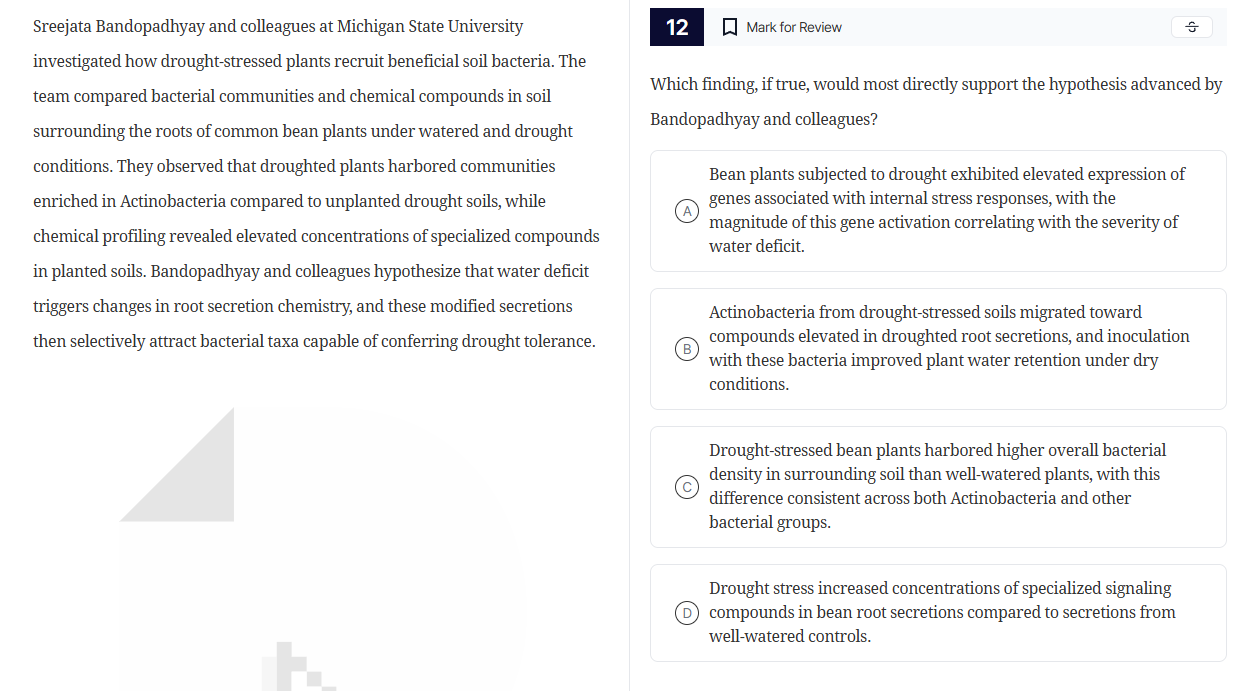
sreejata bandopadhyay and colleagues at michigan state university investigated how drought - stressed plants recruit beneficial soil bacteria. the team compared bacterial communities and chemical compounds in soil surrounding the roots of common bean plants under watered and drought conditions. they observed that droughted plants harbored communities enriched in actinobacteria compared to unplanted drought soils, while chemical profiling revealed elevated concentrations of specialized compounds in planted soils. bandopadhyay and colleagues hypothesize that water deficit triggers changes in root secretion chemistry, and these modified secretions then selectively attract bacterial taxa capable of conferring drought tolerance.
12
mark for review
which finding, if true, would most directly support the hypothesis advanced by bandopadhyay and colleagues?
a bean plants subjected to drought exhibited elevated expression of genes associated with internal stress responses, with the magnitude of this gene activation correlating with the severity of water deficit.
b actinobacteria from drought - stressed soils migrated toward compounds elevated in droughted root secretions, and inoculation with these bacteria improved plant water retention under dry conditions.
c drought - stressed bean plants harbored higher overall bacterial density in surrounding soil than well - watered plants, with this difference consistent across both actinobacteria and other bacterial groups.
d drought stress increased concentrations of specialized signaling compounds in bean root secretions compared to secretions from well - watered controls.
The hypothesis is that water deficit changes root secretion chemistry, and these secretions attract bacteria that confer drought tolerance. Option B shows that Actinobacteria (a bacterial taxon) from drought - stressed soils are attracted to droughted root secretions and that inoculating with these bacteria improves plant water retention. This directly supports the idea that modified root secretions attract beneficial bacteria (that confer drought tolerance). Option A focuses on internal stress responses of plants, not the interaction with bacteria. Option C is about overall bacterial density, not the specific attraction of beneficial bacteria. Option D only shows an increase in signaling compounds but not the connection to attracting beneficial bacteria and their drought - tolerance - conferring ability.

Snap & solve any problem in the app
Get step-by-step solutions on Sovi AI
Photo-based solutions with guided steps
Explore more problems and detailed explanations
B. Actinobacteria from drought - stressed soils migrated toward compounds elevated in droughted root secretions, and inoculation with these bacteria improved plant water retention under dry conditions.