QUESTION IMAGE
Question
9
ss.912.a.4.4 (high)
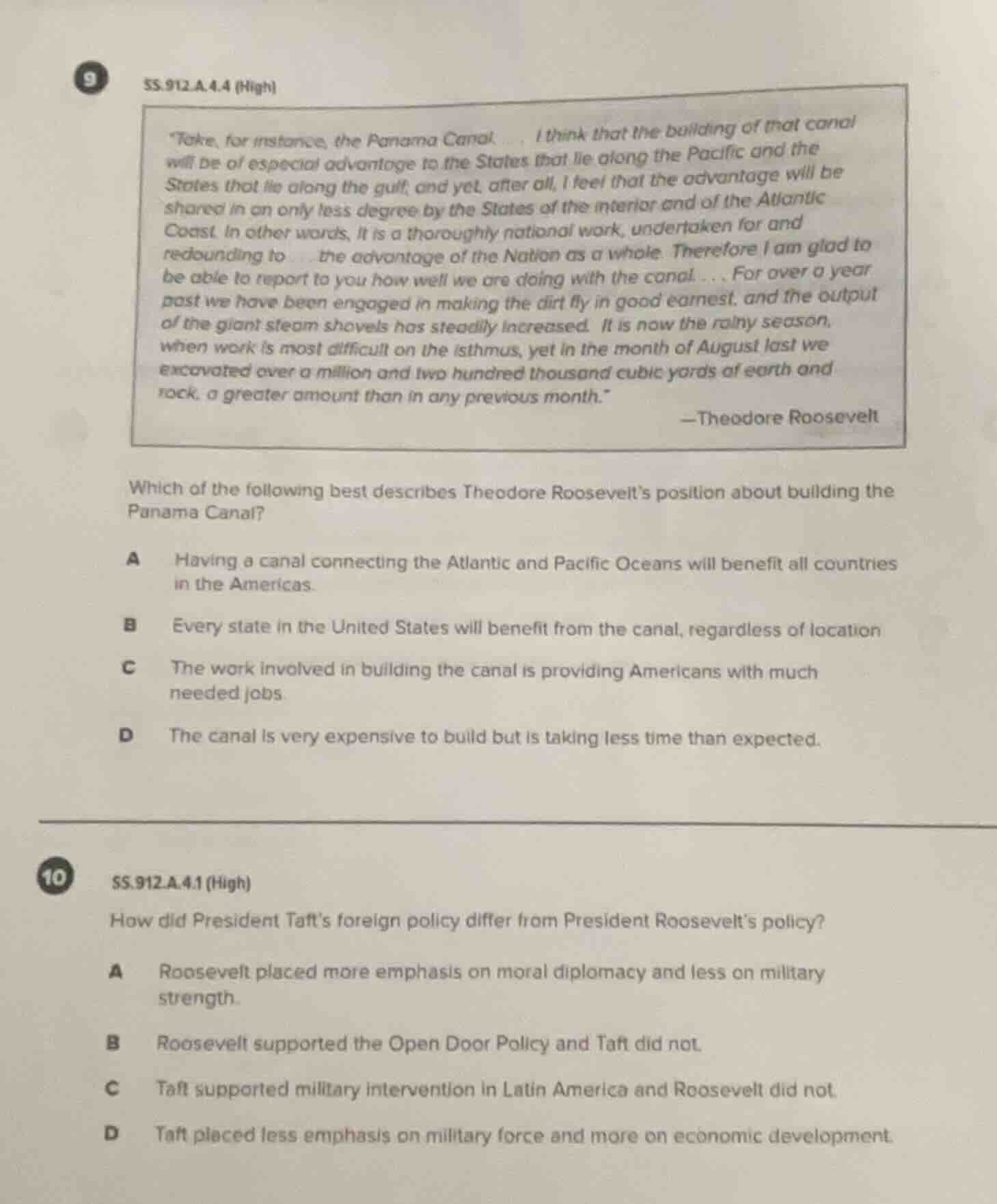
\take, for instance, the panama canal. ... i think that the building of that canal will be of especial advantage to the states that lie along the pacific and the states that lie along the gulf; and yet, after all, i feel that the advantage will be shared in on only less degree by the states of the interior and of the atlantic coast. in other words, it is a thoroughly national work, undertaken for and redounding to ... the advantage of the nation as a whole. therefore i am glad to be able to report to you how well we are doing with the canal. ... for over a year past we have been engaged in making the dirt fly in good earnest, and the output of the giant steam shovels has steadily increased. it is now the rainy season, when work is most difficult on the isthmus, yet in the month of august last we excavated over a million and two hundred thousand cubic yards of earth and rock, a greater amount than in any previous month.\
—theodore roosevelt
which of the following best describes theodore roosevelt’s position about building the panama canal?
a having a canal connecting the atlantic and pacific oceans will benefit all countries in the americas.
b every state in the united states will benefit from the canal, regardless of location
c the work involved in building the canal is providing americans with much needed jobs.
d the canal is very expensive to build but is taking less time than expected.
10
ss.912.a.4.1 (high)
how did president taft’s foreign policy differ from president roosevelt’s policy?
a roosevelt placed more emphasis on moral diplomacy and less on military strength.
b roosevelt supported the open door policy and taft did not.
c taft supported military intervention in latin america and roosevelt did not.
d taft placed less emphasis on military force and more on economic development.
For question 9: Roosevelt states the canal benefits Pacific/Gulf states, and interior/Atlantic states to a nearly equal degree, framing it as a national benefit for all US states. Option A is incorrect as he focuses on the US, not all Americas. Option C is not mentioned, and Option D is not addressed in the text.
For question 10: Roosevelt's foreign policy relied heavily on military strength (Big Stick Diplomacy), while Taft's Dollar Diplomacy prioritized economic investment and influence over military force. Option A is reversed, Option B is false as both supported the Open Door Policy, and Option C is incorrect as Roosevelt used military intervention in Latin America.

Snap & solve any problem in the app
Get step-by-step solutions on Sovi AI
Photo-based solutions with guided steps
Explore more problems and detailed explanations
- B. Every state in the United States will benefit from the canal, regardless of location
- D. Taft placed less emphasis on military force and more on economic development.