QUESTION IMAGE
Question
ss7h3 analyze continuity and change in southern and eastern asia.
asian history
british empire in asia
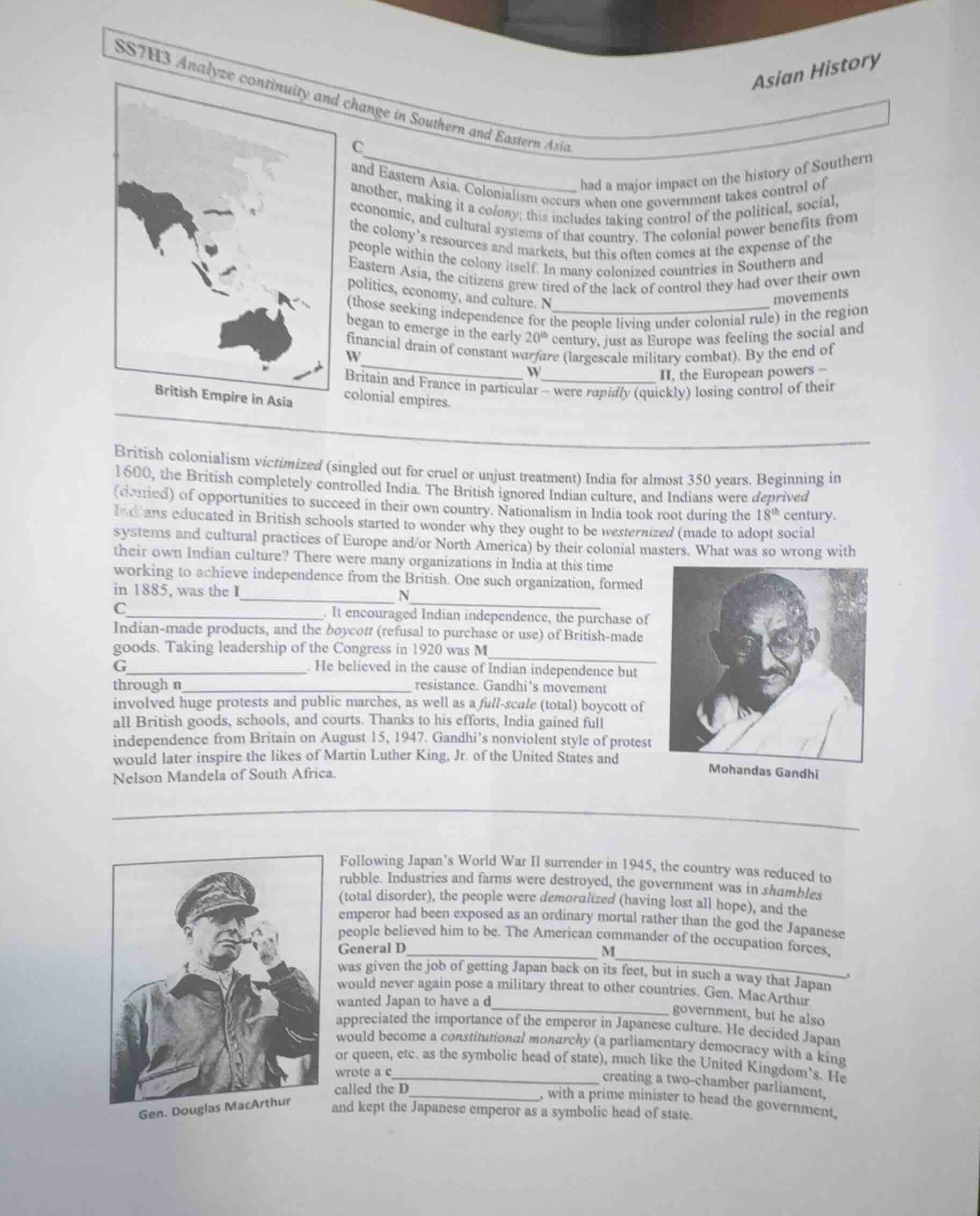
c____ had a major impact on the history of southern and eastern asia. colonialism occurs when one government takes control of another, making it a colony; this includes taking control of the political, social, economic, and cultural systems of that country. the colonial power benefits from the colony’s resources and markets, but this often comes at the expense of the people within the colony itself. in many colonized countries in southern and eastern asia, the citizens grew tired of the lack of control they had over their own politics, economy, and culture. n__ movements (those seeking independence for the people living under colonial rule) in the region began to emerge in the early 20th century, just as europe was feeling the social and financial drain of constant warfare (largescale military combat). by the end of w__ w____ ii, the european powers – britain and france in particular – were rapidly (quickly) losing control of their colonial empires.
british colonialism victimized (singled out for cruel or unjust treatment) india for almost 350 years. beginning in 1600, the british completely controlled india. the british ignored indian culture, and indians were deprived (denied) of opportunities to succeed in their own country. nationalism in india took root during the 18th century. indians educated in british schools started to wonder why they ought to be westernized (made to adopt social systems and cultural practices of europe and/or north america) by their colonial masters. what was so wrong with their own indian culture? there were many organizations in india at this time working to achieve independence from the british. one such organization, formed in 1885, was the i____ n__ c__. it encouraged indian independence, the purchase of indian - made products, and the boycott (refusal to purchase or use) of british - made goods. taking leadership of the congress in 1920 was m__ g__. he believed in the cause of indian independence but through n____ resistance. gandhi’s movement involved huge protests and public marches, as well as a full - scale (total) boycott of all british goods, schools, and courts. thanks to his efforts, india gained full independence from britain on august 15, 1947. gandhi’s nonviolent style of protest would later inspire the likes of martin luther king, jr. of the united states and nelson mandela of south africa.
mohandas gandhi
gen. douglas macarthur
following japan’s world war ii surrender in 1945, the country was reduced to rubble. industries and farms were destroyed, the government was in shambles (total disorder), the people were demoralized (having lost all hope), and the emperor had been exposed as an ordinary mortal rather than the god the japanese people believed him to be. the american commander of the occupation forces, general d____ m__, was given the job of getting japan back on its feet, but in such a way that japan would never again pose a military threat to other countries. gen. macarthur wanted japan to have a d__ government, but he also appreciated the importance of the emperor in japanese culture. he decided japan would become a constitutional monarchy (a parliamentary democracy with a king or queen, etc. as the symbolic head of state), much like the united kingdom’s. he wrote a c__ creating a two - chamber parliament, called the d____, with a prime minister to head the government, and kept the japanese emperor as a symbolic head of state.
Each blank is filled based on key historical terms and figures related to colonialism, independence movements in South Asia, and post-WWII Japan occupation:
- First blank: The text defines colonialism as the control of one nation by another, so this is the key term.
- Second blank: Movements seeking independence from colonial rule are nationalist movements.
- Third/forth blanks: The war that weakened European colonial powers is World War II.
- Fifth/sixth/seventh blanks: The 1885 Indian organization for independence is the Indian National Congress.
- Eighth/ninth blanks: The leader of the Indian independence movement using nonviolence is Mohandas Gandhi.
- Tenth blank: Gandhi's method was nonviolent resistance.
- Eleventh/twelfth blanks: The American commander of Japan's occupation was Douglas MacArthur.
- Thirteenth blank: MacArthur wanted Japan to have a democratic government.
- Fourteenth blank: He oversaw the creation of a constitution for Japan.
- Fifteenth blank: Japan's post-WWII governing document is the Diet (parliament).

Snap & solve any problem in the app
Get step-by-step solutions on Sovi AI
Photo-based solutions with guided steps
Explore more problems and detailed explanations
- Colonialism
- Nationalist
- World War
- Indian National Congress
- Mohandas Gandhi
- nonviolent
- Douglas MacArthur
- democratic
- constitution
- Diet