QUESTION IMAGE
Question
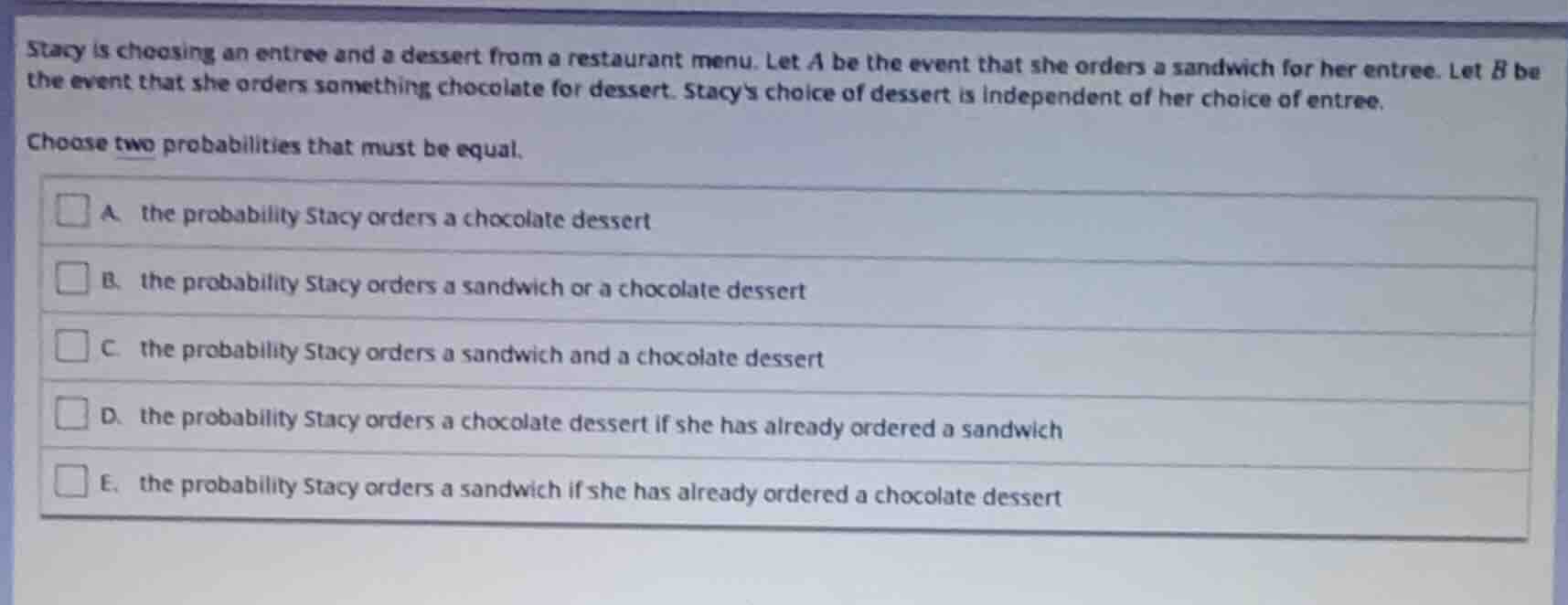
stacy is choosing an entree and a dessert from a restaurant menu. let a be the event that she orders a sandwich for her entree. let b be the event that she orders something chocolate for dessert. stacys choice of dessert is independent of her choice of entree.
choose two probabilities that must be equal.
a. the probability stacy orders a chocolate dessert
b. the probability stacy orders a sandwich or a chocolate dessert
c. the probability stacy orders a sandwich and a chocolate dessert
d. the probability stacy orders a chocolate dessert if she has already ordered a sandwich
e. the probability stacy orders a sandwich if she has already ordered a chocolate dessert
Step1: Recall the definition of independent events
For two independent events \( A \) and \( B \), the conditional probability \( P(B|A) = P(B) \) and \( P(A|B)=P(A) \). Also, the probability of both events occurring is \( P(A\cap B)=P(A)\times P(B) \) (by the multiplication rule for independent events).
Step2: Analyze each option
- Option A: \( P(B) \) (probability of chocolate dessert)
- Option B: \( P(A\cup B)=P(A)+P(B)-P(A\cap B) \). Since \( P(A\cap B)=P(A)P(B) \), this is \( P(A)+P(B)-P(A)P(B) \), not equal to \( P(B) \) generally.
- Option C: \( P(A\cap B) = P(A)P(B) \), not equal to \( P(B) \) unless \( P(A) = 1 \), which is not given.
- Option D: \( P(B|A) \). By the definition of independence, \( P(B|A)=\frac{P(A\cap B)}{P(A)}=\frac{P(A)P(B)}{P(A)} = P(B) \) (since \( P(A)
eq0 \), otherwise the conditional probability is not well - defined in the usual sense, but assuming \( P(A)>0 \))
- Option E: \( P(A|B)=\frac{P(A\cap B)}{P(B)}=\frac{P(A)P(B)}{P(B)}=P(A) \), which is not necessarily equal to \( P(B) \) unless \( P(A) = P(B) \), which is not given.
So, \( P(B) \) (Option A) and \( P(B|A) \) (Option D) are equal. Also, if we consider \( P(A) \) and \( P(A|B) \), but in the options, A ( \( P(B) \)) and D ( \( P(B|A) \)) are equal, and also A and D, and also we can see that \( P(B) \) (A) and \( P(B|A) \) (D) are equal, and also \( P(A) \) and \( P(A|B) \) (E), but from the options, A and D are equal, and also A and D, and also we can check:
Since \( A \) and \( B \) are independent, \( P(B|A)=P(B) \). So the probability in Option A ( \( P(B) \)) and Option D ( \( P(B|A) \)) are equal. Also, \( P(A) \) and \( P(A|B) \) (Option E) are equal, but from the options, the pair is A and D (or also A and D, and if we consider the other pair, but the question says "choose two", so A and D, and also A and D, and also we can see that \( P(B) \) (A) and \( P(B|A) \) (D) are equal.

Snap & solve any problem in the app
Get step-by-step solutions on Sovi AI
Photo-based solutions with guided steps
Explore more problems and detailed explanations
A. the probability Stacy orders a chocolate dessert, D. the probability Stacy orders a chocolate dessert if she has already ordered a sandwich