QUESTION IMAGE
Question
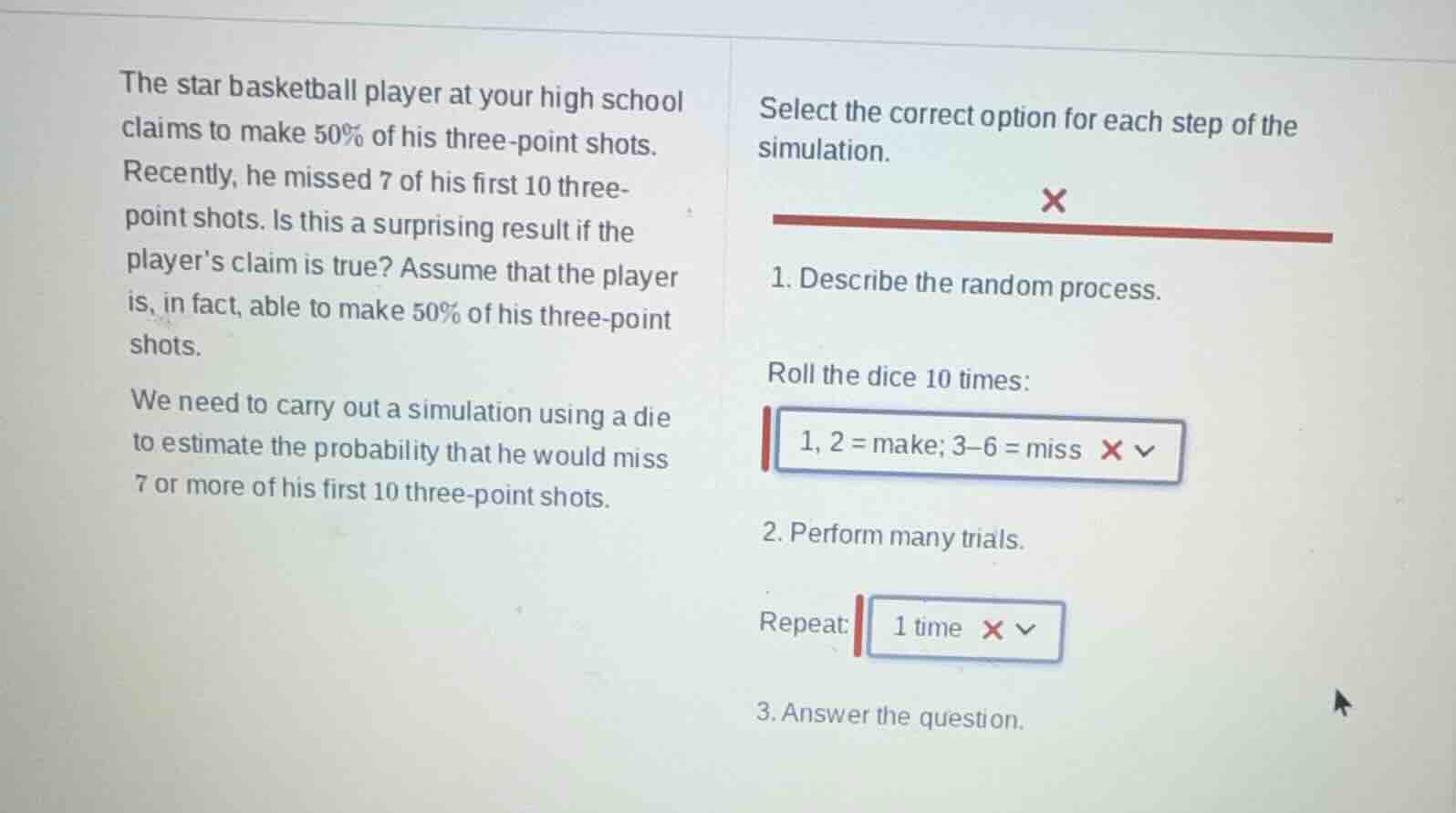
the star basketball player at your high school claims to make 50% of his three-point shots. recently, he missed 7 of his first 10 three-point shots. is this a surprising result if the players claim is true? assume that the player is, in fact, able to make 50% of his three-point shots.
we need to carry out a simulation using a die to estimate the probability that he would miss 7 or more of his first 10 three-point shots.
select the correct option for each step of the simulation.
- describe the random process.
roll the dice 10 times:
1, 2 = make; 3-6 = miss
- perform many trials.
repeat: 1 time
- answer the question.
Step1: Fix random process mapping
Since the player has a 50% make/miss rate, we need an equal split of the die outcomes.
Map: $1,2,3 = \text{make}; 4,5,6 = \text{miss}$ (or $1-3=\text{miss}, 4-6=\text{make}$)
This gives a $\frac{3}{6}=50\%$ probability for each outcome.
Step2: Correct trial repetition
A simulation requires many trials to estimate probability, not 1.
Repeat the 10-dice-roll trial 500+ times (a large number of trials).
Step3: Define success condition
For each trial, count the number of "miss" outcomes. Count how many trials have 7 or more misses.
Calculate the probability as:
$$\text{Probability} = \frac{\text{Number of trials with } \geq 7 \text{ misses}}{\text{Total number of trials}}$$

Snap & solve any problem in the app
Get step-by-step solutions on Sovi AI
Photo-based solutions with guided steps
Explore more problems and detailed explanations
- Describe the random process: Roll the dice 10 times: $\boldsymbol{1, 2, 3 = \text{make}; 4, 5, 6 = \text{miss}}$
- Perform many trials: Repeat: $\boldsymbol{\text{500+ times}}$ (any large number of trials, e.g., 1000)
- Answer the question: Calculate the proportion of trials with 7 or more misses. If this proportion is less than 5%, the result is surprising; otherwise, it is not. (Typically, this probability is ~17%, so the result is not surprising.)