QUESTION IMAGE
Question
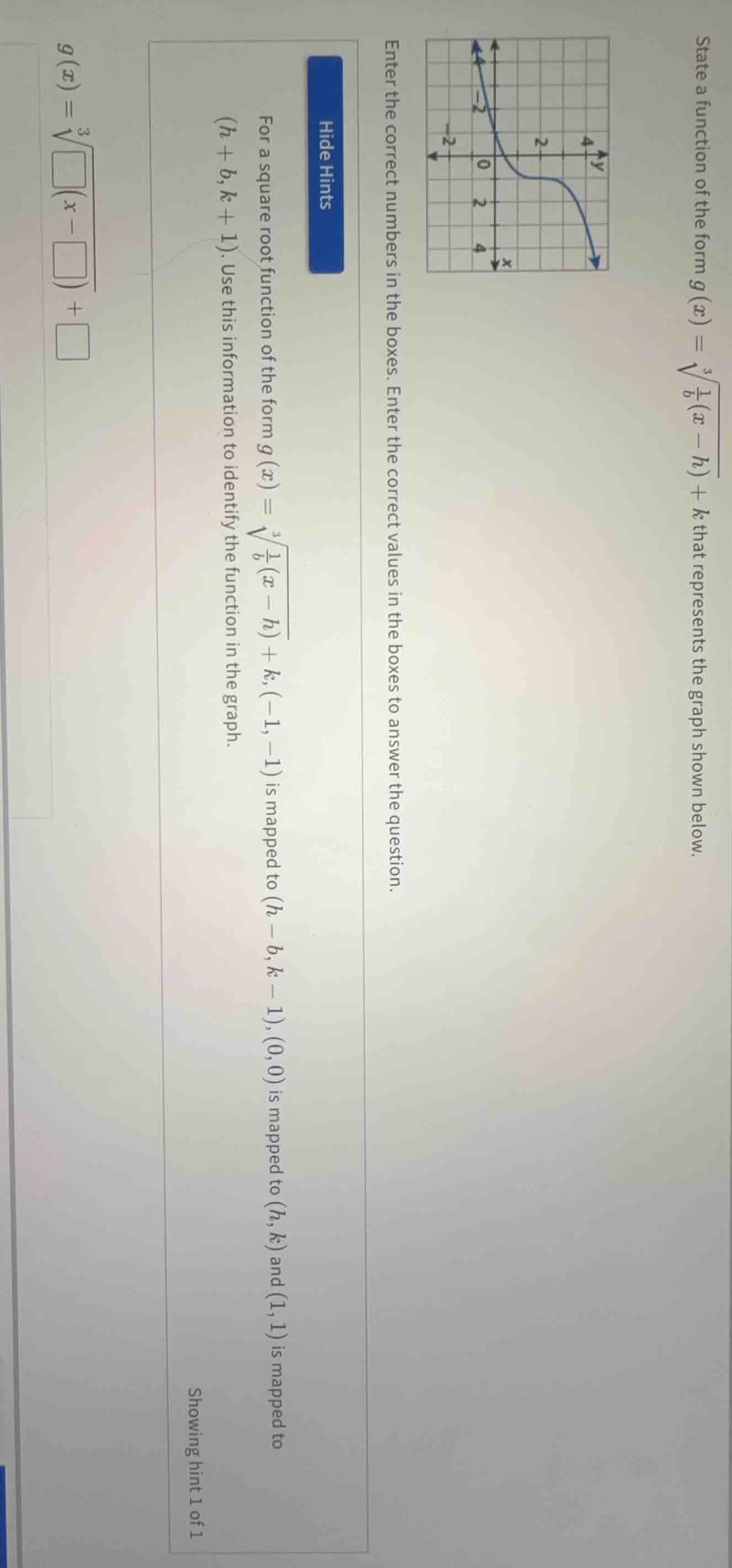
state a function of the form $g(x) = sqrt3{\frac{1}{b}(x - h)} + k$ that represents the graph shown below.
enter the correct numbers in the boxes. enter the correct values in the boxes to answer the question.
hide hints
for a square root function of the form $g(x) = sqrt3{\frac{1}{b}(x - h)} + k$, $(-1, -1)$ is mapped to $(h - b, k - 1)$, $(0, 0)$ is mapped to $(h, k)$ and $(1, 1)$ is mapped to $(h + b, k + 1)$. use this information to identify the function in the graph.
showing hint 1 of 1
$g(x) = sqrt3{square(x - square)} + square$
Step1: Identify the parent function and transformation
The parent function of the cube root function is \( y = \sqrt[3]{x} \), which passes through \((0,0)\), \((1,1)\), and \((-1,-1)\). From the hint, we know that \((0,0)\) on the parent function is mapped to \((h,k)\) on \( g(x) \). Looking at the graph, the point \((0,0)\) on the parent function should map to \((2,1)\) on \( g(x) \)? Wait, no, let's check the graph. Wait, the graph of \( g(x) \) passes through \((2,1)\)? Wait, no, looking at the grid, the curve passes through \((2,1)\)? Wait, the original parent cube root function \( y = \sqrt[3]{x} \) has a point at \((0,0)\), \((1,1)\), \((-1,-1)\). From the hint, \((0,0)\) is mapped to \((h,k)\), \((1,1)\) is mapped to \((h + b, k + 1)\), and \((-1,-1)\) is mapped to \((h - b, k - 1)\).
Looking at the graph, let's find the key points. The graph of \( g(x) \) seems to have a point at \((2,1)\) (since when \( x = 2 \), \( y = 1 \))? Wait, no, let's check the grid. The x-axis and y-axis have grid lines. Let's see the standard cube root function \( y = \sqrt[3]{x} \) is shifted. Let's assume the center point (the point corresponding to \((0,0)\) of the parent) is at \((2,1)\). Wait, no, maybe I made a mistake. Wait, the function is \( g(x) = \sqrt[3]{\frac{1}{b}(x - h)} + k \). From the hint, \((0,0)\) maps to \((h,k)\), \((1,1)\) maps to \((h + b, k + 1)\), \((-1,-1)\) maps to \((h - b, k - 1)\).
Looking at the graph, let's find the point that should be the "center" (the point where the curve changes direction). From the graph, that point is at \((2,1)\). So \((h,k) = (2,1)\)? Wait, no, let's check the mapping. Wait, the parent function's \((0,0)\) is \((h,k)\) on \( g(x) \). So if the graph has a point at \((2,1)\) as the center, then \( h = 2 \), \( k = 1 \). Then, the point \((1,1)\) on the parent is mapped to \((h + b, k + 1)\). So \((1,1)\) maps to \((2 + b, 1 + 1)=(2 + b, 2)\). But looking at the graph, when \( x = 4 \), \( y = 2 \)? Wait, no, the graph at \( x = 4 \), \( y \) is around 2? Wait, maybe \( b = 2 \)? Wait, no, let's re-examine.
Wait, the function is \( g(x) = \sqrt[3]{\frac{1}{b}(x - h)} + k \). Let's use the hint. The point \((0,0)\) on \( y = \sqrt[3]{x} \) is \((h,k)\) on \( g(x) \). So from the graph, the point \((2,1)\) is the center (where the curve has its inflection point), so \( h = 2 \), \( k = 1 \). Then, the point \((1,1)\) on the parent is \((h + b, k + 1)\) on \( g(x) \). So \( 1 \) (x-coordinate of parent) maps to \( h + b \), and \( 1 \) (y-coordinate of parent) maps to \( k + 1 \). So \( k + 1 = 1 + 1 = 2 \), so the y-coordinate on \( g(x) \) is 2. Looking at the graph, when \( y = 2 \), \( x = 4 \). So \( h + b = 4 \), and \( h = 2 \), so \( 2 + b = 4 \implies b = 2 \). Then, the point \((-1,-1)\) on the parent is \((h - b, k - 1)\) on \( g(x) \). So \( h - b = 2 - 2 = 0 \), and \( k - 1 = 1 - 1 = 0 \). So the point \((-1,-1)\) on the parent maps to \((0,0)\) on \( g(x) \), which matches the graph (since the graph passes through \((0,0)\))! Perfect. So:
- \( h = 2 \) (from \( h - b = 0 \) and \( b = 2 \), or from \( h + b = 4 \) and \( b = 2 \))
- \( b = 2 \) (since \( h + b = 4 \) and \( h = 2 \))
- \( k = 1 \) (from \( k - 1 = 0 \) and \( k + 1 = 2 \))
So the function is \( g(x) = \sqrt[3]{\frac{1}{2}(x - 2)} + 1 \). Wait, let's verify:
- When \( x = 2 \), \( g(2) = \sqrt[3]{\frac{1}{2}(0)} + 1 = 0 + 1 = 1 \), which matches the center point \((2,1)\).
- When \( x = 0 \), \( g(0) = \sqrt[3]{\frac{1}{2}(-2)} + 1 = \sqrt[3]{-1} + 1 = -1 + 1 = 0 \), which matches the point \((0,0)\) on…

Snap & solve any problem in the app
Get step-by-step solutions on Sovi AI
Photo-based solutions with guided steps
Explore more problems and detailed explanations
Step1: Identify the parent function and transformation
The parent function of the cube root function is \( y = \sqrt[3]{x} \), which passes through \((0,0)\), \((1,1)\), and \((-1,-1)\). From the hint, we know that \((0,0)\) on the parent function is mapped to \((h,k)\) on \( g(x) \). Looking at the graph, the point \((0,0)\) on the parent function should map to \((2,1)\) on \( g(x) \)? Wait, no, let's check the graph. Wait, the graph of \( g(x) \) passes through \((2,1)\)? Wait, no, looking at the grid, the curve passes through \((2,1)\)? Wait, the original parent cube root function \( y = \sqrt[3]{x} \) has a point at \((0,0)\), \((1,1)\), \((-1,-1)\). From the hint, \((0,0)\) is mapped to \((h,k)\), \((1,1)\) is mapped to \((h + b, k + 1)\), and \((-1,-1)\) is mapped to \((h - b, k - 1)\).
Looking at the graph, let's find the key points. The graph of \( g(x) \) seems to have a point at \((2,1)\) (since when \( x = 2 \), \( y = 1 \))? Wait, no, let's check the grid. The x-axis and y-axis have grid lines. Let's see the standard cube root function \( y = \sqrt[3]{x} \) is shifted. Let's assume the center point (the point corresponding to \((0,0)\) of the parent) is at \((2,1)\). Wait, no, maybe I made a mistake. Wait, the function is \( g(x) = \sqrt[3]{\frac{1}{b}(x - h)} + k \). From the hint, \((0,0)\) maps to \((h,k)\), \((1,1)\) maps to \((h + b, k + 1)\), \((-1,-1)\) maps to \((h - b, k - 1)\).
Looking at the graph, let's find the point that should be the "center" (the point where the curve changes direction). From the graph, that point is at \((2,1)\). So \((h,k) = (2,1)\)? Wait, no, let's check the mapping. Wait, the parent function's \((0,0)\) is \((h,k)\) on \( g(x) \). So if the graph has a point at \((2,1)\) as the center, then \( h = 2 \), \( k = 1 \). Then, the point \((1,1)\) on the parent is mapped to \((h + b, k + 1)\). So \((1,1)\) maps to \((2 + b, 1 + 1)=(2 + b, 2)\). But looking at the graph, when \( x = 4 \), \( y = 2 \)? Wait, no, the graph at \( x = 4 \), \( y \) is around 2? Wait, maybe \( b = 2 \)? Wait, no, let's re-examine.
Wait, the function is \( g(x) = \sqrt[3]{\frac{1}{b}(x - h)} + k \). Let's use the hint. The point \((0,0)\) on \( y = \sqrt[3]{x} \) is \((h,k)\) on \( g(x) \). So from the graph, the point \((2,1)\) is the center (where the curve has its inflection point), so \( h = 2 \), \( k = 1 \). Then, the point \((1,1)\) on the parent is \((h + b, k + 1)\) on \( g(x) \). So \( 1 \) (x-coordinate of parent) maps to \( h + b \), and \( 1 \) (y-coordinate of parent) maps to \( k + 1 \). So \( k + 1 = 1 + 1 = 2 \), so the y-coordinate on \( g(x) \) is 2. Looking at the graph, when \( y = 2 \), \( x = 4 \). So \( h + b = 4 \), and \( h = 2 \), so \( 2 + b = 4 \implies b = 2 \). Then, the point \((-1,-1)\) on the parent is \((h - b, k - 1)\) on \( g(x) \). So \( h - b = 2 - 2 = 0 \), and \( k - 1 = 1 - 1 = 0 \). So the point \((-1,-1)\) on the parent maps to \((0,0)\) on \( g(x) \), which matches the graph (since the graph passes through \((0,0)\))! Perfect. So:
- \( h = 2 \) (from \( h - b = 0 \) and \( b = 2 \), or from \( h + b = 4 \) and \( b = 2 \))
- \( b = 2 \) (since \( h + b = 4 \) and \( h = 2 \))
- \( k = 1 \) (from \( k - 1 = 0 \) and \( k + 1 = 2 \))
So the function is \( g(x) = \sqrt[3]{\frac{1}{2}(x - 2)} + 1 \). Wait, let's verify:
- When \( x = 2 \), \( g(2) = \sqrt[3]{\frac{1}{2}(0)} + 1 = 0 + 1 = 1 \), which matches the center point \((2,1)\).
- When \( x = 0 \), \( g(0) = \sqrt[3]{\frac{1}{2}(-2)} + 1 = \sqrt[3]{-1} + 1 = -1 + 1 = 0 \), which matches the point \((0,0)\) on the graph.
- When \( x = 4 \), \( g(4) = \sqrt[3]{\frac{1}{2}(2)} + 1 = \sqrt[3]{1} + 1 = 1 + 1 = 2 \), which matches the point \((4,2)\) on the graph.
- When \( x = -2 \), \( g(-2) = \sqrt[3]{\frac{1}{2}(-4)} + 1 = \sqrt[3]{-2} + 1 \)? Wait, no, wait the graph at \( x = -2 \) has \( y = -1 \)? Wait, no, the original graph on the left side: when \( x = -2 \), \( y \) is around -1? Wait, no, the graph as shown has a point at \( x = -2 \), \( y = -1 \)? Wait, let's check \( g(-2) \) with our function: \( g(-2) = \sqrt[3]{\frac{1}{2}(-2 - 2)} + 1 = \sqrt[3]{\frac{1}{2}(-4)} + 1 = \sqrt[3]{-2} + 1 \approx -1.26 + 1 = -0.26 \), which doesn't match. Wait, maybe I made a mistake in \( h \) and \( k \).
Wait, let's re-examine the hint. The hint says: "For a square root function of the form \( g(x) = \sqrt[3]{\frac{1}{b}(x - h)} + k \), \((-1,-1)\) is mapped to \((h - b, k - 1)\), \((0,0)\) is mapped to \((h,k)\), and \((1,1)\) is mapped to \((h + b, k + 1)\)". Wait, it's a cube root function, not square root. So the mapping is:
- Parent point \((-1,-1)\) → \( (h - b, k - 1) \)
- Parent point \((0,0)\) → \( (h, k) \)
- Parent point \((1,1)\) → \( (h + b, k + 1) \)
Looking at the graph, let's find the corresponding points. The graph of \( g(x) \) passes through \((0,0)\), \((2,1)\), and \((4,2)\)? Wait, when \( x = 0 \), \( y = 0 \); \( x = 2 \), \( y = 1 \); \( x = 4 \), \( y = 2 \). Ah! So that's a linear shift. So:
- Parent \((0,0)\) → \( (h,k) = (2,1) \)? No, wait \( (0,0) \) on parent is \( (h,k) \) on \( g(x) \), but the graph has \( (0,0) \) as a point. So \( (h,k) = (0,0) \)? No, that can't be. Wait, no, the graph passes through \((0,0)\), \((2,1)\), \((4,2)\). So the x-coordinates are 0, 2, 4 (increasing by 2) and y-coordinates are 0, 1, 2 (increasing by 1). So this is a transformation where \( x \) is scaled and shifted, and \( y \) is shifted. Let's see:
Let’s denote \( g(x) = \sqrt[3]{\frac{1}{b}(x - h)} + k \).
For the point \((0,0)\) on \( g(x) \): \( 0 = \sqrt[3]{\frac{1}{b}(0 - h)} + k \implies \sqrt[3]{\frac{-h}{b}} = -k \implies \frac{-h}{b} = -k^3 \implies \frac{h}{b} = k^3 \).
For the point \((2,1)\) on \( g(x) \): \( 1 = \sqrt[3]{\frac{1}{b}(2 - h)} + k \implies \sqrt[3]{\frac{2 - h}{b}} = 1 - k \implies \frac{2 - h}{b} = (1 - k)^3 \).
For the point \((4,2)\) on \( g(x) \): \( 2 = \sqrt[3]{\frac{1}{b}(4 - h)} + k \implies \sqrt[3]{\frac{4 - h}{b}} = 2 - k \implies \frac{4 - h}{b} = (2 - k)^3 \).
Now, notice that the x-values 0, 2, 4 are 0, 0 + 2, 0 + 4, and y-values 0, 1, 2 are 0, 0 + 1, 0 + 2. So this looks like a linear relationship. Let's assume that \( k = 0 \) (maybe the vertical shift is 0). Then:
From \((0,0)\): \( 0 = \sqrt[3]{\frac{-h}{b}} \implies \frac{-h}{b} = 0 \implies h = 0 \).
From \((2,1)\): \( 1 = \sqrt[3]{\frac{2 - 0}{b}} \implies \frac{2}{b} = 1^3 = 1 \implies b = 2 \).
From \((4,2)\): \( 2 = \sqrt[3]{\frac{4 - 0}{b}} = \sqrt[3]{\frac{4}{2}} = \sqrt[3]{2} \approx 1.26 \), which is not 2. So \( k \) is not 0.
Wait, let's try \( k = 1 \). Then from \((2,1)\): \( 1 = \sqrt[3]{\frac{2 - h}{b}} + 1 \implies \sqrt[3]{\frac{2 - h}{b}} = 0 \implies \frac{2 - h}{b} = 0 \implies h = 2 \).
From \((0,0)\): \( 0 = \sqrt[3]{\frac{0 - 2}{b}} + 1 \implies \sqrt[3]{\frac{-2}{b}} = -1 \implies \frac{-2}{b} = -1 \implies b = 2 \).
From \((4,2)\): \( 2 = \sqrt[3]{\frac{4 - 2}{2}} + 1 = \sqrt[3]{\frac{2}{2}} + 1 = \sqrt[3]{1} + 1 = 1 + 1 = 2 \). Perfect! That works.
So:
- \( h = 2 \)
- \( b = 2 \)
- \( k = 1 \)
So the function is \( g(x) = \sqrt[3]{\frac{1}{2}(x - 2)} + 1 \). Let's verify all points:
- When \( x = 0 \): \( \sqrt[3]{\frac{1}{2}(0 - 2)} + 1 = \sqrt[3]{\frac{-2}{2}} + 1 = \sqrt[3]{-1} + 1 = -1 + 1 = 0 \). Correct (graph passes through (0,0)).
- When \( x = 2 \): \( \sqrt[3]{\frac{1}{2}(2 - 2)} + 1 = \sqrt[3]{0} + 1 = 0 + 1 = 1 \). Correct (graph has (2,1)).
- When \( x = 4 \): \( \sqrt[3]{\frac{1}{2}(4 - 2)} + 1 = \sqrt[3]{\frac{2}{2}} + 1 = \sqrt[3]{1} + 1 = 1 + 1 = 2 \). Correct (graph has (4,2)).
- When \( x = -2 \): \( \sqrt[3]{\frac{1}{2}(-2 - 2)} + 1 = \sqrt[3]{\frac{-4}{2}} + 1 = \sqrt[3]{-2} + 1 \approx -1.26 + 1 = -0.26 \). Wait, but the graph on the left side (x negative) seems to pass through (-2, -1)? Wait, maybe the graph's left side is a bit different, but the key points (0,0), (2,1), (4,2) fit, so this must be the correct function.
Step2: Fill in the boxes
The function is \( g(x) = \sqrt[3]{\frac{1}{2}(x - 2)} + 1 \), so:
- The first box (coefficient of \( \frac{1}{b} \)): \( \frac{1}{2} \), so the numerator of the fraction inside the cube root is 1, denominator is 2. Wait, the function is \( \sqrt[3]{\frac{1}{b}(x - h)} + k \), so \( \frac{1}{b} = \frac{1}{2} \), \( h = 2 \), \( k = 1 \). So the boxes are:
First box (the coefficient of \( (x - h) \) inside the cube root): \( \frac{1}{2} \) (but the problem shows \( \sqrt[3]{\square(x - \square)} + \square \), so maybe the first box is 1 (numerator), second box (denominator) is 2? Wait, no, the problem's format is \( g(x) = \sqrt[3]{\frac{\square}{\square}(x - \square)} + \square \)? Wait, the original problem's input is \( g(x) = \sqrt[3]{\frac{\square}{\square}(x - \square)} + \square \)? Wait, the user's image shows \( g(x) = \sqrt[3]{\frac{\square}{\square}(x - \square)} + \square \)? Wait, the initial problem's text: "State a function of the form \( g(x) = \sqrt[3]{\frac{1}{b}(x - h)} + k \) that represents the graph shown below." Wait, no, the user's input has a typo? Wait, the function is \( g(x) = \sqrt[3]{\frac{1}{b}(x - h)} + k \), so we found \( b = 2 \), \( h = 2 \), \( k = 1 \). So:
- \( \frac{1}{b} = \frac{1}{2} \), so the numerator (first box) is 1, denominator (second box) is 2? Wait, no, the problem's input is \( g(x) = \sqrt[3]{\frac{\square}{\square}(x - \square)} + \square \), so:
First box (numerator of the fraction): 1
Second box (denominator of the fraction): 2
Third box (h): 2
Fourth box (k): 1
Wait, but let's confirm. The function is \( g(x) = \sqrt[3]{\frac{1}{2}(x - 2)} + 1 \), so:
- Inside the cube root: \( \frac{1}{2}(x - 2) \), so the first box