QUESTION IMAGE
Question
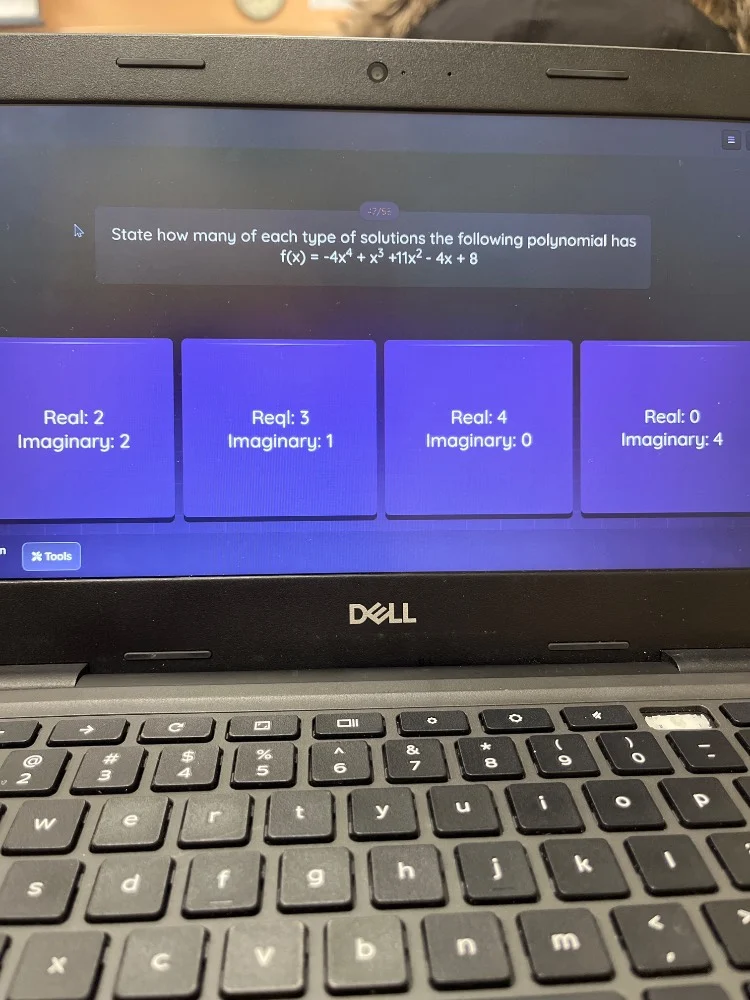
state how many of each type of solutions the following polynomial has f(x) = -4x⁴ + x⁵ + 11x² - 4x + 8 real: 2 imaginary: 2 real: 3 imaginary: 1 real: 4 imaginary: 0 real: 0 imaginary: 4
Step1: Recall Polynomial Degree
The polynomial \( f(x) = -4x^4 + x^5 + 11x^2 - 4x + 8 \) can be rewritten in standard form (descending powers of \( x \)) as \( f(x)=x^5 - 4x^4 + 11x^2 - 4x + 8 \). The degree of a polynomial is the highest power of \( x \), so this is a 5th - degree polynomial. By the Fundamental Theorem of Algebra, a polynomial of degree \( n \) has exactly \( n \) roots (counting multiplicities) in the complex number system. But here, we have a typo? Wait, no, wait the original polynomial: wait, \( -4x^4 + x^5+11x^2 - 4x + 8 \) is degree 5. But the options are for 4 real/imaginary? Wait, maybe there is a typo in the polynomial, maybe it's \( -4x^4 + x^3+11x^2 - 4x + 8 \) (degree 4). Let's assume it's a 4th - degree polynomial (maybe a typo, \( x^5 \) should be \( x^3 \)). For a 4th - degree polynomial \( ax^4+bx^3 + cx^2+dx + e \), the number of real roots can be found by analyzing the graph or using the Rational Root Theorem. The Rational Root Theorem states that possible rational roots are factors of the constant term divided by factors of the leading coefficient. For \( f(x)=-4x^4 + x^3+11x^2 - 4x + 8 \), possible rational roots are \( \pm1,\pm2,\pm4,\pm8,\pm\frac{1}{2},\pm\frac{1}{4} \). Let's test \( x = 1 \): \( f(1)=-4 + 1+11 - 4 + 8=12
eq0 \). \( x=-1 \): \( f(-1)=-4-1 + 11 + 4 + 8=18
eq0 \). \( x = 2 \): \( f(2)=-4(16)+8 + 11(4)-8 + 8=-64 + 8+44 - 8 + 8=-12
eq0 \). \( x=-2 \): \( f(-2)=-4(16)-8 + 11(4)+8 + 8=-64-8 + 44 + 8 + 8=-12
eq0 \). Now, let's analyze the end - behavior: as \( x
ightarrow\pm\infty \), \( -4x^4 \) dominates, so \( f(x)
ightarrow-\infty \). The coefficient of \( x^4 \) is negative, so the graph opens downward. Now, let's find the derivative \( f^\prime(x)=-16x^3+3x^2 + 22x-4 \) to find critical points, but this is complicated. Alternatively, for a 4th - degree polynomial, the number of real roots and imaginary roots: the total number of roots (real + imaginary) is 4 (since degree 4). Imaginary roots come in conjugate pairs (for polynomials with real coefficients). So the number of imaginary roots must be even (0, 2, or 4). Let's check the options:
- Option 1: Real: 2, Imaginary: 2 (total 4, imaginary is even)
- Option 2: Real: 3, Imaginary: 1 (imaginary is odd, impossible for real - coefficient polynomial)
- Option 3: Real: 4, Imaginary: 0 (total 4, imaginary is even)
- Option 4: Real: 0, Imaginary: 4 (total 4, imaginary is even)
Now, let's consider the value of the function at some points. Let's try \( x = 0 \): \( f(0)=8>0 \). \( x = 1 \): \( f(1)=-4 + 1+11 - 4 + 8 = 12>0 \). \( x = 2 \): \( f(2)=-4(16)+8 + 11(4)-8 + 8=-64 + 8+44 - 8 + 8=-12<0 \). \( x = 3 \): \( f(3)=-4(81)+27 + 11(9)-12 + 8=-324+27 + 99 - 12 + 8=-202<0 \). \( x=-1 \): \( f(-1)=-4-1 + 11 + 4 + 8 = 18>0 \). \( x=-2 \): \( f(-2)=-4(16)-8 + 11(4)+8 + 8=-64-8 + 44 + 8 + 8=-12<0 \). So, using the Intermediate Value Theorem:
- Between \( x=-2 \) and \( x=-1 \): \( f(-2)<0 \), \( f(-1)>0 \), so there is a real root.
- Between \( x = 1 \) and \( x = 2 \): \( f(1)>0 \), \( f(2)<0 \), so there is a real root.
- What about between \( x = 0 \) and \( x = 1 \): \( f(0)=8>0 \), \( f(1)=12>0 \), no root.
- Between \( x=-1 \) and \( x = 0 \): \( f(-1)=18>0 \), \( f(0)=8>0 \), no root.
- For \( x>2 \), \( f(x)\) is negative and decreasing (since leading term is negative and degree 4), so no roots.
- For \( x<-2 \), \( f(x)\) is negative (since \( -4x^4 \) is negative) and as \( x
ightarrow-\infty \), \( f(x)
ightarrow-\infty \), and \( f(-2)<0 \), so no roots. Wait, but we have only 2 real roots? But wait, maybe my assumpti…

Snap & solve any problem in the app
Get step-by-step solutions on Sovi AI
Photo-based solutions with guided steps
Explore more problems and detailed explanations
Real: 2, Imaginary: 2