QUESTION IMAGE
Question
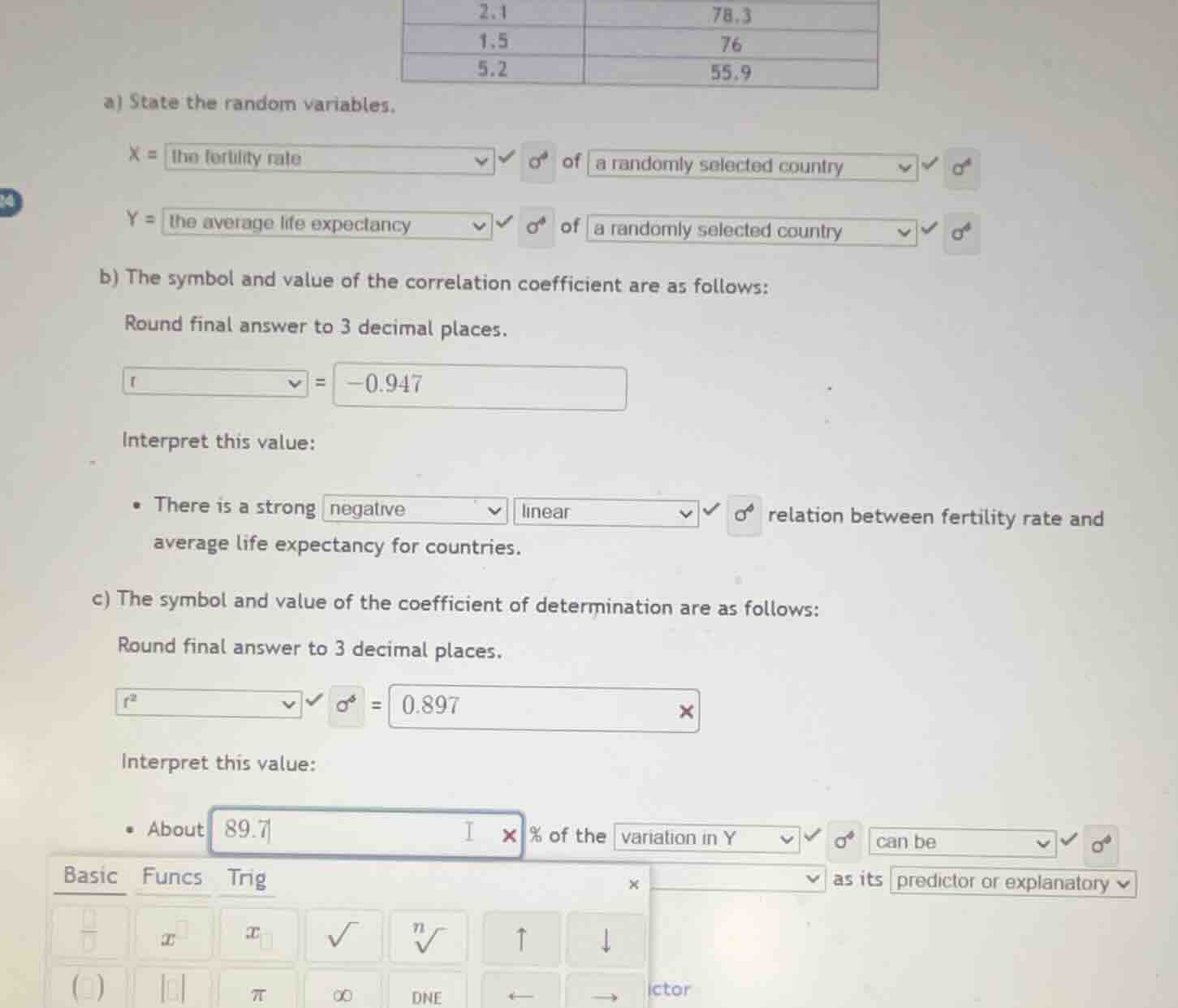
a) state the random variables.
x = the fertility rate of a randomly selected country
y = the average life expectancy of a randomly selected country
b) the symbol and value of the correlation coefficient are as follows:
round final answer to 3 decimal places.
r = -0.947
interpret this value:
- there is a strong negative linear relation between fertility rate and average life expectancy for countries.
c) the symbol and value of the coefficient of determination are as follows:
round final answer to 3 decimal places.
r² = 0.897 ×
interpret this value:
- about 89.7 % of the variation in y can be as its predictor or explanatory
Part c) Calculating Coefficient of Determination
Step 1: Recall the formula for coefficient of determination
The coefficient of determination \( r^2 \) is the square of the correlation coefficient \( r \). Given \( r = -0.947 \), we calculate \( r^2 \) as \( (-0.947)^2 \).
Step 2: Compute the square
\( (-0.947)^2 = 0.947\times0.947 \). Let's calculate that: \( 0.947\times0.947 = 0.896809 \).
Step 3: Round to 3 decimal places
Rounding \( 0.896809 \) to 3 decimal places gives \( 0.897 \) (since the fourth decimal digit is 8, which is greater than 5, we round up the third decimal digit 6 to 7? Wait, no: 0.896809. The third decimal is 6, the next digit is 8. So 0.896809 rounded to three decimal places: look at the fourth digit (8) which is ≥5, so we add 1 to the third digit (6) to get 7. So 0.897. Wait, but 0.896809 is approximately 0.897 when rounded to three decimal places? Wait, 0.896809: first decimal 8, second 9, third 6, fourth 8. So rounding to three decimals: 0.897? Wait, no, 0.896809 is 0.896 (third decimal) plus 0.000809. So since 0.000809 is more than 0.0005, we round the third decimal up: 6 becomes 7. So \( r^2 = 0.897 \) (rounded to three decimal places). Then, to find the percentage, we multiply by 100: \( 0.897\times100 = 89.7\% \). Wait, but let's check the calculation again. \( (-0.947)^2 = 0.947^2 \). Let's compute 0.947*0.947:
\( 0.947\times0.947 \):
First, \( 947\times947 = (900 + 47)^2 = 900^2 + 2\times900\times47 + 47^2 = 810000 + 84600 + 2209 = 810000 + 84600 = 894600 + 2209 = 896809 \). Then, since we have three decimal places in 0.947, the product will have six decimal places: 0.896809. Rounding to three decimal places: 0.897 (because the fourth decimal is 8, which is ≥5, so we round the third decimal 6 up to 7). Then, the percentage is \( 0.897\times100 = 89.7\% \). Wait, but the initial wrong answer was 89.7, but maybe the system thought there was a miscalculation? Wait, no, 0.896809 is 0.897 when rounded to three decimal places, so 89.7% when multiplied by 100. Wait, but let's confirm:
\( r = -0.947 \)
\( r^2 = (-0.947)^2 = 0.947^2 = 0.896809 \approx 0.897 \) (rounded to three decimal places)
Then, the percentage is \( 0.897\times100 = 89.7\% \). So the correct value for the percentage is 89.7 (since \( r^2 = 0.897 \), so 89.7% when converted to a percentage). Wait, but maybe the user made a mistake in the initial input, but according to the calculation, \( r^2 = 0.897 \), so the percentage is 89.7%.

Snap & solve any problem in the app
Get step-by-step solutions on Sovi AI
Photo-based solutions with guided steps
Explore more problems and detailed explanations
For part c), the coefficient of determination \( r^2 = 0.897 \), and the percentage of variation in \( Y \) (average life expectancy) explained by \( X \) (fertility rate) is \( 89.7\% \). So the correct value for the percentage is \( 89.7 \) (when \( r^2 = 0.897 \), multiplying by 100 gives 89.7%).