QUESTION IMAGE
Question
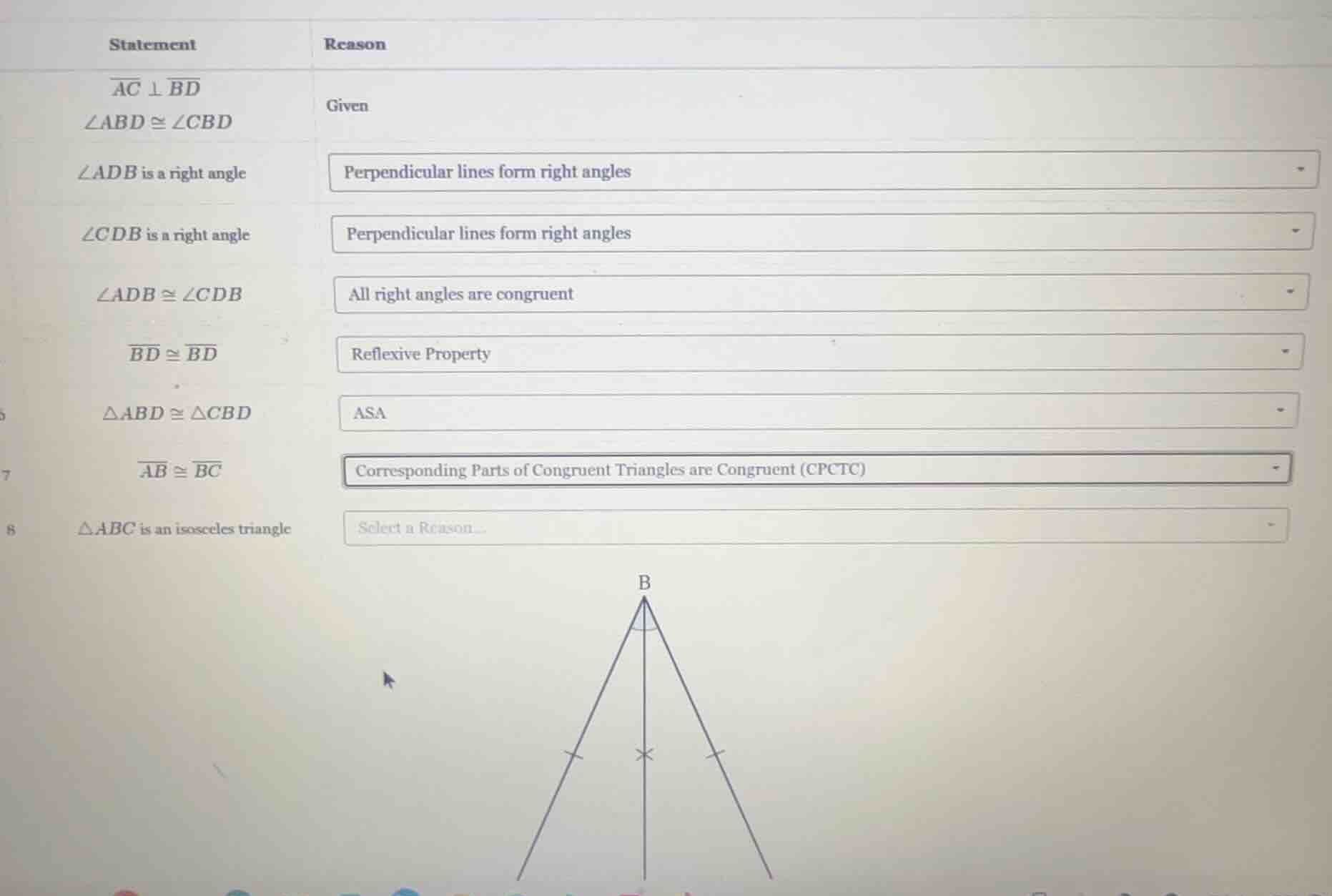
statement reason
\\(\overline{ac} \perp \overline{bd}\\)
\\(\angle abd \cong \angle cbd\\) given
\\(\angle adb\\) is a right angle perpendicular lines form right angles
\\(\angle cdb\\) is a right angle perpendicular lines form right angles
\\(\angle adb \cong \angle cdb\\) all right angles are congruent
\\(\overline{bd} \cong \overline{bd}\\) reflexive property
\\(\triangle abd \cong \triangle cbd\\) asa
\\(\overline{ab} \cong \overline{bc}\\) corresponding parts of congruent triangles are congruent (cpctc)
\\(\triangle abc\\) is an isosceles triangle select a reason...
Step1: Recall the definition of an isosceles triangle
An isosceles triangle is defined as a triangle with at least two congruent sides (or at least two congruent angles).
Step2: Use the result from CPCTC
From step 7, we have $\overline{AB} \cong \overline{BC}$.
Step3: Apply the definition to $\triangle ABC$
Since $\overline{AB} \cong \overline{BC}$, triangle $ABC$ has two congruent sides. By the definition of an isosceles triangle, a triangle with two congruent sides is isosceles. So the reason is "A triangle with two congruent sides is isosceles" (or "Definition of isosceles triangle").

Snap & solve any problem in the app
Get step-by-step solutions on Sovi AI
Photo-based solutions with guided steps
Explore more problems and detailed explanations
A triangle with two congruent sides is isosceles (or Definition of isosceles triangle)