QUESTION IMAGE
Question
statements
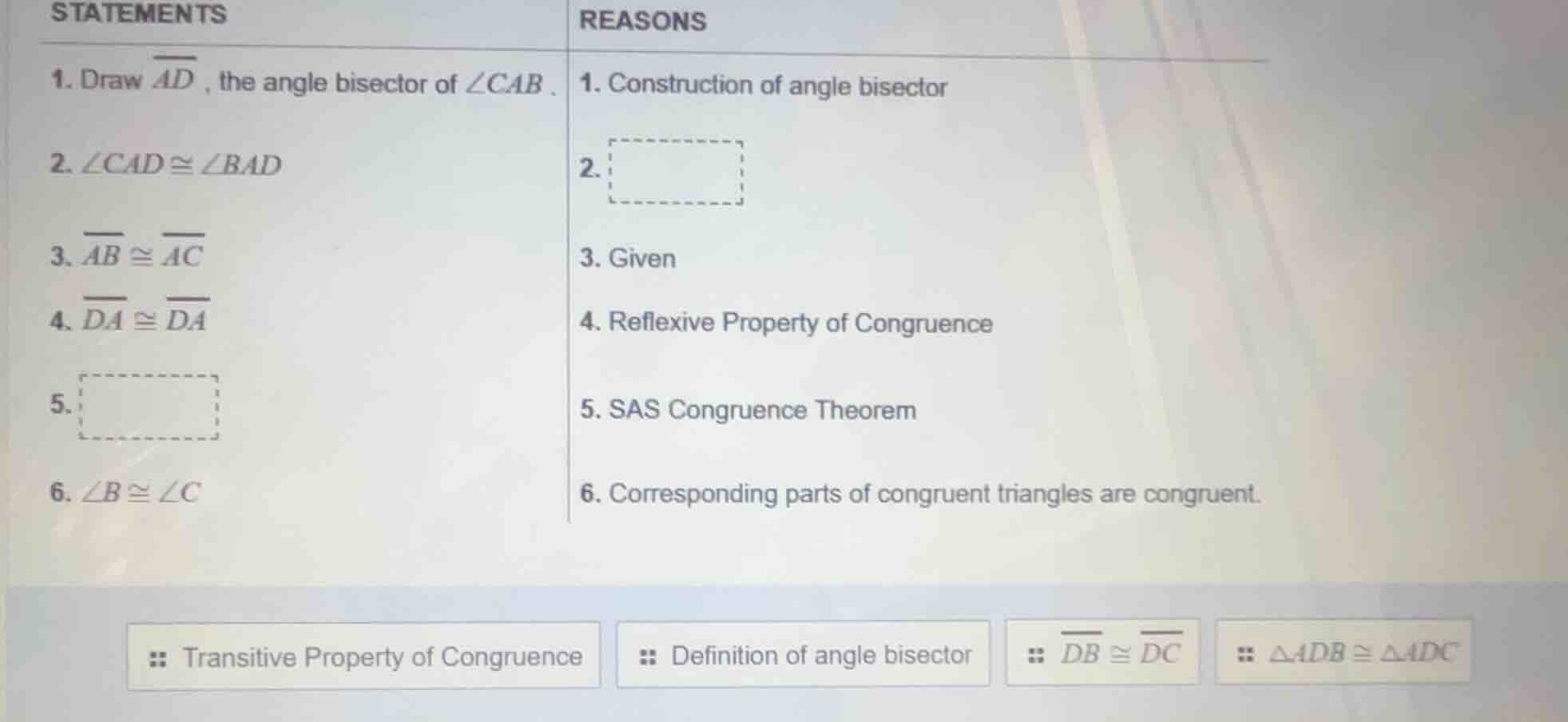
- draw \\(\overline{ad}\\), the angle bisector of \\(\angle cab\\).
- \\(\angle cad \cong \angle bad\\)
- \\(\overline{ab} \cong \overline{ac}\\)
- \\(\overline{da} \cong \overline{da}\\)
- dashed box
- \\(\angle b \cong \angle c\\)
reasons
- construction of angle bisector
- dashed box
- given
- reflexive property of congruence
- sas congruence theorem
- corresponding parts of congruent triangles are congruent.
options: transitive property of congruence, definition of angle bisector, \\(\overline{db} \cong \overline{dc}\\), \\(\triangle adb \cong \triangle adc\\)
For Reason 2:
To determine the reason for \( \angle CAD \cong \angle BAD \), we recall that an angle bisector divides an angle into two congruent angles. Since \( \overline{AD} \) is the angle bisector of \( \angle CAB \), by the definition of an angle bisector, \( \angle CAD \) and \( \angle BAD \) must be congruent.
We know from the given information and previous steps: \( \overline{AB} \cong \overline{AC} \) (given), \( \angle CAD \cong \angle BAD \) (from angle bisector definition), and \( \overline{DA} \cong \overline{DA} \) (reflexive property). Using the SAS (Side - Angle - Side) Congruence Theorem, we can conclude that \( \triangle ADB \cong \triangle ADC \) because we have two sides and the included angle of one triangle congruent to the corresponding two sides and included angle of the other triangle.

Snap & solve any problem in the app
Get step-by-step solutions on Sovi AI
Photo-based solutions with guided steps
Explore more problems and detailed explanations
Definition of angle bisector