QUESTION IMAGE
Question
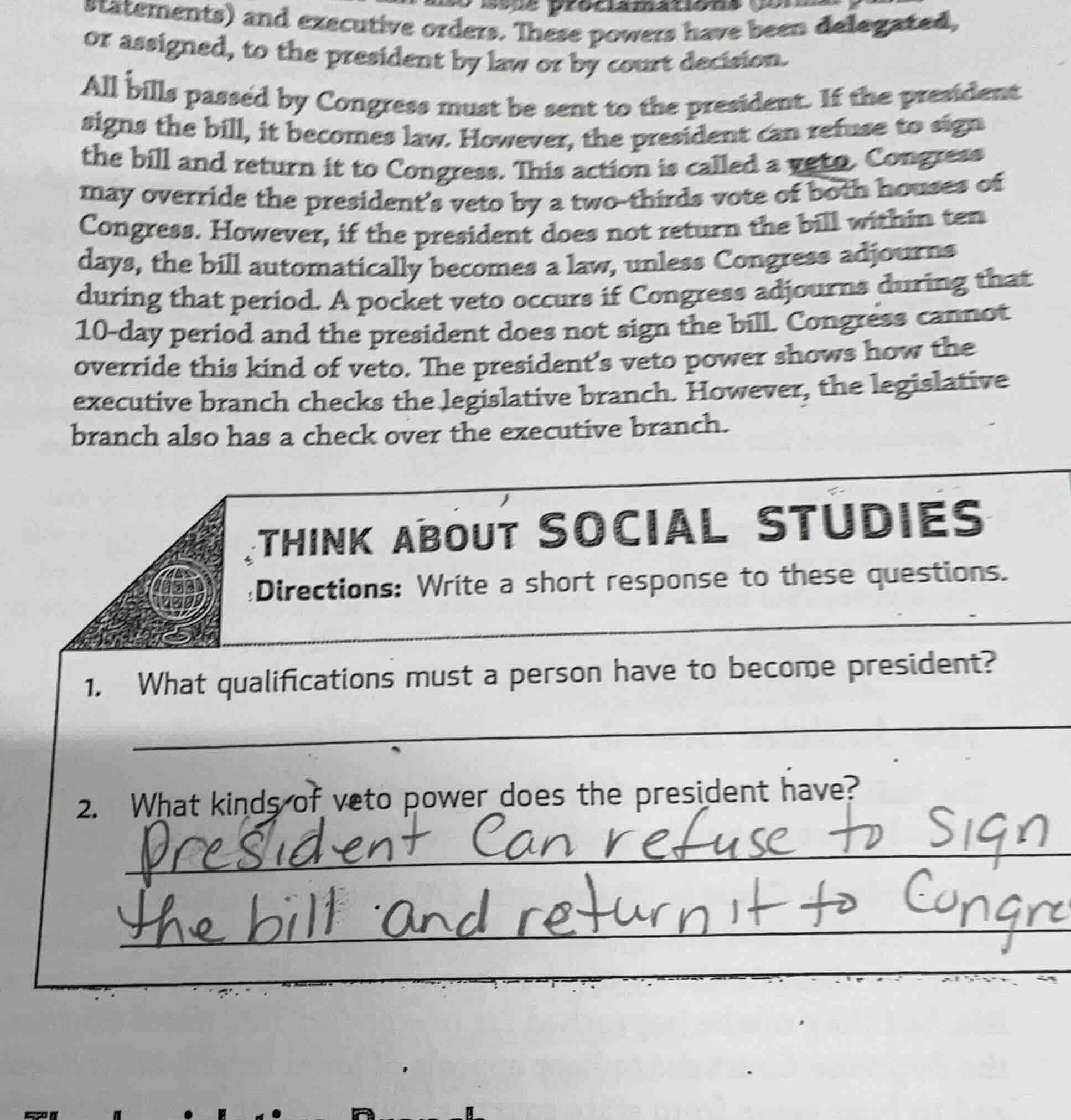
statements) and executive orders. these powers have been delegated, or assigned, to the president by law or by court decision. all bills passed by congress must be sent to the president. if the president signs the bill, it becomes law. however, the president can refuse to sign the bill and return it to congress. this action is called a veto. congress may override the president’s veto by a two - thirds vote of both houses of congress. however, if the president does not return the bill within ten days, the bill automatically becomes a law, unless congress adjourns during that period. a pocket veto occurs if congress adjourns during that 10 - day period and the president does not sign the bill. congress cannot override this kind of veto. the president’s veto power shows how the executive branch checks the legislative branch. however, the legislative branch also has a check over the executive branch. think about social studies directions: write a short response to these questions. 1. what qualifications must a person have to become president? 2. what kinds of veto power does the president have?
Question 1:
To determine the qualifications to become president (in the US context, as per typical civics knowledge), the person must be a natural - born citizen of the United States, at least 35 years old, and a resident of the United States for at least 14 years.
From the given text, the president has two types of veto power. One is the regular veto where the president refuses to sign a bill and returns it to Congress. The other is the pocket veto, which occurs when Congress adjourns during the 10 - day period after the bill is sent to the president and the president does not sign the bill. Congress can override a regular veto with a two - thirds vote in both houses, but cannot override a pocket veto.

Snap & solve any problem in the app
Get step-by-step solutions on Sovi AI
Photo-based solutions with guided steps
Explore more problems and detailed explanations
To become the US president, a person must be a natural - born US citizen, at least 35 years old, and a US resident for at least 14 years.