QUESTION IMAGE
Question
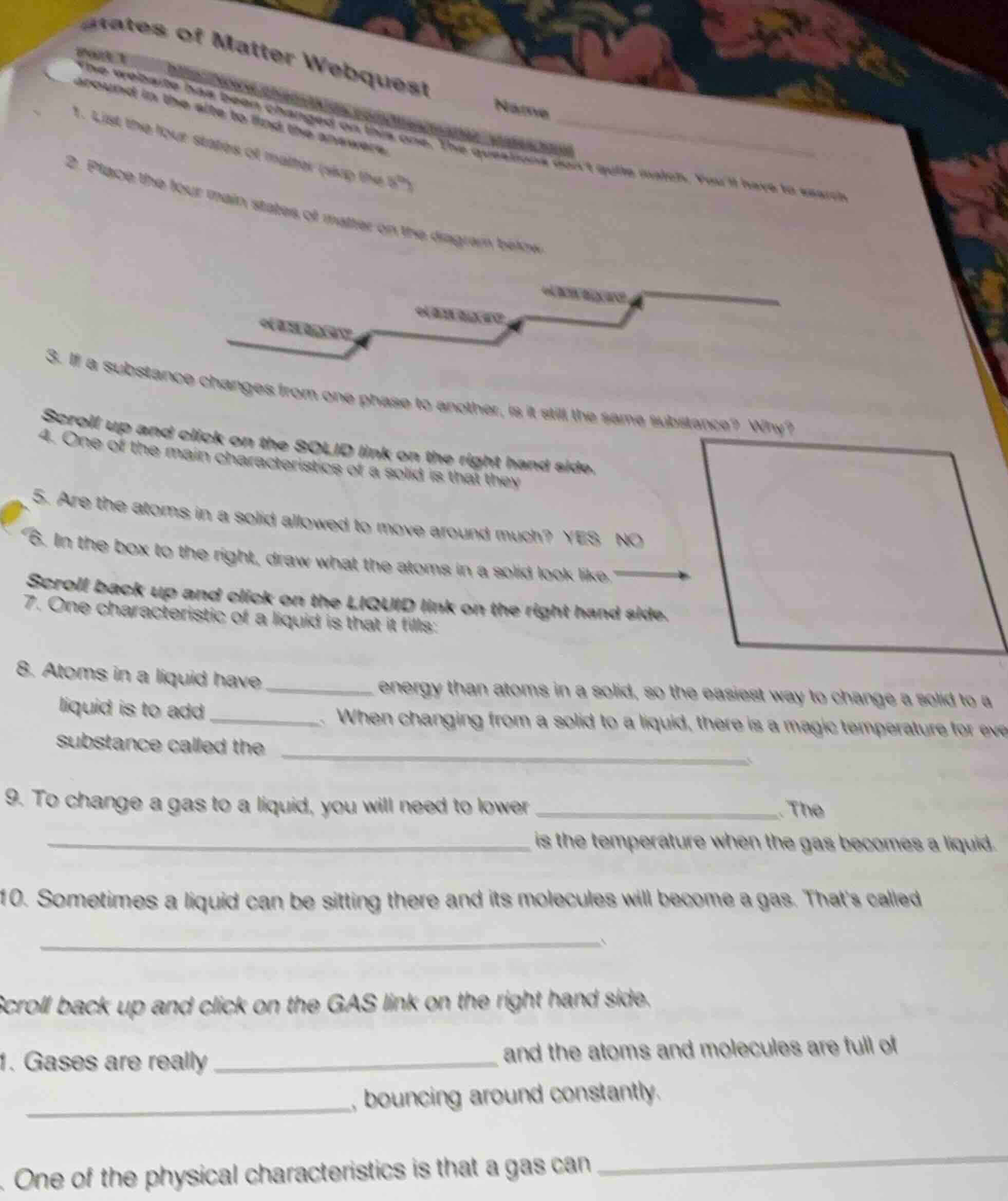
states of matter webquest
name
the website has been changed on this one. the questions wont quite match. youll have to search around in the site to find the answers.
- list the four states of matter (skip the 5th)
- place the four main states of matter on the diagram below.
- if a substance changes from one phase to another, is it still the same substance? why?
scroll up and click on the solid link on the right hand side.
- one of the main characteristics of a solid is that they
- are the atoms in a solid allowed to move around much? yes no
- in the box to the right, draw what the atoms in a solid look like.
scroll back up and click on the liquid link on the right hand side.
- one characteristic of a liquid is that it fills:
- atoms in a liquid have ____ energy than atoms in a solid, so the easiest way to change a solid to a liquid is to add __. when changing from a solid to a liquid, there is a magic temperature for every substance called the ____
- to change a gas to a liquid, you will need to lower ____. the ____ is the temperature when the gas becomes a liquid.
- sometimes a liquid can be sitting there and its molecules will become a gas. thats called ______.
scroll back up and click on the gas link on the right hand side.
- gases are really ____ and the atoms and molecules are full of ____, bouncing around constantly.
one of the physical characteristics is that a gas can ______
Brief Explanations
- The four main states of matter are the fundamental categories for most basic chemistry/physics contexts.
- The diagram follows the typical energy progression of matter states.
- Phase changes are physical changes, not chemical, so the substance's identity stays the same.
- Solids have a fixed, rigid structure that holds their shape.
- Atoms in solids only vibrate in fixed positions, so they don't move around freely.
- Atoms in solids are tightly packed in a regular, fixed arrangement.
- Liquids take the shape of the container they are placed in, but don't expand to fill it entirely.
- Liquids have more atomic energy than solids; adding heat (energy) raises temperature to the melting point to melt a solid.
- Lowering temperature (removing energy) causes gas to condense; the condensation point is the specific temperature for this change.
- Evaporation is the process where liquid molecules at the surface turn to gas without boiling.
- Gases have large spaces between particles, making them low-density, and their particles have high kinetic energy.
- Gases expand to fill the entire volume of their container.

Snap & solve any problem in the app
Get step-by-step solutions on Sovi AI
Photo-based solutions with guided steps
Explore more problems and detailed explanations
- Solid, Liquid, Gas, Plasma
- (From left to right on the diagram) Solid, Liquid, Gas, Plasma
- Yes, because phase changes are physical changes that only alter the arrangement/energy of particles, not the chemical composition of the substance.
- have a definite shape and volume
- NO
- (A tight, regular, packed arrangement of atoms/molecules with little space between them, vibrating in fixed positions)
- the shape of its container (but not the entire volume)
- more; heat/thermal energy; melting point
- the temperature (or remove thermal energy); condensation point
- evaporation
- low-density; kinetic energy
- expand to fill its entire container