QUESTION IMAGE
Question
station 7: analyze the graph; draw conclusions
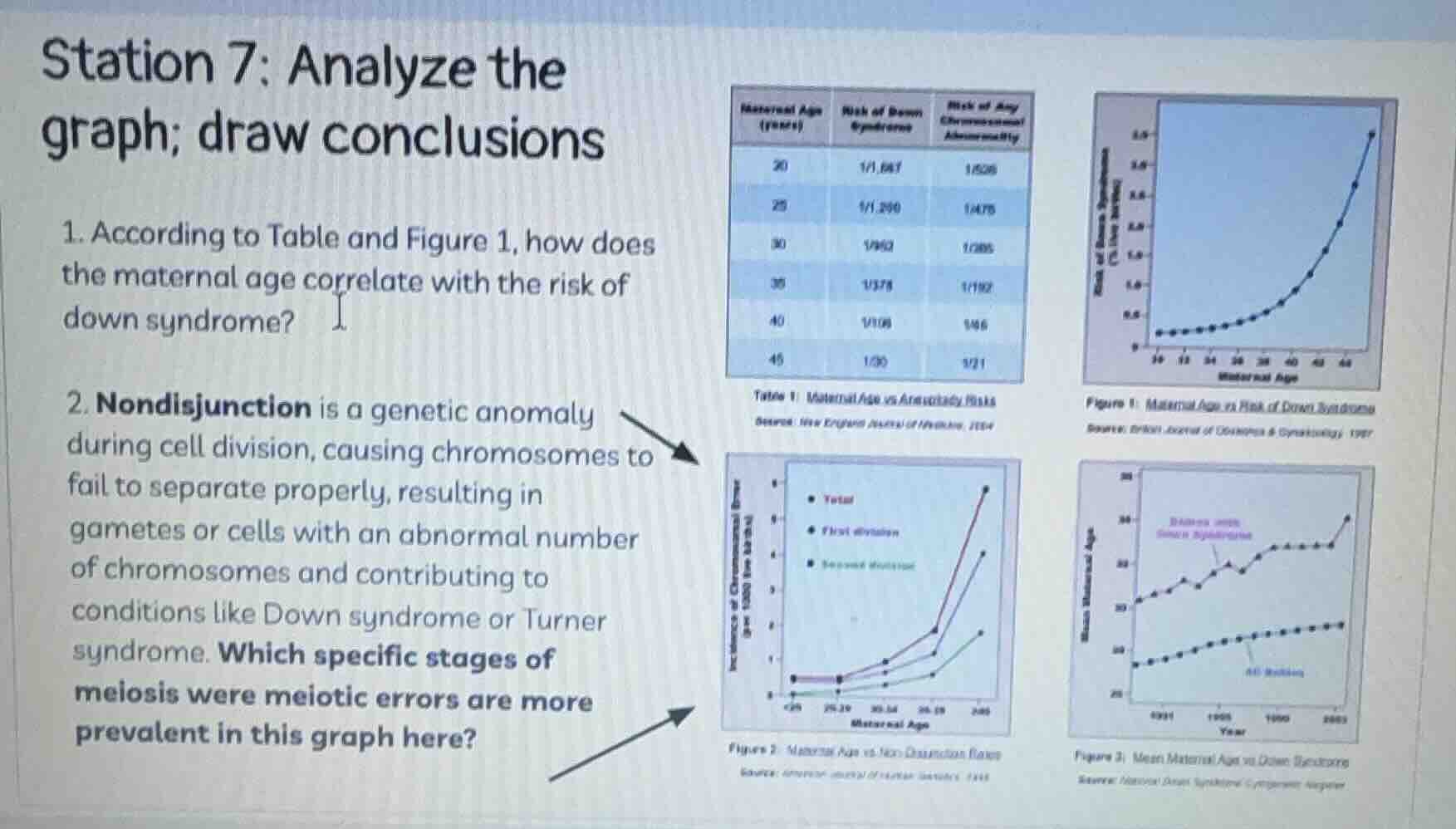
- according to table and figure 1, how does the maternal age correlate with the risk of down syndrome?
- nondisjunction is a genetic anomaly during cell division, causing chromosomes to fail to separate properly, resulting in gametes or cells with an abnormal number of chromosomes and contributing to conditions like down syndrome or turner syndrome. which specific stages of meiosis were meiotic errors are more prevalent in this graph here?
table 1 maternal age vs aneuploidy risk
source: new england journal of medicine, 1994
figure 1: maternal age vs risk of down syndrome
source: british journal of obstetrics & gynaecology, 1997
figure 2: maternal age vs non - disjunction rates
source: american journal of human genetics, 1994
figure 3: mean maternal age in ozone depletion
source: national down syndrome cytogenetic register
Brief Explanations
- For the first question: By examining Table 1 and Figure 1, as maternal age increases, the numerical risk ratio for Down syndrome (e.g., 1/1,667 at 20 vs. 1/30 at 45) and the plotted risk trend both show a positive, upward correlation, with a sharp increase after age 35.
- For the second question: Looking at Figure 2, the line representing first division nondisjunction has a higher and steeper upward trend across maternal age groups compared to second division, meaning errors are more prevalent in this stage.

Snap & solve any problem in the app
Get step-by-step solutions on Sovi AI
Photo-based solutions with guided steps
Explore more problems and detailed explanations
- Maternal age has a positive correlation with the risk of Down syndrome; the risk increases significantly, especially after the age of 35.
- Meiotic errors (nondisjunction) are more prevalent in the first division stage of meiosis, as shown by the higher incidence rate in Figure 2.