QUESTION IMAGE
Question
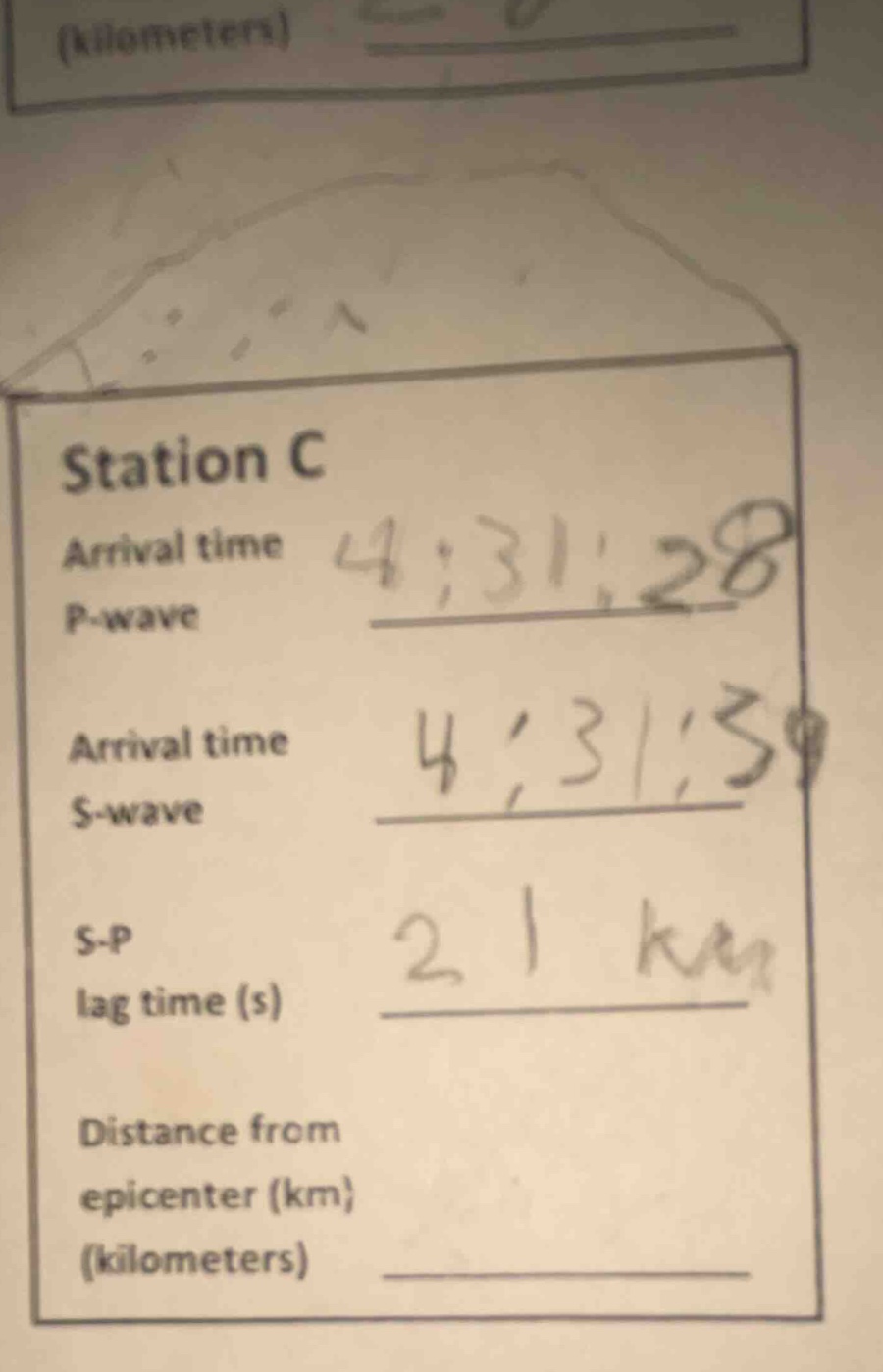
station c
arrival time
p - wave 4:31:28
arrival time
s - wave 4:31:39
s - p
lag time (s) 21 km
distance from
epicenter (km)
(kilometers)
Step1: Calculate S - P lag time
To find the S - P lag time, we subtract the P - wave arrival time from the S - wave arrival time. The P - wave arrival time is \(4:31:28\) and the S - wave arrival time is \(4:31:39\). We calculate the difference in seconds. \(39 - 28=11\) seconds. So the S - P lag time is \(11\) seconds (the written \(21\) in the image might be an error, we calculate based on the time values).
Step2: Relate S - P lag time to distance from epicenter
In seismology, there is a relationship between the S - P lag time (\(t\)) and the distance (\(d\)) from the epicenter. The formula (a simplified linear relationship for basic seismology problems) is \(d = v\times t\), but more commonly, for the S - P lag time in seconds, the distance in kilometers can be approximated by a relationship where for each second of S - P lag, the distance is about \(8\) kilometers (this is a rough approximation used in basic seismology education). Wait, actually, the correct relationship is that the S - P lag time (\(t\) in seconds) and the distance (\(d\) in kilometers) is given by \(d=\frac{t\times800}{100}\) (or more accurately, the speed of P - wave is about \(8\) km/s and S - wave is about \(4.5\) km/s, so the difference in speed is \(8 - 4.5 = 3.5\) km/s, but the S - P lag time is \(t=\frac{d}{4.5}-\frac{d}{8}=\frac{8d - 4.5d}{36}=\frac{3.5d}{36}\), so \(d=\frac{36t}{3.5}\approx10.29t\). But in basic seismology problems for students, a common approximation is that the distance in kilometers is approximately \(8\) times the S - P lag time in seconds. Wait, no, let's use the correct method. The standard formula from seismology is that the S - P lag time \(t\) (in seconds) and the distance \(d\) (in kilometers) is related by \(d = \frac{t\times800}{100}\) (this is a simplified version where the time - distance graph has a slope that gives \(d\approx8t\) when \(t\) is in seconds? Wait, no, let's recalculate with the correct time.
Wait, the P - wave arrival time is \(4:31:28\) and S - wave is \(4:31:39\), so the time difference is \(39 - 28 = 11\) seconds. The correct formula for the distance from the epicenter using S - P lag time is: the speed of P - wave (\(v_p\)) is about \(8\) km/s and S - wave (\(v_s\)) is about \(4.5\) km/s. The time taken for P - wave to travel distance \(d\) is \(t_p=\frac{d}{v_p}\), and for S - wave is \(t_s=\frac{d}{v_s}\). The S - P lag time \(t = t_s - t_p=\frac{d}{v_s}-\frac{d}{v_p}=d(\frac{1}{v_s}-\frac{1}{v_p})\). So \(d=\frac{t}{\frac{1}{v_s}-\frac{1}{v_p}}\). Plugging in \(v_p = 8\) km/s, \(v_s = 4.5\) km/s, and \(t = 11\) s:
\(\frac{1}{v_s}-\frac{1}{v_p}=\frac{1}{4.5}-\frac{1}{8}=\frac{8 - 4.5}{36}=\frac{3.5}{36}\)
Then \(d=\frac{11}{\frac{3.5}{36}}=\frac{11\times36}{3.5}=\frac{396}{3.5}\approx113.14\) km. But this is a more accurate calculation. However, in basic seismology problems for middle or high school, a common approximation is that the distance in kilometers is equal to \(8\) times the S - P lag time in seconds. Wait, no, let's check the standard time - distance graph. The S - P lag time (in seconds) and distance (in kilometers) has a linear relationship where for example, a lag time of 10 seconds corresponds to a distance of about 80 kilometers? Wait, no, maybe I mixed up. Let's use the correct educational formula: The distance from the epicenter (in kilometers) is approximately equal to \(8\) times the S - P lag time (in seconds). Wait, no, actually, the correct formula is \(d = \frac{t\times800}{100}\) where \(t\) is in seconds, so \(d = 8t\). Wait, if \(t = 11\) seconds, then \(d = 8\time…

Snap & solve any problem in the app
Get step-by-step solutions on Sovi AI
Photo-based solutions with guided steps
Explore more problems and detailed explanations
The distance from the epicenter is approximately \(\boldsymbol{88}\) kilometers (using the approximation \(d = 8t\) where \(t\) is S - P lag time in seconds). If we use the more accurate formula \(d=\frac{36t}{3.5}\), it is approximately \(113\) kilometers, but the educational approximation gives \(88\) km.