QUESTION IMAGE
Question
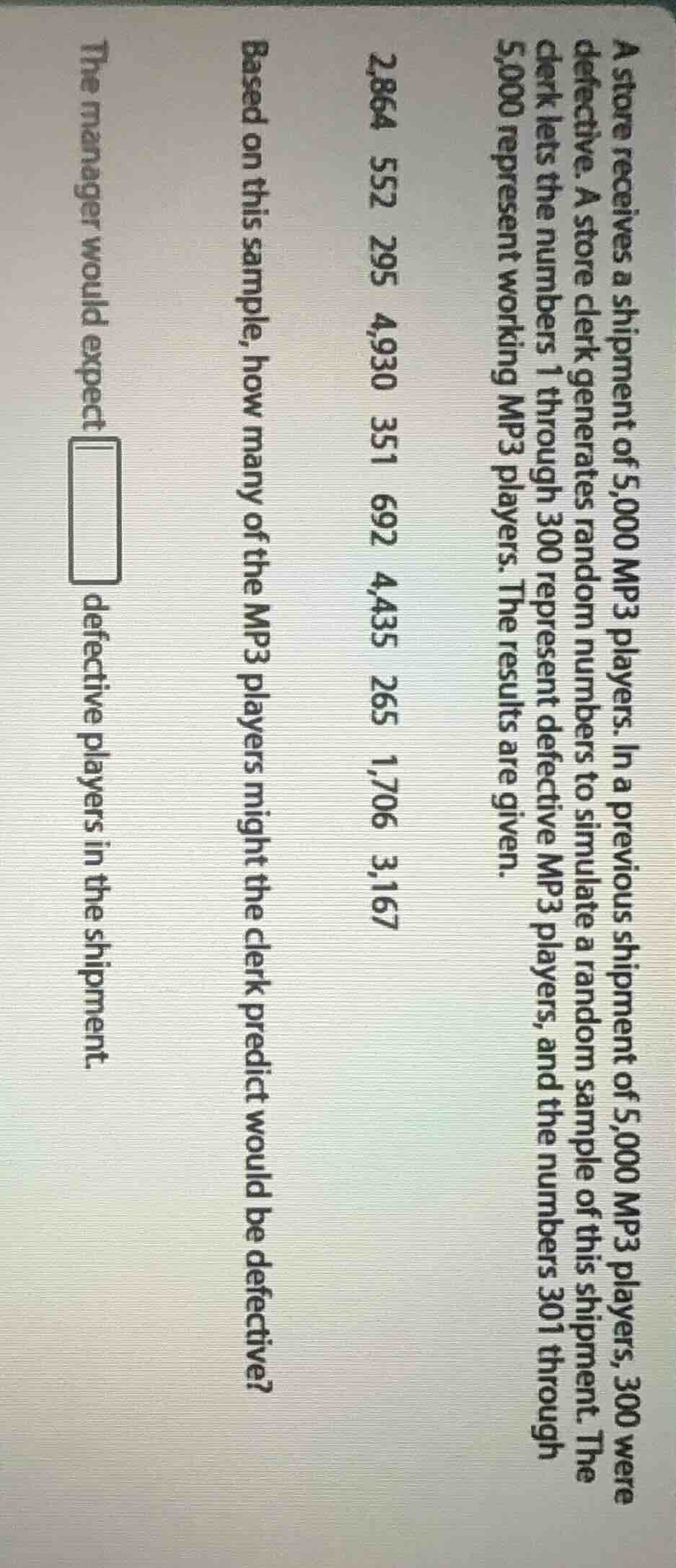
a store receives a shipment of 5,000 mp3 players. in a previous shipment of 5,000 mp3 players, 300 were defective. a store clerk generates random numbers to simulate a random sample of this shipment. the clerk lets the numbers 1 through 300 represent defective mp3 players, and the numbers 301 through 5,000 represent working mp3 players. the results are given.\\2,864 552 295 4,930 351 692 4,435 265 1,706 3,167\based on this sample, how many of the mp3 players might the clerk predict would be defective?\the manager would expect \boxed{} defective players in the shipment.
Step1: Count defective numbers
First, we need to identify which numbers represent defective MP3 players. The problem states that numbers 1 through 300 represent defective, and 301 through 5000 represent working. Let's check each number:
- 2864: >300 (working)
- 552: >300 (working)
- 295: ≤300 (defective)
- 4930: >300 (working)
- 351: >300 (working)
- 692: >300 (working)
- 4435: >300 (working)
- 265: ≤300 (defective)
- 1706: >300 (working)
- 3167: >300 (working)
Wait, maybe I misread the sample size. Wait, the clerk generates random numbers to simulate a sample of this shipment. Wait, the previous shipment of 5000 had 300 defective. Wait, no, the problem says "A store receives a shipment of 5,000 MP3 players. In a previous shipment of 5,000 MP3 players, 300 were defective. A store clerk generates random numbers to simulate a sample of this shipment. The clerk lets the numbers 1 through 300 represent defective MP3 players, and the numbers 301 through 5,000 represent working MP3 players. The results are given." Wait, the results are the list: 2864, 552, 295, 4930, 351, 692, 4435, 265, 1706, 3167. Wait, how many numbers are there? Let's count: 2864 (1), 552 (2), 295 (3), 4930 (4), 351 (5), 692 (6), 4435 (7), 265 (8), 1706 (9), 3167 (10). So 10 numbers in the sample.
Now, count how many of these 10 numbers are between 1 and 300 (defective):
- 295: yes (295 ≤ 300)
- 265: yes (265 ≤ 300)
Any others? Let's check each:
- 2864: 2864 > 300 → no
- 552: 552 > 300 → no
- 295: yes
- 4930: >300 → no
- 351: >300 → no
- 692: >300 → no
- 4435: >300 → no
- 265: yes
- 1706: >300 → no
- 3167: >300 → no
Wait, that's only 2 defective in the sample of 10? That can't be right. Wait, maybe I misinterpreted the sample. Wait, maybe the numbers are the counts? Wait, no, the problem says "the results are given" as those numbers. Wait, maybe the numbers are the counts of defective or working? No, that doesn't make sense. Wait, maybe the sample size is 10, and we need to find the proportion of defective in the sample, then apply to 5000.
Wait, let's re-read the problem: "A store receives a shipment of 5,000 MP3 players. In a previous shipment of 5,000 MP3 players, 300 were defective. A store clerk generates random numbers to simulate a sample of this shipment. The clerk lets the numbers 1 through 300 represent defective MP3 players, and the numbers 301 through 5,000 represent working MP3 players. The results are given: 2864, 552, 295, 4930, 351, 692, 4435, 265, 1706, 3167."
So each number is a random number representing an MP3 player. So we have 10 numbers (sample size n=10). Now, count how many of these 10 numbers are ≤300 (defective):
- 295: ≤300 → defective (1)
- 265: ≤300 → defective (2)
Wait, that's only 2? But that seems low. Wait, maybe I made a mistake. Wait, maybe the numbers are the number of defective or working? No, the problem says "the numbers 1 through 300 represent defective MP3 players, and the numbers 301 through 5,000 represent working MP3 players". So each number is a unique identifier, and if it's between 1-300, it's defective; 301-5000, working.
Wait, let's list all 10 numbers and check:
- 2864: 2864 > 300 → working
- 552: 552 > 300 → working
- 295: 295 ≤ 300 → defective
- 4930: 4930 > 300 → working
- 351: 351 > 300 → working
- 692: 692 > 300 → working
- 4435: 4435 > 300 → working
- 265: 265 ≤ 300 → defective
- 1706: 1706 > 300 → working
- 3167: 3167 > 300 → working
So in the sample of 10, there are 2 defective. Wait, but that seems inconsistent with the previous shipment's 300 defective in 5000 (which is 300/5000 = 0.06…

Snap & solve any problem in the app
Get step-by-step solutions on Sovi AI
Photo-based solutions with guided steps
Explore more problems and detailed explanations
1000