QUESTION IMAGE
Question
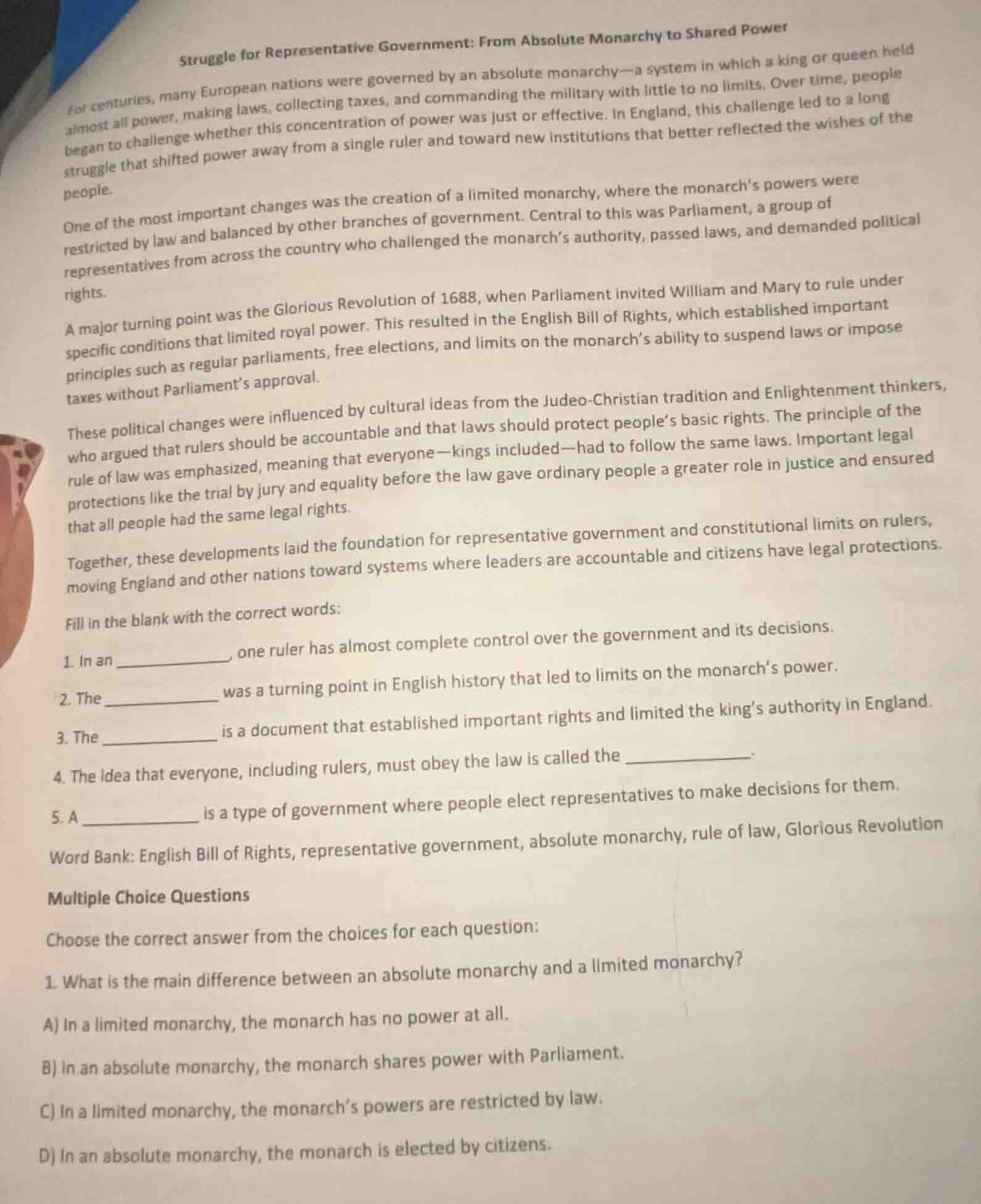
struggle for representative government: from absolute monarchy to shared power
for centuries, many european nations were governed by an absolute monarchy—a system in which a king or queen held almost all power, making laws, collecting taxes, and commanding the military with little to no limits. over time, people began to challenge whether this concentration of power was just or effective. in england, this challenge led to a long struggle that shifted power away from a single ruler and toward new institutions that better reflected the wishes of the people.
one of the most important changes was the creation of a limited monarchy, where the monarch’s powers were restricted by law and balanced by other branches of government. central to this was parliament, a group of representatives from across the country who challenged the monarch’s authority, passed laws, and demanded political rights.
a major turning point was the glorious revolution of 1688, when parliament invited william and mary to rule under specific conditions that limited royal power. this resulted in the english bill of rights, which established important principles such as regular parliaments, free elections, and limits on the monarch’s ability to suspend laws or impose taxes without parliament’s approval.
these political changes were influenced by cultural ideas from the judeo - christian tradition and enlightenment thinkers, who argued that rulers should be accountable and that laws should protect people’s basic rights. the principle of the rule of law was emphasized, meaning that everyone—kings included—had to follow the same laws. important legal protections like the trial by jury and equality before the law gave ordinary people a greater role in justice and ensured that all people had the same legal rights.
together, these developments laid the foundation for representative government and constitutional limits on rulers, moving england and other nations toward systems where leaders are accountable and citizens have legal protections.
fill in the blank with the correct words:
- in an ________, one ruler has almost complete control over the government and its decisions.
- the ________ was a turning point in english history that led to limits on the monarch’s power.
- the ________ is a document that established important rights and limited the king’s authority in england.
- the idea that everyone, including rulers, must obey the law is called the ________.
- a ________ is a type of government where people elect representatives to make decisions for them.
word bank: english bill of rights, representative government, absolute monarchy, rule of law, glorious revolution
multiple choice questions
choose the correct answer from the choices for each question:
- what is the main difference between an absolute monarchy and a limited monarchy?
a) in a limited monarchy, the monarch has no power at all.
b) in an absolute monarchy, the monarch shares power with parliament.
c) in a limited monarchy, the monarch’s powers are restricted by law.
d) in an absolute monarchy, the monarch is elected by citizens.
Fill in the blank:
- From the text "many European nations were governed by an absolute monarchy—a system in which a king or queen held almost all power...", so the answer is absolute monarchy.
- From "A major turning point was the Glorious Revolution of 1688...", so the answer is Glorious Revolution.
- From "This resulted in the English Bill of Rights, which established important principles...", so the answer is English Bill of Rights.
- From "The principle of the rule of law was emphasized, meaning that everyone—kings included—had to follow the same laws", so the answer is rule of law.
- From "these developments laid the foundation for representative government...where people elect representatives to make decisions for them", so the answer is representative government.
Multiple Choice Questions:
- Analyze each option:
- Option A: A limited monarchy doesn't mean the monarch has no power at all, so A is wrong.
- Option B: In an absolute monarchy, the monarch has almost all power and doesn't share with Parliament, so B is wrong.
- Option C: From the text "the creation of a limited monarchy, where the monarch’s powers were restricted by law", so C is correct.
- Option D: In an absolute monarchy, the monarch is not elected by citizens, so D is wrong.

Snap & solve any problem in the app
Get step-by-step solutions on Sovi AI
Photo-based solutions with guided steps
Explore more problems and detailed explanations
s:
Fill in the blank:
- absolute monarchy
- Glorious Revolution
- English Bill of Rights
- rule of law
- representative government
Multiple Choice Questions:
- C. In a limited monarchy, the monarch’s powers are restricted by law.