QUESTION IMAGE
Question
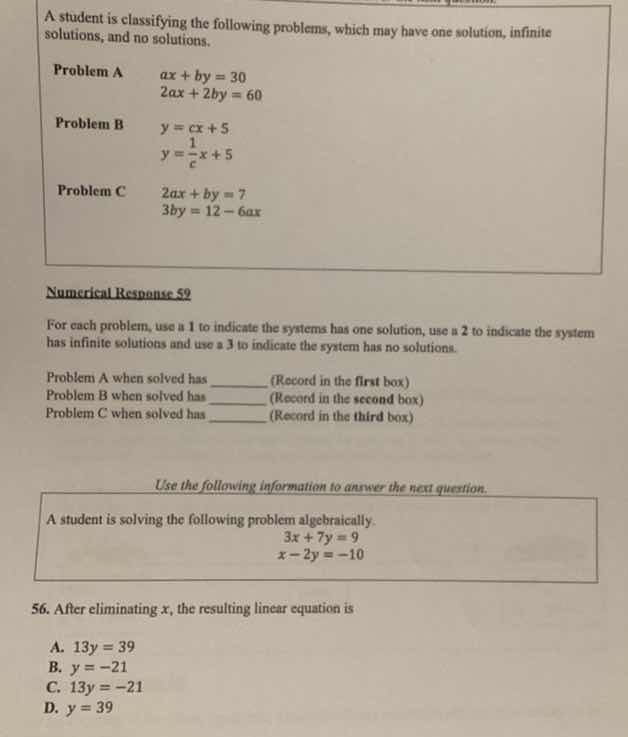
a student is classifying the following problems, which may have one solution, infinite solutions, and no solutions.
problem a
$ax + by = 30$
$2ax + 2by = 60$
problem b
$y = cx + 5$
$y = \frac{1}{c}x + 5$
problem c
$2ax + by = 7$
$3by = 12 - 6ax$
numerical response 59
for each problem, use a 1 to indicate the systems has one solution, use a 2 to indicate the system has infinite solutions and use a 3 to indicate the system has no solutions.
problem a when solved has \underline{\quad\quad} (record in the first box)
problem b when solved has \underline{\quad\quad} (record in the second box)
problem c when solved has \underline{\quad\quad} (record in the third box)
use the following information to answer the next question.
a student is solving the following problem algebraically.
$3x + 7y = 9$
$x - 2y = -10$
- after eliminating $x$, the resulting linear equation is
a. $13y = 39$
b. $y = -21$
c. $13y = -21$
d. $y = 39$
First Set of Problems (Problem A, B, C)
Step1: Analyze Problem A
The second equation is $2ax + 2by = 60$, which simplifies to $ax + by = 30$ (divide by 2). This is identical to the first equation, so the system has infinite solutions.
Step2: Analyze Problem B
Set the two equations equal: $cx + 5 = \frac{1}{c}x + 5$. Rearrange: $(c - \frac{1}{c})x = 0$. For $c
eq \pm1$, $x=0$ (one solution); for $c=\pm1$, the equations are identical (infinite solutions). But since $c$ and $\frac{1}{c}$ are distinct slopes unless $c=\pm1$, the general case (assuming $c
eq \pm1$) gives one solution.
Step3: Analyze Problem C
Rearrange the second equation: $6ax + 3by = 12$, which simplifies to $2ax + by = 4$ (divide by 3). The first equation is $2ax + by = 7$. These are parallel lines with no overlap, so no solutions.
Step1: Eliminate $x$ from the system
Multiply the second equation $x - 2y = -10$ by 3: $3x - 6y = -30$. Subtract this from the first equation $3x + 7y = 9$.
Step2: Compute the resulting equation
$(3x + 7y) - (3x - 6y) = 9 - (-30)$
$3x + 7y - 3x + 6y = 9 + 30$
$13y = 39$

Snap & solve any problem in the app
Get step-by-step solutions on Sovi AI
Photo-based solutions with guided steps
Explore more problems and detailed explanations
Problem A when solved has $\boldsymbol{2}$
Problem B when solved has $\boldsymbol{1}$
Problem C when solved has $\boldsymbol{3}$
---