QUESTION IMAGE
Question
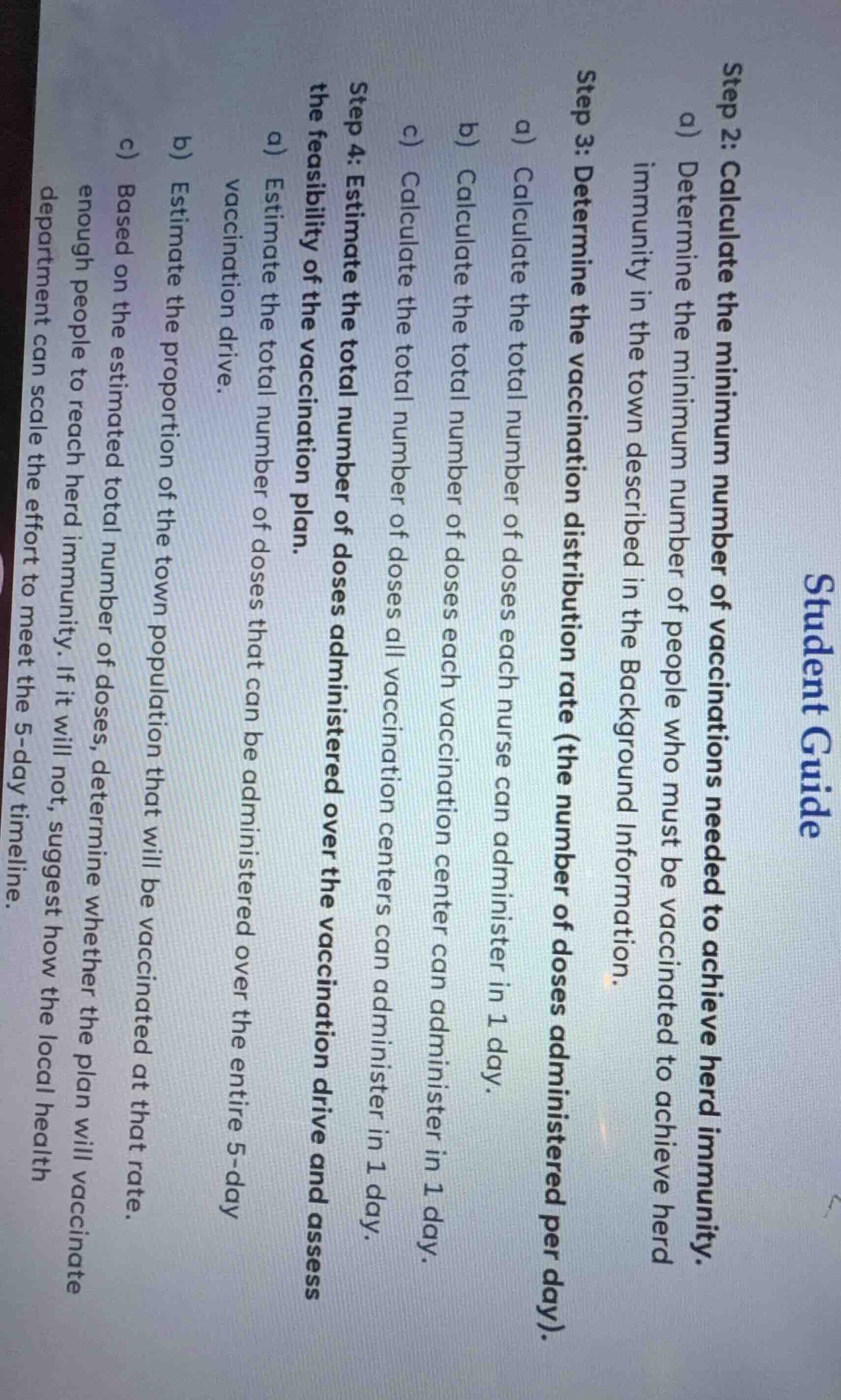
student guide step 2: calculate the minimum number of vaccinations needed to achieve herd immunity. a) determine the minimum number of people who must be vaccinated to achieve herd immunity in the town described in the background information. step 3: determine the vaccination distribution rate (the number of doses administered per day). a) calculate the total number of doses each nurse can administer in 1 day. b) calculate the total number of doses each vaccination center can administer in 1 day. c) calculate the total number of doses all vaccination centers can administer in 1 day. step 4: estimate the total number of doses administered over the vaccination drive and assess the feasibility of the vaccination plan. a) estimate the total number of doses that can be administered over the entire 5 - day vaccination drive. b) estimate the proportion of the town population that will be vaccinated at that rate. c) based on the estimated total number of doses, determine whether the plan will vaccinate enough people to reach herd immunity. if it will not, suggest how the local health department can scale the effort to meet the 5 - day timeline.
To solve this vaccination - related problem, we need to follow the given steps. However, since the problem lacks specific data (such as the population of the town, the number of nurses, the number of vaccination centers, the vaccination rate per nurse or per center, and the herd immunity threshold), we can't perform the actual calculations. Here are the general steps to solve it:
Step 1: Step 2a - Determine Herd Immunity
We need to know the total population of the town, let's call it \( P \), and the herd immunity threshold (usually a percentage, let's say \( h \) which is between 0 and 1). The minimum number of people to be vaccinated, \( N \), to achieve herd immunity is calculated as \( N=P\times h \). But without the values of \( P \) and \( h \), we can't get a numerical result.
Step 2: Step 3 - Determine Vaccination Distribution Rate
- Step 3a: If we know the number of nurses, \( n \), and the number of doses each nurse can administer in a day, \( d_{nurse} \), then the total number of doses per day by nurses is \( D_{nurse}=n\times d_{nurse} \).
- Step 3b: If we know the number of vaccination centers, \( c \), and the number of doses each center can administer in a day, \( d_{center} \), then the total number of doses per day by centers is \( D_{center}=c\times d_{center} \).
- Step 3c: The total number of doses all vaccination centers can administer in a day is the sum of the doses from nurses and centers (if applicable) or just the doses from centers (if nurses are not considered in the center - based administration), \( D_{total - day}=D_{nurse}+D_{center} \) (or \( D_{total - day}=D_{center} \) depending on the context). But again, without the values of \( n \), \( d_{nurse} \), \( c \), and \( d_{center} \), we can't calculate this.
Step 3: Step 4 - Estimate and Assess Feasibility
- Step 4a: The total number of doses that can be administered over 5 days is \( D_{5 - day}=D_{total - day}\times5 \).
- Step 4b: The proportion of the town's population that will be vaccinated at that rate is \( r=\frac{D_{5 - day}}{P} \) (assuming one dose per person, if it's a two - dose vaccine, we need to adjust accordingly).
- Step 4c: We compare \( r \) with \( h \). If \( r\geq h \), then the plan can vaccinate enough people to reach herd immunity. If \( r < h \), we need to suggest ways to scale up, such as increasing the number of nurses, increasing the number of vaccination centers, or extending the timeline.
Since the problem doesn't provide the necessary data (population, number of nurses, number of vaccination centers, doses per nurse/day, doses per center/day, herd immunity threshold), we can only present the formulas. If we assume some sample values, for example, if the town has a population of \( P = 10000 \), herd immunity threshold \( h = 0.7 \), number of nurses \( n = 10 \), each nurse can administer \( d_{nurse}=50 \) doses per day, number of vaccination centers \( c = 5 \), each center can administer \( d_{center}=100 \) doses per day:
- Step 2a: \( N = 10000\times0.7=7000 \)
- Step 3a: \( D_{nurse}=10\times50 = 500 \)
- Step 3b: \( D_{center}=5\times100 = 500 \)
- Step 3c: \( D_{total - day}=500 + 500=1000 \)
- Step 4a: \( D_{5 - day}=1000\times5 = 5000 \)
- Step 4b: \( r=\frac{5000}{10000}=0.5 \)
- Step 4c: Since \( 0.5<0.7 \), the plan will not vaccinate enough people to reach herd immunity. We can suggest increasing the number of nurses (e.g., hire more nurses so that \( n \) increases, which will increase \( D_{nurse} \) and thus \( D_{total - day} \) and \( D_{5 - day} \)) or…

Snap & solve any problem in the app
Get step-by-step solutions on Sovi AI
Photo-based solutions with guided steps
Explore more problems and detailed explanations
To solve this vaccination - related problem, we need to follow the given steps. However, since the problem lacks specific data (such as the population of the town, the number of nurses, the number of vaccination centers, the vaccination rate per nurse or per center, and the herd immunity threshold), we can't perform the actual calculations. Here are the general steps to solve it:
Step 1: Step 2a - Determine Herd Immunity
We need to know the total population of the town, let's call it \( P \), and the herd immunity threshold (usually a percentage, let's say \( h \) which is between 0 and 1). The minimum number of people to be vaccinated, \( N \), to achieve herd immunity is calculated as \( N=P\times h \). But without the values of \( P \) and \( h \), we can't get a numerical result.
Step 2: Step 3 - Determine Vaccination Distribution Rate
- Step 3a: If we know the number of nurses, \( n \), and the number of doses each nurse can administer in a day, \( d_{nurse} \), then the total number of doses per day by nurses is \( D_{nurse}=n\times d_{nurse} \).
- Step 3b: If we know the number of vaccination centers, \( c \), and the number of doses each center can administer in a day, \( d_{center} \), then the total number of doses per day by centers is \( D_{center}=c\times d_{center} \).
- Step 3c: The total number of doses all vaccination centers can administer in a day is the sum of the doses from nurses and centers (if applicable) or just the doses from centers (if nurses are not considered in the center - based administration), \( D_{total - day}=D_{nurse}+D_{center} \) (or \( D_{total - day}=D_{center} \) depending on the context). But again, without the values of \( n \), \( d_{nurse} \), \( c \), and \( d_{center} \), we can't calculate this.
Step 3: Step 4 - Estimate and Assess Feasibility
- Step 4a: The total number of doses that can be administered over 5 days is \( D_{5 - day}=D_{total - day}\times5 \).
- Step 4b: The proportion of the town's population that will be vaccinated at that rate is \( r=\frac{D_{5 - day}}{P} \) (assuming one dose per person, if it's a two - dose vaccine, we need to adjust accordingly).
- Step 4c: We compare \( r \) with \( h \). If \( r\geq h \), then the plan can vaccinate enough people to reach herd immunity. If \( r < h \), we need to suggest ways to scale up, such as increasing the number of nurses, increasing the number of vaccination centers, or extending the timeline.
Since the problem doesn't provide the necessary data (population, number of nurses, number of vaccination centers, doses per nurse/day, doses per center/day, herd immunity threshold), we can only present the formulas. If we assume some sample values, for example, if the town has a population of \( P = 10000 \), herd immunity threshold \( h = 0.7 \), number of nurses \( n = 10 \), each nurse can administer \( d_{nurse}=50 \) doses per day, number of vaccination centers \( c = 5 \), each center can administer \( d_{center}=100 \) doses per day:
- Step 2a: \( N = 10000\times0.7=7000 \)
- Step 3a: \( D_{nurse}=10\times50 = 500 \)
- Step 3b: \( D_{center}=5\times100 = 500 \)
- Step 3c: \( D_{total - day}=500 + 500=1000 \)
- Step 4a: \( D_{5 - day}=1000\times5 = 5000 \)
- Step 4b: \( r=\frac{5000}{10000}=0.5 \)
- Step 4c: Since \( 0.5<0.7 \), the plan will not vaccinate enough people to reach herd immunity. We can suggest increasing the number of nurses (e.g., hire more nurses so that \( n \) increases, which will increase \( D_{nurse} \) and thus \( D_{total - day} \) and \( D_{5 - day} \)) or increasing the number of vaccination centers (increase \( c \) to increase \( D_{center} \)) or extending the vaccination timeline beyond 5 days.
But as the problem is stated without specific data, we can only provide the general method of solution. If you provide the specific values for the population, herd immunity threshold, number of nurses, doses per nurse per day, number of vaccination centers, and doses per center per day, we can give you the numerical answers for each step.