QUESTION IMAGE
Question
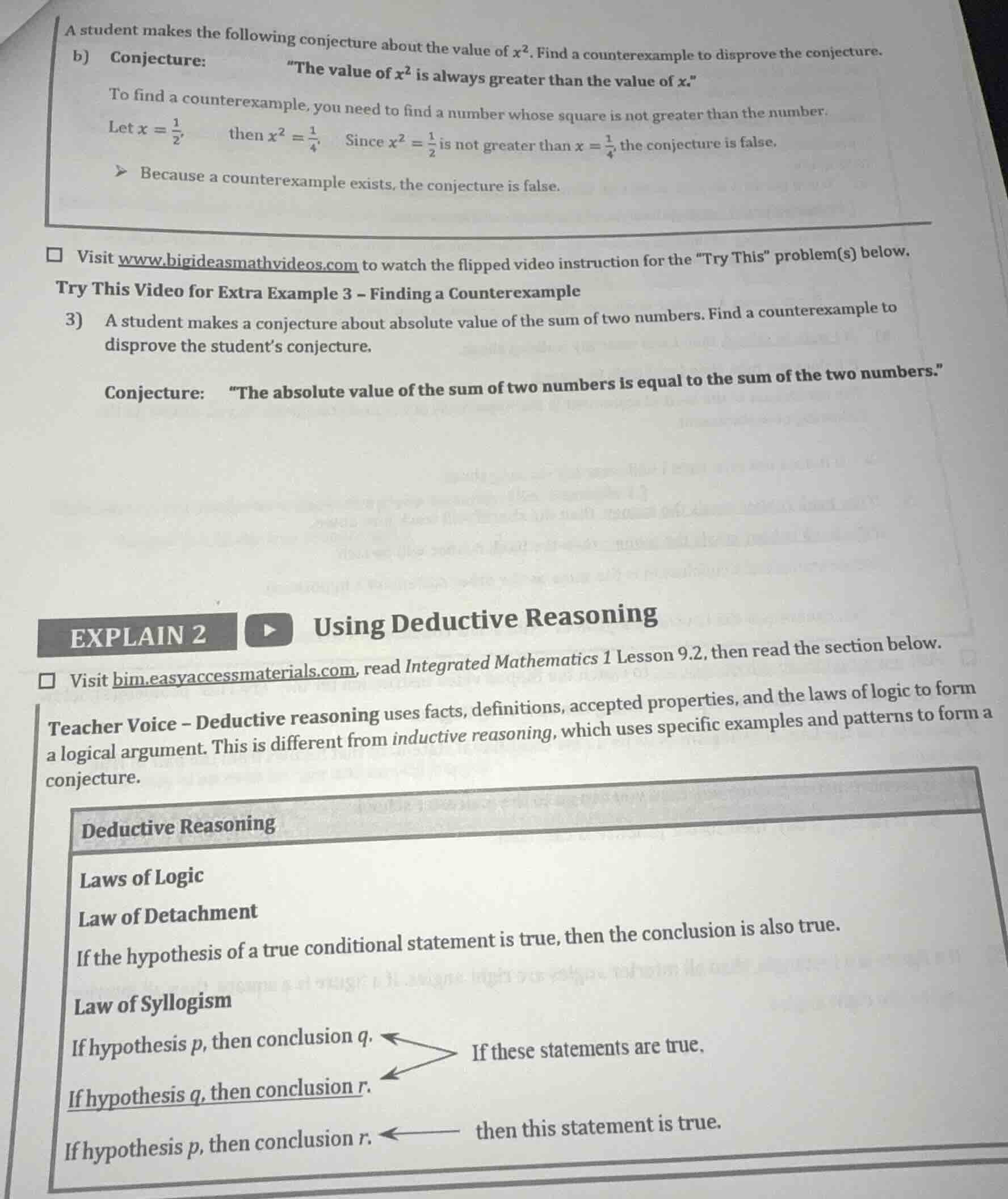
a student makes the following conjecture about the value of ( x^2 ). find a counterexample to disprove the conjecture.
b) conjecture: \the value of ( x^2 ) is always greater than the value of ( x ).\
to find a counterexample, you need to find a number whose square is not greater than the number.
let ( x = \frac{1}{2} ), then ( x^2 = \frac{1}{4} ). since ( x^2 = \frac{1}{2} ) is not greater than ( x = \frac{1}{4} ), the conjecture is false.
because a counterexample exists, the conjecture is false.
visit www.bigideasmathvideos.com to watch the flipped video instruction for the \try this\ problem(s) below.
try this video for extra example 3 - finding a counterexample
- a student makes a conjecture about absolute value of the sum of two numbers. find a counterexample to disprove the student’s conjecture.
conjecture: \the absolute value of the sum of two numbers is equal to the sum of the two numbers.\
explain 2 using deductive reasoning
visit bim.easyaccessmaterials.com, read integrated mathematics 1 lesson 9.2, then read the section below.
teacher voice - deductive reasoning uses facts, definitions, accepted properties, and the laws of logic to form a logical argument. this is different from inductive reasoning, which uses specific examples and patterns to form a conjecture.
deductive reasoning
laws of logic
law of detachment
if the hypothesis of a true conditional statement is true, then the conclusion is also true.
law of syllogism
if hypothesis ( p ), then conclusion ( q ).
if hypothesis ( q ), then conclusion ( r ).
if these statements are true.
if hypothesis ( p ), then conclusion ( r ). then this statement is true.
Step1: Pick two test numbers
Choose \(x = 3\) and \(y = -5\)
Step2: Calculate sum absolute value
Compute \(|x + y| = |3 + (-5)| = |-2| = 2\)
Step3: Calculate sum of numbers
Compute \(x + y = 3 + (-5) = -2\)
Step4: Compare the two results
\(2
eq -2\), so the conjecture fails.

Snap & solve any problem in the app
Get step-by-step solutions on Sovi AI
Photo-based solutions with guided steps
Explore more problems and detailed explanations
A counterexample is using the numbers 3 and -5: \(|3 + (-5)| = 2\), while \(3 + (-5) = -2\), and \(2
eq -2\), disproving the conjecture.