QUESTION IMAGE
Question
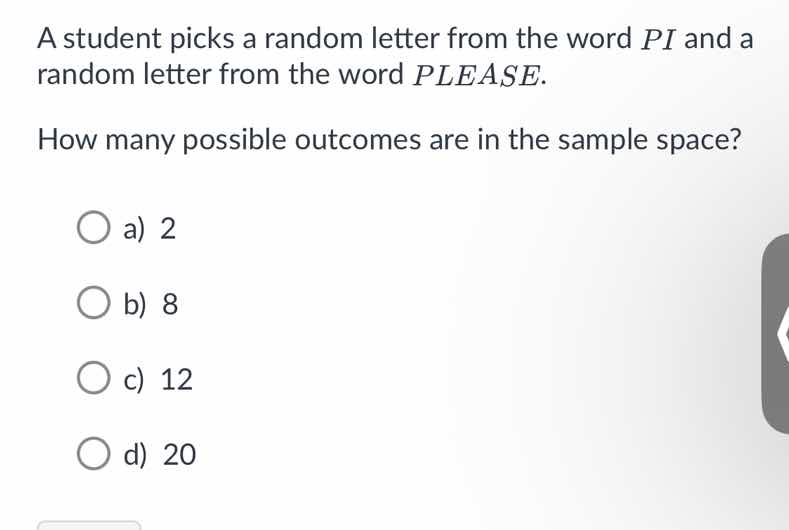
a student picks a random letter from the word $pi$ and a random letter from the word $please$. how many possible outcomes are in the sample space? \\(\circ\\) a) 2 \\(\circ\\) b) 8 \\(\circ\\) c) 12 \\(\circ\\) d) 20
Step1: Determine number of letters in each word
The word "PI" has 2 letters. The word "PLEASE" has 6 letters (P, L, E, A, S, E – note that repeated letters still count as separate when picking randomly, but here we count the number of distinct choices? Wait, no, when picking a random letter, for "PI" there are 2 possible letters (P and I), and for "PLEASE" let's check: P, L, E, A, S, E – but the number of distinct letters? Wait, no, the problem is about possible outcomes when picking one from each. Wait, actually, when picking a letter from "PI", there are 2 possible results (P or I). When picking a letter from "PLEASE", let's see the letters: P, L, E, A, S, E – but how many distinct letters? Wait, no, the word "PLEASE" has 6 letters (including the repeated E? Wait, no, the length of "PLEASE" is 6? Wait, P-L-E-A-S-E: that's 6 letters (P, L, E, A, S, E). But when picking a random letter, each position is a possible outcome? Wait, no, the problem is about the number of possible pairs. So first, number of choices from "PI": 2 (P and I). Number of choices from "PLEASE": let's see, the letters in "PLEASE" are P, L, E, A, S, E – but how many distinct letters? Wait, no, maybe we should count the number of distinct letters? Wait, no, the problem is about possible outcomes when picking one from each word. So for "PI", there are 2 letters (P, I), so 2 possible choices. For "PLEASE", let's list the letters: P, L, E, A, S, E – but the distinct letters are P, L, E, A, S (since E is repeated, but when picking a random letter, does the repeated E count as two separate outcomes? Wait, no, when you pick a letter from a word, each occurrence is a possible outcome? Wait, no, the problem is about the sample space of possible pairs (letter from PI, letter from PLEASE). So first, determine the number of possible letters in each word.
Wait, "PI" has 2 letters (P, I) – so 2 possible choices. "PLEASE" – let's check the letters: P, L, E, A, S, E. But the number of distinct letters? Wait, no, the problem is probably considering that when picking a letter from "PLEASE", how many different letters are there? Wait, P, L, E, A, S – that's 5? Wait, no, E is repeated, but when you pick a letter, if you pick E, is it considered the same outcome regardless of which E? Wait, the problem says "a random letter", so for "PLEASE", the possible letters are P, L, E, A, S, E – but the distinct letters are P, L, E, A, S (since E is repeated, but maybe the problem considers the distinct letters? Wait, no, let's check the answer options. The options are 2, 8, 12, 20. Let's think again.
Wait, maybe I made a mistake. Let's count the number of letters in each word: "PI" has 2 letters (so 2 possible choices: P or I). "PLEASE" – let's spell it: P (1), L (2), E (3), A (4), S (5), E (6). So there are 6 letters, but some are repeated. However, when forming the sample space, each outcome is a pair (letter from PI, letter from PLEASE). So we need to find the number of possible pairs.
But wait, maybe the problem is considering the number of distinct letters in each word. Wait, "PI" has 2 distinct letters (P, I). "PLEASE" – let's see: P, L, E, A, S – that's 5 distinct letters? But 2*5=10, which is not an option. Alternatively, maybe "PLEASE" has 6 letters (including the repeated E), but when picking a letter, the repeated E is considered the same? No, that doesn't make sense. Wait, maybe I miscounted the letters in "PLEASE". Wait, P-L-E-A-S-E: that's 6 letters (P, L, E, A, S, E). So the number of distinct letters is 5 (P, L, E, A, S), but the number of possible letters when picking ra…

Snap & solve any problem in the app
Get step-by-step solutions on Sovi AI
Photo-based solutions with guided steps
Explore more problems and detailed explanations
c) 12