QUESTION IMAGE
Question
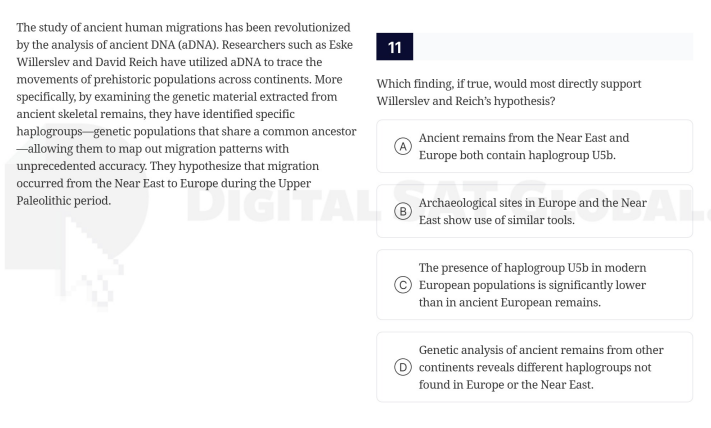
the study of ancient human migrations has been revolutionized by the analysis of ancient dna (adna). researchers such as eske willerslev and david reich have utilized adna to trace the movements of prehistoric populations across continents. more specifically, by examining the genetic material extracted from ancient skeletal remains, they have identified specific haplogroups—genetic populations that share a common ancestor—allowing them to map out migration patterns with unprecedented accuracy. they hypothesize that migration occurred from the near east to europe during the upper paleolithic period.
11 which finding, if true, would most directly support willerslev and reich’s hypothesis?
a ancient remains from the near east and europe both contain haplogroup u5b.
b archaeological sites in europe and the near east show use of similar tools.
c the presence of haplogroup u5b in modern european populations is significantly lower than in ancient european remains.
d genetic analysis of ancient remains from other continents reveals different haplogroups not found in europe or the near east.
The hypothesis is that migration from the Near East to Europe occurred in the Upper Paleolithic. Option A shows ancient remains from both regions have the same haplogroup (U5b), suggesting a genetic link consistent with migration (shared genetic material from a common ancestor, as haplogroups are genetic populations with a common ancestor). Option B (similar tools) is cultural, not direct genetic support. Option C (modern vs ancient haplogroup U5b in Europe) doesn't relate to Near East - Europe migration. Option D (different haplogroups in other continents) is irrelevant to this migration hypothesis. So A directly supports the hypothesis by showing shared genetic markers (haplogroup) between the two regions' ancient remains, implying migration - related genetic transfer.

Snap & solve any problem in the app
Get step-by-step solutions on Sovi AI
Photo-based solutions with guided steps
Explore more problems and detailed explanations
A. Ancient remains from the Near East and Europe both contain haplogroup U5b.