QUESTION IMAGE
Question
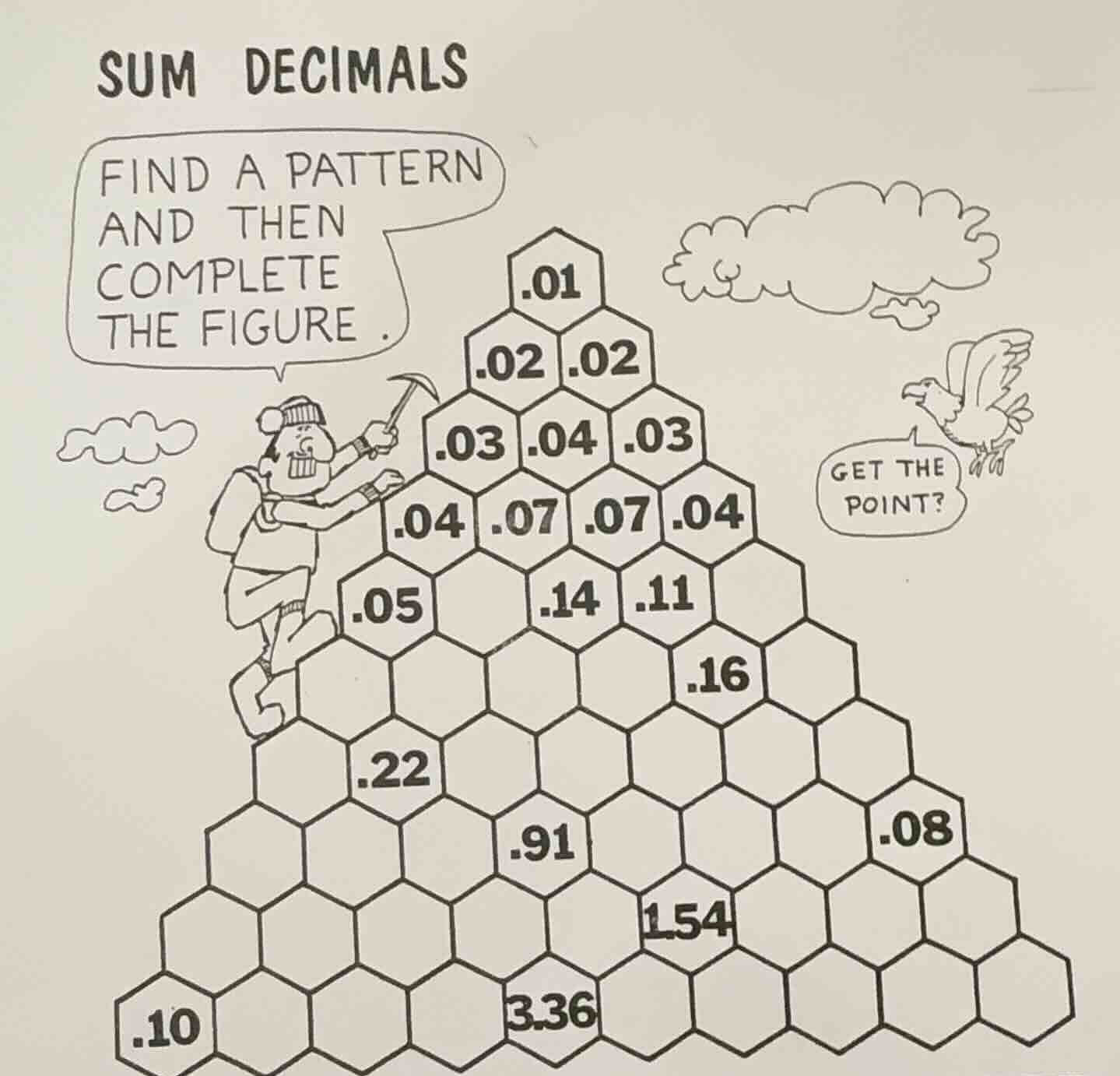
sum decimals find a pattern and then complete the figure. .01 .02 .02 .03 .04 .03 .04 .07 .07 .04 .05 .14 .11 .16 .22 .91 .08 1.54 .10 3.36 get the point?
Step1: Identify the pattern
Looking at the hexagon structure, we observe that each number (except those in the first row) is the sum of the two numbers directly above it. For example, in the third row, \(.03 = .01 + .02\) (wait, no, let's check again. Wait, the second row is \(.02, .02\); third row: \(.03, .04, .03\) – wait, \(.03 = .01 + .02\)? No, \(.01 + .02 = .03\), yes! Then \(.04 = .02 + .02\), and \(.03 = .02 + .01\) (mirror). Then fourth row: \(.04 = .01 + .03\)? Wait, no, fourth row is \(.04, .07, .07, .04\). Let's check: \(.04 = .03 + .01\)? No, \(.03 + .01 = .04\), yes. Then \(.07 = .03 + .04\), \(.07 = .04 + .03\), \(.04 = .03 + .01\). Ah, so each hexagon (except the top) is the sum of the two hexagons above it (the ones diagonally above, forming a triangle).
Let's confirm with the fifth row: \(.05, ?, .14, .11, ?\). Wait, the fourth row is \(.04, .07, .07, .04\). So the first element of the fifth row: \(.05\) – wait, no, the fourth row first is \(.04\), fifth row first is \(.05\) – maybe the leftmost column is increasing by \(.01\) each time? Wait, first row: \(.01\), second row first: \(.02\), third row first: \(.03\), fourth row first: \(.04\), fifth row first: \(.05\), so sixth row first should be \(.06\), etc. But let's focus on the missing numbers.
First, the fifth row: positions (from left) 1: \(.05\), 2: ?, 3: \(.14\), 4: \(.11\), 5: ?
Looking at the fourth row: \(.04, .07, .07, .04\). So the number in the fifth row, second position (let's call it \(x\)) should be the sum of the fourth row, first and second positions: \(.04 + .07 = .11\)? Wait, no, the fifth row third position is \(.14\), which should be the sum of fourth row second and third: \(.07 + .07 = .14\) – yes! That works. Then fifth row fourth position: \(.11\) should be the sum of fourth row third and fourth: \(.07 + .04 = .11\) – perfect! So then fifth row second position (\(x\)) is sum of fourth row first and second: \(.04 + .07 = .11\)? Wait, no, fifth row first position is \(.05\), which is sum of fourth row first and... Wait, maybe the leftmost column is \(.01, .02, .03, .04, .05, .06, ...\) (increasing by \(.01\) each row). Then the fifth row first is \(.05\), sixth row first is \(.06\), etc. But let's check the fifth row second: the numbers above it are fourth row first (\(.04\)) and fourth row second (\(.07\)), so \(.04 + .07 = .11\). Wait, but the fifth row third is \(.14\) (from \(.07 + .07\)), fourth is \(.11\) (from \(.07 + .04\)), so fifth row second should be \(.04 + .07 = .11\), and fifth row fifth should be \(.04 + .04\)? No, fourth row fourth is \(.04\), so fifth row fifth is sum of fourth row fourth and... Wait, fourth row has four elements: \(.04, .07, .07, .04\). So fifth row has five elements: first is \(.05\) (maybe leftmost column, row 5: \(.05\)), then second: \(.04 + .07 = .11\), third: \(.07 + .07 = .14\), fourth: \(.07 + .04 = .11\), fifth: \(.04 + 0\)? No, maybe the rightmost column is mirroring the left. Left column: \(.01, .02, .03, .04, .05, .06, ...\), right column: \(.01, .02, .03, .04, ?, ?, ...\). So fifth row fifth should be \(.05\) (mirror of first). Wait, but let's check the sixth row: \(.16\) is in the sixth row, fourth position? Wait, maybe we need to fill the fifth row second and fifth, sixth row, etc.
Wait, let's re-express the rows:
Row 1: [.01]
Row 2: [.02, .02]
Row 3: [.03, .04, .03]
Row 4: [.04, .07, .07, .04]
Row 5: [.05, x, .14, .11, y]
Row 6: [.06, a, b, c, d, .06] (assuming mirror)
From row 4 to row 5:
- First element: .05 (leftmost, row 5: .05)
- Second element (x): sum of row 4 first (.0…

Snap & solve any problem in the app
Get step-by-step solutions on Sovi AI
Photo-based solutions with guided steps
Explore more problems and detailed explanations
Step1: Identify the pattern
Looking at the hexagon structure, we observe that each number (except those in the first row) is the sum of the two numbers directly above it. For example, in the third row, \(.03 = .01 + .02\) (wait, no, let's check again. Wait, the second row is \(.02, .02\); third row: \(.03, .04, .03\) – wait, \(.03 = .01 + .02\)? No, \(.01 + .02 = .03\), yes! Then \(.04 = .02 + .02\), and \(.03 = .02 + .01\) (mirror). Then fourth row: \(.04 = .01 + .03\)? Wait, no, fourth row is \(.04, .07, .07, .04\). Let's check: \(.04 = .03 + .01\)? No, \(.03 + .01 = .04\), yes. Then \(.07 = .03 + .04\), \(.07 = .04 + .03\), \(.04 = .03 + .01\). Ah, so each hexagon (except the top) is the sum of the two hexagons above it (the ones diagonally above, forming a triangle).
Let's confirm with the fifth row: \(.05, ?, .14, .11, ?\). Wait, the fourth row is \(.04, .07, .07, .04\). So the first element of the fifth row: \(.05\) – wait, no, the fourth row first is \(.04\), fifth row first is \(.05\) – maybe the leftmost column is increasing by \(.01\) each time? Wait, first row: \(.01\), second row first: \(.02\), third row first: \(.03\), fourth row first: \(.04\), fifth row first: \(.05\), so sixth row first should be \(.06\), etc. But let's focus on the missing numbers.
First, the fifth row: positions (from left) 1: \(.05\), 2: ?, 3: \(.14\), 4: \(.11\), 5: ?
Looking at the fourth row: \(.04, .07, .07, .04\). So the number in the fifth row, second position (let's call it \(x\)) should be the sum of the fourth row, first and second positions: \(.04 + .07 = .11\)? Wait, no, the fifth row third position is \(.14\), which should be the sum of fourth row second and third: \(.07 + .07 = .14\) – yes! That works. Then fifth row fourth position: \(.11\) should be the sum of fourth row third and fourth: \(.07 + .04 = .11\) – perfect! So then fifth row second position (\(x\)) is sum of fourth row first and second: \(.04 + .07 = .11\)? Wait, no, fifth row first position is \(.05\), which is sum of fourth row first and... Wait, maybe the leftmost column is \(.01, .02, .03, .04, .05, .06, ...\) (increasing by \(.01\) each row). Then the fifth row first is \(.05\), sixth row first is \(.06\), etc. But let's check the fifth row second: the numbers above it are fourth row first (\(.04\)) and fourth row second (\(.07\)), so \(.04 + .07 = .11\). Wait, but the fifth row third is \(.14\) (from \(.07 + .07\)), fourth is \(.11\) (from \(.07 + .04\)), so fifth row second should be \(.04 + .07 = .11\), and fifth row fifth should be \(.04 + .04\)? No, fourth row fourth is \(.04\), so fifth row fifth is sum of fourth row fourth and... Wait, fourth row has four elements: \(.04, .07, .07, .04\). So fifth row has five elements: first is \(.05\) (maybe leftmost column, row 5: \(.05\)), then second: \(.04 + .07 = .11\), third: \(.07 + .07 = .14\), fourth: \(.07 + .04 = .11\), fifth: \(.04 + 0\)? No, maybe the rightmost column is mirroring the left. Left column: \(.01, .02, .03, .04, .05, .06, ...\), right column: \(.01, .02, .03, .04, ?, ?, ...\). So fifth row fifth should be \(.05\) (mirror of first). Wait, but let's check the sixth row: \(.16\) is in the sixth row, fourth position? Wait, maybe we need to fill the fifth row second and fifth, sixth row, etc.
Wait, let's re-express the rows:
Row 1: [.01]
Row 2: [.02, .02]
Row 3: [.03, .04, .03]
Row 4: [.04, .07, .07, .04]
Row 5: [.05, x, .14, .11, y]
Row 6: [.06, a, b, c, d, .06] (assuming mirror)
From row 4 to row 5:
- First element: .05 (leftmost, row 5: .05)
- Second element (x): sum of row 4 first (.04) and row 4 second (.07) → .04 + .07 = .11
- Third element: sum of row 4 second (.07) and row 4 third (.07) → .07 + .07 = .14 (matches)
- Fourth element: sum of row 4 third (.07) and row 4 fourth (.04) → .07 + .04 = .11 (matches)
- Fifth element (y): sum of row 4 fourth (.04) and... Wait, row 4 has four elements, so row 5 fifth should be sum of row 4 fourth (.04) and... Maybe the leftmost and rightmost elements of each row are equal (mirror), so row 5 fifth should be .05 (same as first), so y = .05? But .04 + 0? No, maybe the rightmost column is same as left: row 1: .01, row 2: .02, row 3: .03, row 4: .04, row 5: .05, row 6: .06, etc. So row 5 fifth is .05. Let's check: row 4 fourth is .04, row 5 fifth is .05 – but how? Wait, maybe the leftmost element of row n is .01 + (n-1).01 = .01n. So row 1: .011 = .01, row 2: .012 = .02, row 3: .013 = .03, row 4: .014 = .04, row 5: .015 = .05, row 6: .016 = .06, etc. That makes sense. So leftmost column: .01n, rightmost column: .01n (mirror). So row 5 fifth is .05.
Now row 5: [.05, .11, .14, .11, .05]
Let's check row 6: elements are [.06, m, n, p, q, .06]
Row 5 elements: .05, .11, .14, .11, .05
So row 6 first element: .06 (leftmost, .01*6)
Row 6 second element (m): sum of row 5 first (.05) and row 5 second (.11) → .05 + .11 = .16
Row 6 third element (n): sum of row 5 second (.11) and row 5 third (.14) → .11 + .14 = .25
Row 6 fourth element (p): sum of row 5 third (.14) and row 5 fourth (.11) → .14 + .11 = .25
Row 6 fifth element (q): sum of row 5 fourth (.11) and row 5 fifth (.05) → .11 + .05 = .16
Row 6: [.06, .16, .25, .25, .16, .06]
But the given row 6 has .16 in the fourth position? Wait, the original figure shows row 6 (the sixth row from top) has .16. Wait, maybe I miscounted the rows. Let's count the rows:
Row 1: 1 hexagon
Row 2: 2 hexagons
Row 3: 3 hexagons
Row 4: 4 hexagons
Row 5: 5 hexagons (with .05, x, .14, .11, y)
Row 6: 6 hexagons (with .06, a, b, c, d, .06) – but the given figure has a .16 in row 6 (maybe the fourth hexagon? Wait, the original figure shows:
After row 5 (.05, x, .14, .11, y), row 6 has .16. Let's check the given numbers:
In the figure, row 5 (fifth row) is: .05, [blank], .14, .11, [blank]
Row 6 (sixth row): [blank], [blank], [blank], [blank], .16, [blank]
Wait, maybe my initial row counting was wrong. Let's look at the figure:
- Top: .01 (row 1)
- Row 2: .02, .02 (2 hexagons)
- Row 3: .03, .04, .03 (3)
- Row 4: .04, .07, .07, .04 (4)
- Row 5: .05, [blank], .14, .11, [blank] (5)
- Row 6: [blank], [blank], [blank], [blank], .16, [blank] (6)
- Row 7: [blank], .22, [blank], [blank], [blank], [blank], [blank] (7)
- Row 8: [blank], [blank], [blank], [blank], [blank], [blank], [blank], .08 (8)
- Row 9: [blank], [blank], [blank], [blank], [blank], [blank], [blank], [blank], 1.54 (9)
- Row 10: [blank], [blank], [blank], [blank], [blank], 3.36, [blank], [blank], [blank], [blank] (10)
- Row 11: .10, [blank], [blank], [blank], [blank], [blank], [blank], [blank], [blank], [blank], [blank] (11)
Wait, maybe the pattern is that each number is the sum of the two numbers above it (the ones directly above, i.e., the two hexagons that are above and adjacent). So for a hexagon in row n, column k, it's equal to the sum of the hexagon in row n-1, column k-1 and row n-1, column k (with columns starting at 1).
Let's index rows from top (row 1) and columns from left (column 1).
Row 1, column 1: .01
Row 2, column 1: .02; row 2, column 2: .02
Row 3, column 1: .03; row 3, column 2: .04; row 3, column 3: .03
Check: row 3, column 1 = row 2, column 1 + row 1, column 1? No, .02 + .01 = .03 – yes! row 3, column 2 = row 2, column 1 + row 2, column 2 = .02 + .02 = .04 – yes! row 3, column 3 = row 2, column 2 + row 1, column 1? No, .02 + .01 = .03 – yes (mirror of column 1).
Row 4, column 1: .04; row 4, column 2: .07; row 4, column 3: .07; row 4, column 4: .04
Check: row 4, column 1 = row 3, column 1 + row 2, column 1? No, .03 + .02 = .05 – no, but .03 + .01 = .04? No, row 4, column 1: .04. Wait, row 3, column 1 is .03, row 2, column 1 is .02, row 1, column 1 is .01. Wait, row 4, column 1: .04 = row 3, column 1 + row 2, column 1? .03 + .02 = .05 – no. Wait, row 4, column 2: .07 = row 3, column 1 + row 3, column 2 = .03 + .04 = .07 – yes! row 4, column 3: .07 = row 3, column 2 + row 3, column 3 = .04 + .03 = .07 – yes! row 4, column 4: .04 = row 3, column 3 + row 2, column 2? .03 + .02 = .05 – no, but .03 + .01 = .04? No, row 4, column 4: .04 = row 3, column 3 + row 2, column 2? No, .03 + .02 = .05. Wait, row 4, column 1: .04 = row 3, column 1 + row 2, column 1? .03 + .02 = .05 – no. Wait, maybe row n, column 1 is .01 n. So row 1: .011 = .01, row 2: .012 = .02, row 3: .013 = .03, row 4: .014 = .04, row 5: .015 = .05, row 6: .016 = .06, etc. That works. Then row 4, column 1: .04 (40.01), row 4, column 4: .04 (mirror of column 1). Then row 4, column 2: sum of row 3, column 1 and row 3, column 2: .03 + .04 = .07 – yes. row 4, column 3: sum of row 3, column 2 and row 3, column 3: .04 + .03 = .07 – yes. Perfect! So the pattern is:
- Leftmost and rightmost elements of row n: \( 0.01 \times n \) (mirror each other)
- Middle elements (columns 2 to n-1) of row n: sum of the element above-left (row n-1, column k-1) and above-right (row n-1, column k)
Let's verify with row 4:
- row 4, column 1: \( 0.01 \times 4 = 0.04 \)
- row 4, column 2: row 3, column 1 + row 3, column 2 = .03 + .04 = .07
- row 4, column 3: row 3, column 2 + row 3, column 3 = .04 + .03 = .07
- row 4, column 4: \( 0.01 \times 4 = 0.04 \) (mirror)
Row 5:
- row 5, column 1: \( 0.01 \times 5 = 0.05 \)
- row 5, column 2: row 4, column 1 + row 4, column 2 = .04 + .07 = .11
- row 5, column 3: row 4, column 2 + row 4, column 3 = .07 + .07 = .14 (matches the given .14)
- row 5, column 4: row 4, column 3 + row 4, column