QUESTION IMAGE
Question
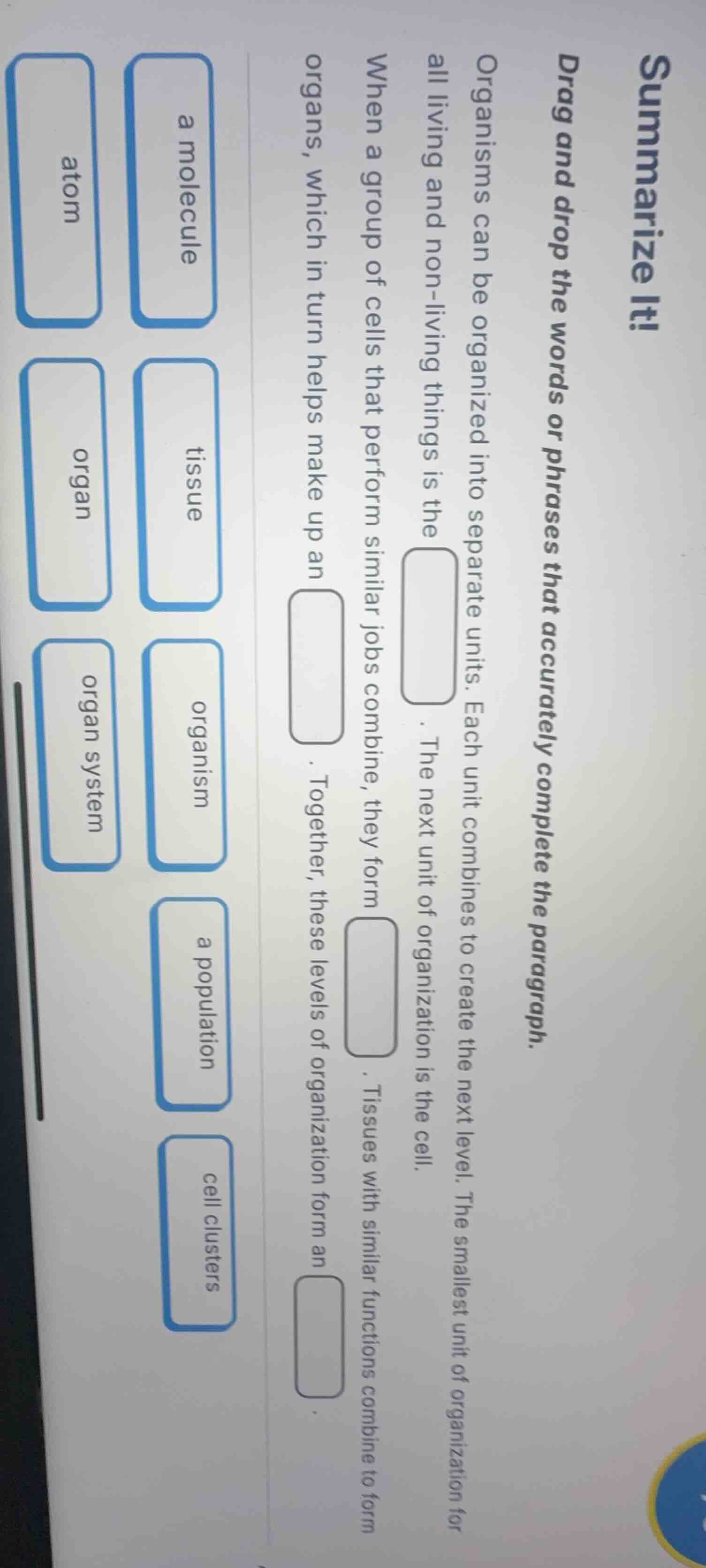
summarize it!drag and drop the words or phrases that accurately complete the paragraph.organisms can be organized into separate units. each unit combines to create the next level. the smallest unit of organization for all living and non-living things is the □. the next unit of organization is the cell.when a group of cells that perform similar jobs combine, they form □. tissues with similar functions combine to form organs, which in turn helps make up an □. together, these levels of organization form an □.a moleculeatomtissueorganorganismorgan systema populationcell clusters
- The smallest unit of organization for all living and non-living things is an atom, as atoms are the basic building blocks of matter.
- A group of cells with similar jobs forms a tissue, which is the defined level of biological organization above cells.
- Tissues with similar functions combine to make organs, which then form an organ system when working together.
- All these levels of organization together make up a complete, independent living thing called an organism.

Snap & solve any problem in the app
Get step-by-step solutions on Sovi AI
Photo-based solutions with guided steps
Explore more problems and detailed explanations
Organisms can be organized into separate units. Each unit combines to create the next level. The smallest unit of organization for all living and non-living things is the atom. The next unit of organization is the cell.
When a group of cells that perform similar jobs combine, they form tissue. Tissues with similar functions combine to form organs, which in turn helps make up an organ system. Together, these levels of organization form an organism.