QUESTION IMAGE
Question
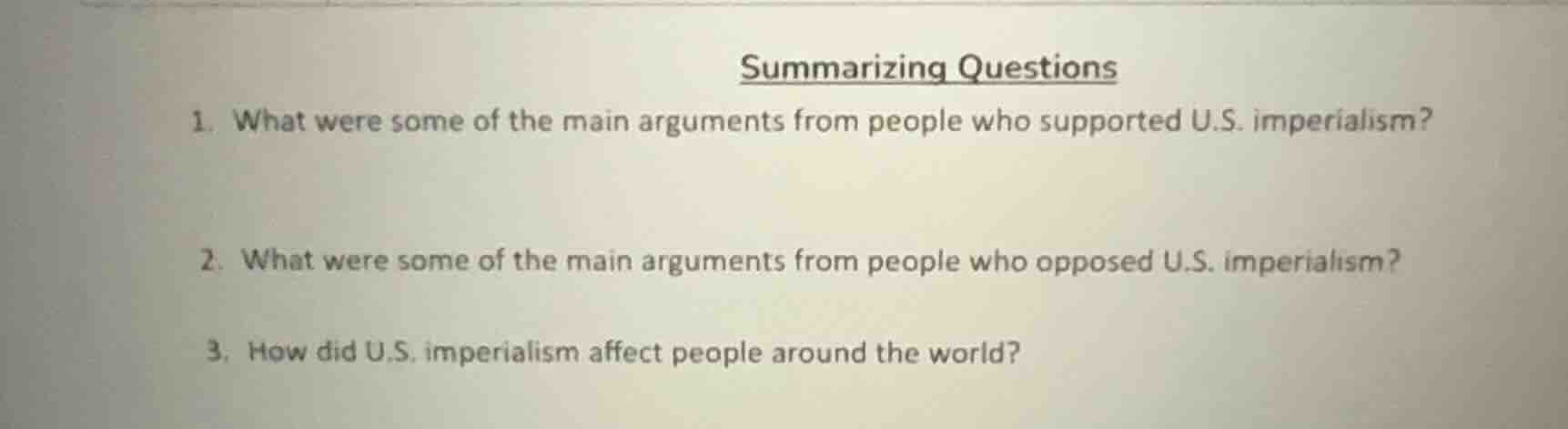
summarizing questions
- what were some of the main arguments from people who supported u.s. imperialism?
- what were some of the main arguments from people who opposed u.s. imperialism?
- how did u.s. imperialism affect people around the world?
1.
Supporters of U.S. imperialism had several arguments. One was the idea of "Manifest Destiny," believing the U.S. was destined to expand and spread its culture, values (like democracy and capitalism) globally. Economic motives were also key—access to new markets for goods, sources of raw materials (e.g., in territories like the Philippines, Hawaii) to fuel industrial growth. There was a sense of national pride and competition with European imperial powers; having colonies would boost U.S. status as a global power. Also, a belief in "civilizing missions"—that the U.S. could uplift "lesser" or "uncivilized" peoples through its institutions, education, and technology. Strategic military interests were another, such as establishing naval bases (like in Hawaii) to project power and protect trade routes.
Opponents of U.S. imperialism argued on moral, legal, and practical grounds. Morally, they saw imperialism as contradictory to U.S. ideals of liberty and self - determination (since colonies were not given the right to self - govern, going against the Declaration of Independence’s principles). Legally, they argued that annexing territories without granting them statehood or equal rights violated constitutional principles (e.g., the idea of “consent of the governed”). Practically, they worried about the costs of governing and defending distant colonies, potential conflicts with native populations (e.g., in the Philippines, the Filipino independence movement), and the risk of entangling the U.S. in foreign disputes. Some also saw it as a form of exploitation, where the U.S. would benefit at the expense of colonized peoples.
U.S. imperialism had diverse impacts on people worldwide. In colonized territories (e.g., Philippines, Puerto Rico, Hawaii), it brought both positive and negative changes. Positively, there were improvements in infrastructure (roads, schools, hospitals), introduction of modern education systems, and some economic development (e.g., new agricultural or trade opportunities). However, negatively, native cultures were suppressed (e.g., Hawaiian culture faced erosion, Filipino traditions were sidelined), economies were often restructured to serve U.S. interests (e.g., cash - crop plantations replacing subsistence farming, leading to food insecurity), and political self - determination was denied (e.g., Philippines fought for independence after annexation). In Latin America (through interventions like the Roosevelt Corollary), U.S. imperialism led to political instability as the U.S. supported authoritarian regimes that served its economic interests, while local populations faced exploitation and limited sovereignty. Globally, it increased U.S. global influence, shifting the balance of power and setting a precedent for imperialist competition, but also sparked anti - imperialist movements worldwide (inspired by U.S. own anti - imperialist voices and colonized peoples’ struggles).

Snap & solve any problem in the app
Get step-by-step solutions on Sovi AI
Photo-based solutions with guided steps
Explore more problems and detailed explanations
- Manifest Destiny: Belief U.S. was destined to expand and spread its culture/values globally.
- Economic Motives: Access to new markets for goods and raw materials (e.g., in Philippines, Hawaii) to fuel industrial growth.
- National Pride/Global Power: Compete with European imperial powers; colonies boosted U.S. status as a global power.
- Civilizing Mission: Belief U.S. could “uplift” “lesser” peoples through its institutions, education, and technology.
- Strategic Military Interests: Establish naval bases (e.g., Hawaii) to project power and protect trade routes.