QUESTION IMAGE
Question
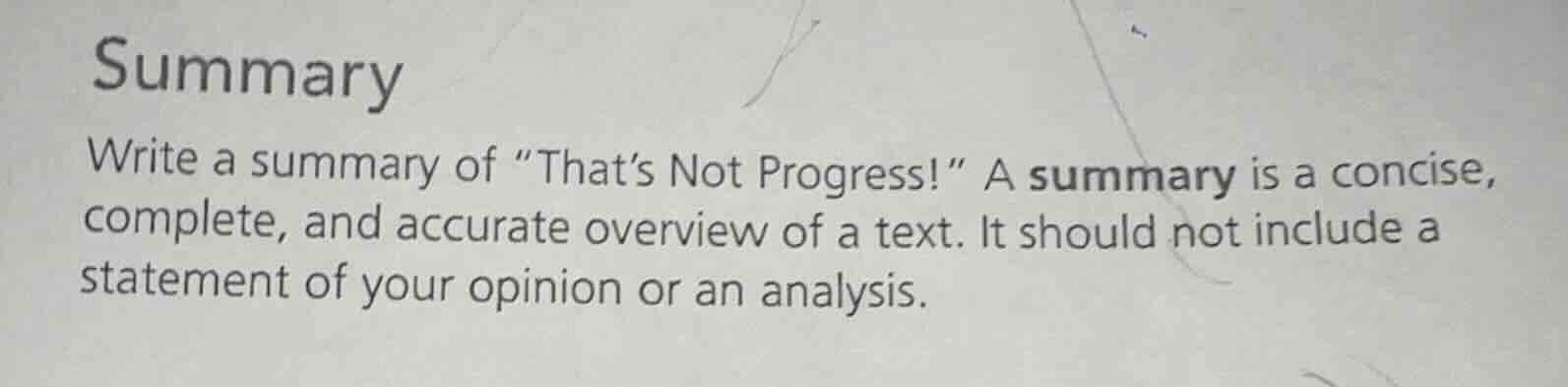
summary
write a summary of \that’s not progress!\ a summary is a concise, complete, and accurate overview of a text. it should not include a statement of your opinion or an analysis.
To write the summary of “That's Not Progress!”, we would need the actual content of the text “That's Not Progress!”. Since the text of “That's Not Progress!” is not provided here, we can't create the summary directly. However, if we had the text, we would:
- Read through the entire text carefully to understand its main ideas, key arguments, and important details.
- Identify the main topic or theme of the text.
- Extract the central ideas, including any main arguments, supporting evidence, and conclusions.
- Paraphrase these main ideas in a concise way, ensuring that we cover all the essential points without including personal opinions or analysis.
- Check the summary to make sure it is complete (covers all major parts of the original text), accurate (reflects the original meaning), and concise (is not overly long or detailed).
For example, if the text “That's Not Progress!” was about critics arguing that a new technology, despite being hailed as progress, actually has negative impacts on society like job loss and privacy invasion, the summary might be: “‘That's Not Progress!’ presents the view that a newly - lauded technology, though considered progress by some, is criticized for having negative societal impacts such as causing job losses and invading people's privacy.” But again, this is just a hypothetical example and the actual summary depends on the real content of “That's Not Progress!”.

Snap & solve any problem in the app
Get step-by-step solutions on Sovi AI
Photo-based solutions with guided steps
Explore more problems and detailed explanations
To write the summary of “That's Not Progress!”, we would need the actual content of the text “That's Not Progress!”. Since the text of “That's Not Progress!” is not provided here, we can't create the summary directly. However, if we had the text, we would:
- Read through the entire text carefully to understand its main ideas, key arguments, and important details.
- Identify the main topic or theme of the text.
- Extract the central ideas, including any main arguments, supporting evidence, and conclusions.
- Paraphrase these main ideas in a concise way, ensuring that we cover all the essential points without including personal opinions or analysis.
- Check the summary to make sure it is complete (covers all major parts of the original text), accurate (reflects the original meaning), and concise (is not overly long or detailed).
For example, if the text “That's Not Progress!” was about critics arguing that a new technology, despite being hailed as progress, actually has negative impacts on society like job loss and privacy invasion, the summary might be: “‘That's Not Progress!’ presents the view that a newly - lauded technology, though considered progress by some, is criticized for having negative societal impacts such as causing job losses and invading people's privacy.” But again, this is just a hypothetical example and the actual summary depends on the real content of “That's Not Progress!”.