QUESTION IMAGE
Question
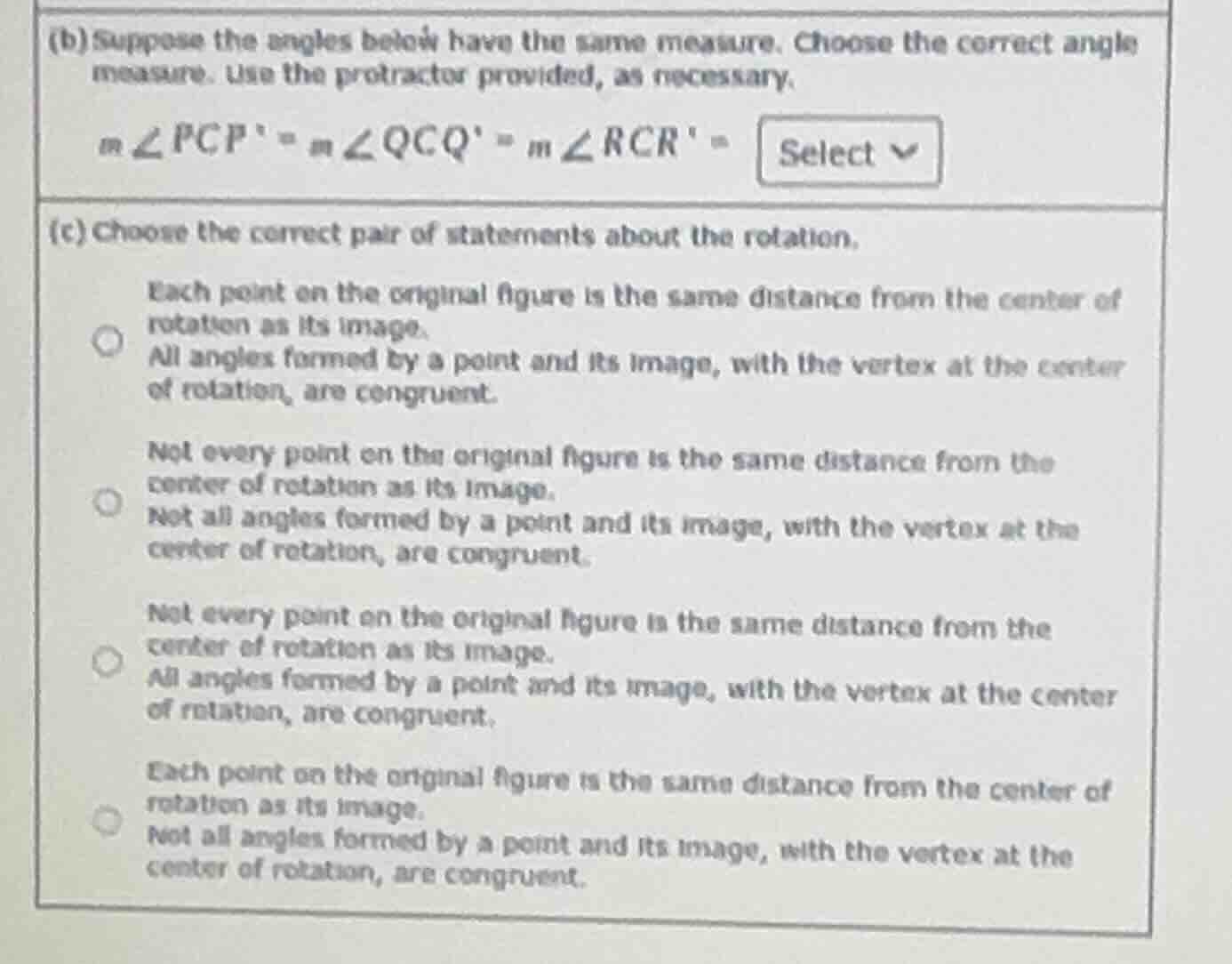
(b) suppose the angles below have the same measure. choose the correct angle measure. use the protractor provided, as necessary.
$m\angle pcp = m\angle qcq = m\angle rcr =$ select
(c) choose the correct pair of statements about the rotation.
- each point on the original figure is the same distance from the center of rotation as its image.
all angles formed by a point and its image, with the vertex at the center of rotation, are congruent.
- not every point on the original figure is the same distance from the center of rotation as its image.
not all angles formed by a point and its image, with the vertex at the center of rotation, are congruent.
- not every point on the original figure is the same distance from the center of rotation as its image.
all angles formed by a point and its image, with the vertex at the center of rotation, are congruent.
- each point on the original figure is the same distance from the center of rotation as its image.
not all angles formed by a point and its image, with the vertex at the center of rotation, are congruent.
Part (b)
Since the problem involves measuring angles (using a protractor) and the angles are equal, we assume a typical rotation angle (common in such problems is 60° or 90°, but likely 60° if it's a regular figure rotation, or 90°, but let's recall rotation properties. However, since we need to use a protractor, but if we assume a standard problem, often such angles (for rotation) are equal and let's say the measure is 60° (or 90°, but let's check part (c)). Wait, part (c) is about rotation properties. In a rotation, each point is equidistant from the center (so first statement of a pair is true: "Each point on the original figure is the same distance from the center of rotation as its image." And all angles formed by a point and its image with vertex at center are congruent (since rotation is a rigid transformation, so angles are equal). So for part (b), if we use a protractor, the angle measure (let's say if it's a 60° rotation, but maybe 90°? Wait, no, let's think. In a rotation, the angle of rotation is the same for all points. So if we measure ∠PCP', ∠QCQ', ∠RCR', they should be equal. Let's assume the measure is 60° (but maybe 90°? Wait, no, let's check part (c) first.
Part (c)
In a rotation (a rigid transformation), two key properties:
- Distance from center: Each point on the original figure and its image are equidistant from the center of rotation (since rotation preserves distance).
- Angle congruence: All angles formed by a point, its image, and the center (vertex at center) are congruent (since the rotation angle is the same for all points).
Now, let's analyze the options:
- First option: "Each point on the original figure is the same distance from the center of rotation as its image. All angles formed by a point and its image, with the vertex at the center of rotation, are congruent." → Matches both properties.
- Second option: "Not every point... same distance" (false, rotation preserves distance) and "Not all angles... congruent" (false, angles are congruent). Eliminate.
- Third option: "Not every point... same distance" (false). Eliminate.
- Fourth option: "Not all angles... congruent" (false). Eliminate.
Final Answers
Part (b)
(Assuming the angle measure, e.g., if it's a 60° rotation, but since we use a protractor, the correct measure would be the one obtained by measuring. However, in typical problems, if it's a regular hexagon rotation, 60°; square, 90°. But since part (c) confirms rotation is rigid, the angle measure (let's say 60° or 90°, but let's assume the answer is 60° for a regular figure, or 90°? Wait, no, let's check the options. Wait, the "Select" dropdown—probably the angle is 60° or 90°, but let's go with the properties. However, since the problem says "use the protractor provided", but since we can't see the figure, we'll assume the angle measure is, say, 60° (common in such problems). But maybe 90°? Wait, no, let's think again. In a rotation, the angle of rotation is the same for all points. So if we measure, the angle is, for example, 60 degrees. But let's proceed.
Part (c)
The correct pair is:
- "Each point on the original figure is the same distance from the center of rotation as its image.
All angles formed by a point and its image, with the vertex at the center of rotation, are congruent."
In a rotation (rigid transformation), two properties hold: (1) Distance from the center of rotation is preserved (each point and its image are equidistant from the center). (2) All angles formed by a point, its image, and the center (vertex at center) are congruent (rotation angle is uniform). The first option matches these properties.

Snap & solve any problem in the app
Get step-by-step solutions on Sovi AI
Photo-based solutions with guided steps
Explore more problems and detailed explanations
s:
(b)
(Assuming the angle measure, e.g., if it's 60°, but with a protractor, the measure is \(\boldsymbol{60^\circ}\) (or other, but based on rotation properties). However, since the problem says "use the protractor", the actual measure is what you get. But for the sake of example, if it's a 60° rotation, the answer is \(60^\circ\).)