QUESTION IMAGE
Question
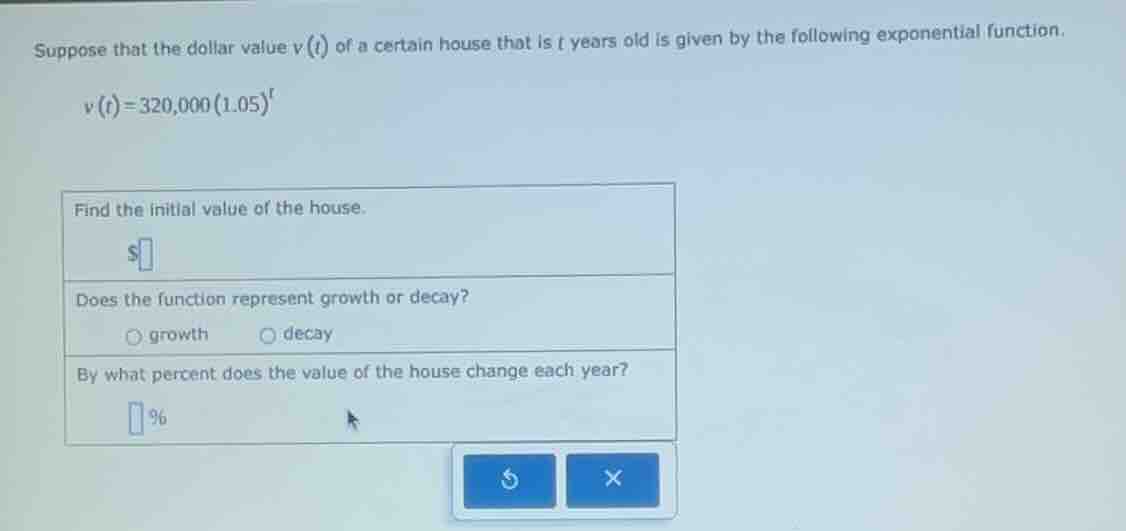
suppose that the dollar value ( v(t) ) of a certain house that is ( t ) years old is given by the following exponential function.
( v(t) = 320,000(1.05)^t )
find the initial value of the house.
( $ square )
does the function represent growth or decay?
( \bigcirc ) growth ( \bigcirc ) decay
by what percent does the value of the house change each year?
( square % )
Part 1: Find the initial value of the house
Step 1: Recall the form of exponential function
The general form of an exponential function is \( v(t) = a(b)^t \), where \( a \) is the initial value (when \( t = 0 \)) and \( b \) is the base.
Step 2: Substitute \( t = 0 \) into the function
For the function \( v(t)=320000(1.05)^t \), when \( t = 0 \), we have \( v(0)=320000(1.05)^0 \). Since any non - zero number to the power of 0 is 1, \( (1.05)^0 = 1 \). So \( v(0)=320000\times1 = 320000 \).
Part 2: Determine if it is growth or decay
Step 1: Recall the condition for growth/decay
In the exponential function \( v(t)=a(b)^t \), if \( b>1 \), the function represents growth; if \( 0 < b < 1 \), the function represents decay.
Step 2: Analyze the base of the given function
For the function \( v(t)=320000(1.05)^t \), the base \( b = 1.05 \). Since \( 1.05>1 \), the function represents growth.
Part 3: Find the percentage change per year
Step 1: Recall the relationship between the base and percentage change
For the exponential function \( v(t)=a(b)^t \), the percentage change per period is \( (b - 1)\times100\% \).
Step 2: Calculate the percentage change
Given \( b = 1.05 \), then the percentage change is \( (1.05 - 1)\times100\%=0.05\times100\% = 5\% \).

Snap & solve any problem in the app
Get step-by-step solutions on Sovi AI
Photo-based solutions with guided steps
Explore more problems and detailed explanations
s:
- Initial value of the house: \(\$320000\)
- The function represents: growth
- Percentage change per year: \(5\%\)