QUESTION IMAGE
Question
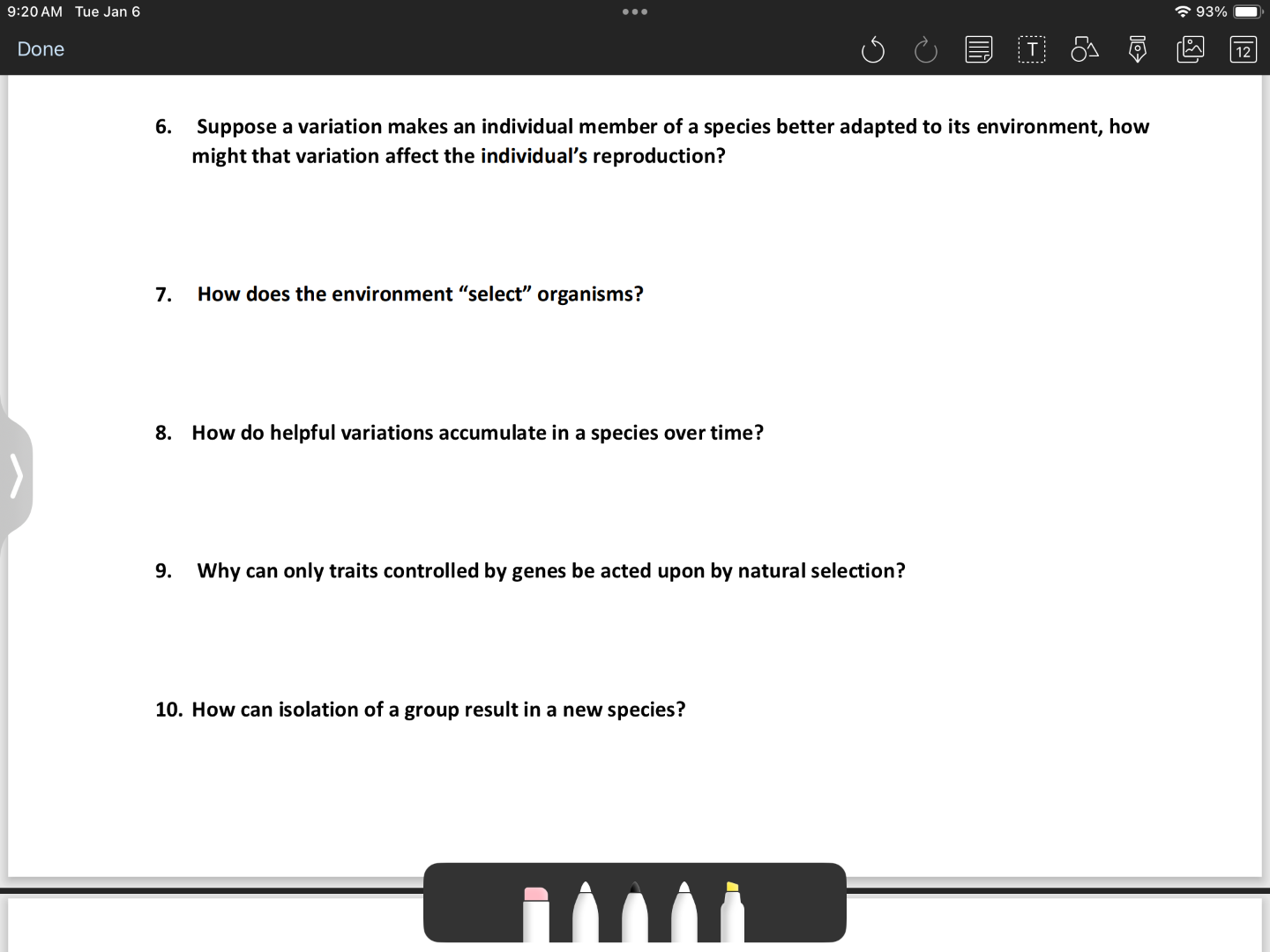
- suppose a variation makes an individual member of a species better adapted to its environment, how might that variation affect the individual’s reproduction?
- how does the environment “select” organisms?
- how do helpful variations accumulate in a species over time?
- why can only traits controlled by genes be acted upon by natural selection?
- how can isolation of a group result in a new species?
Brief Explanations
- Adaptations improve survival chances, allowing more opportunities to reproduce.
- Environmental pressures (e.g., food scarcity) filter individuals by trait suitability (natural selection).
- Inherited helpful traits become more common as adapted individuals reproduce more successfully.
- Non-genetic traits (acquired) cannot be passed down, so selection cannot affect future generations.
- Isolation leads to independent evolution; groups diverge until they cannot interbreed (new species).

Snap & solve any problem in the app
Get step-by-step solutions on Sovi AI
Photo-based solutions with guided steps
Explore more problems and detailed explanations
- The better-adapted individual is more likely to survive and reproduce, passing the variation to offspring.
- The environment favors individuals with traits that enhance survival/reproduction, increasing their fitness.
- Helpful variations are inherited by offspring; over generations, their frequency rises in the population.
- Only genetic traits are heritable, so they can be passed to offspring for selection to act on.
- Isolation prevents gene flow; separate groups accumulate unique adaptations, becoming reproductively isolated.