QUESTION IMAGE
Question
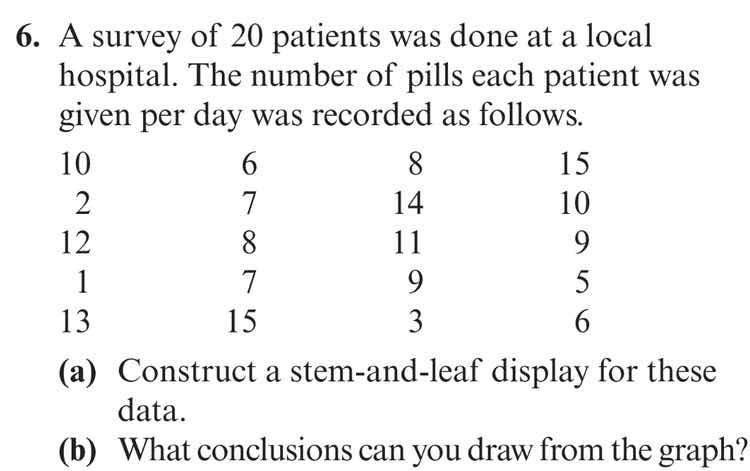
- a survey of 20 patients was done at a local hospital. the number of pills each patient was given per day was recorded as follows.
10 6 8 15
2 7 14 10
12 8 11 9
1 7 9 5
13 15 3 6
(a) construct a stem-and-leaf display for these data.
(b) what conclusions can you draw from the graph?
Response
Part (a)
Step1: Identify stems (tens place)
Stems are the tens digit of each number. Possible stems: 0, 1 (since numbers range from 1 to 15).
Step2: List leaves (units place) for each stem
- Stem 0 (numbers 1,2,3,5,6,6,7,7,8,8,9,9): Leaves: 1,2,3,5,6,6,7,7,8,8,9,9
- Stem 1 (numbers 10,10,11,12,13,14,15,15): Leaves: 0,0,1,2,3,4,5,5
Step3: Construct stem - and - leaf display
| Stem | Leaf |
|---|---|
| 1 | 0, 0, 1, 2, 3, 4, 5, 5 |
Part (b)
Brief Explanations
- Distribution Shape: The data seems to be somewhat symmetric around the middle values. For stem 0, the leaves are spread from 1 - 9 and for stem 1, from 0 - 5. There is no extreme skewness (no long tail on one side).
- Frequency of Values: Values in the lower range (0 - 9 pills) are more frequent (12 values) compared to the higher range (10 - 15 pills, 8 values). The values 6,7,8,9,0 (for stem 1) and 5,6 (for stem 0) have relatively higher frequencies (appearing twice or more).
- Range: The range of the number of pills per day is from 1 to 15 (since the minimum value is 1 and maximum is 15).

Snap & solve any problem in the app
Get step-by-step solutions on Sovi AI
Photo-based solutions with guided steps
Explore more problems and detailed explanations
s:
(a)
| Stem | Leaf |
|---|---|
| 1 | 0, 0, 1, 2, 3, 4, 5, 5 |
(b) The data has a relatively symmetric distribution (no extreme skewness), most values are in the 0 - 9 (tens place 0) range, with a range of 1 to 15 pills per day. Frequent values include 6,7,8,9,0 (for stem 1), 5,6 (for stem 0).