QUESTION IMAGE
Question
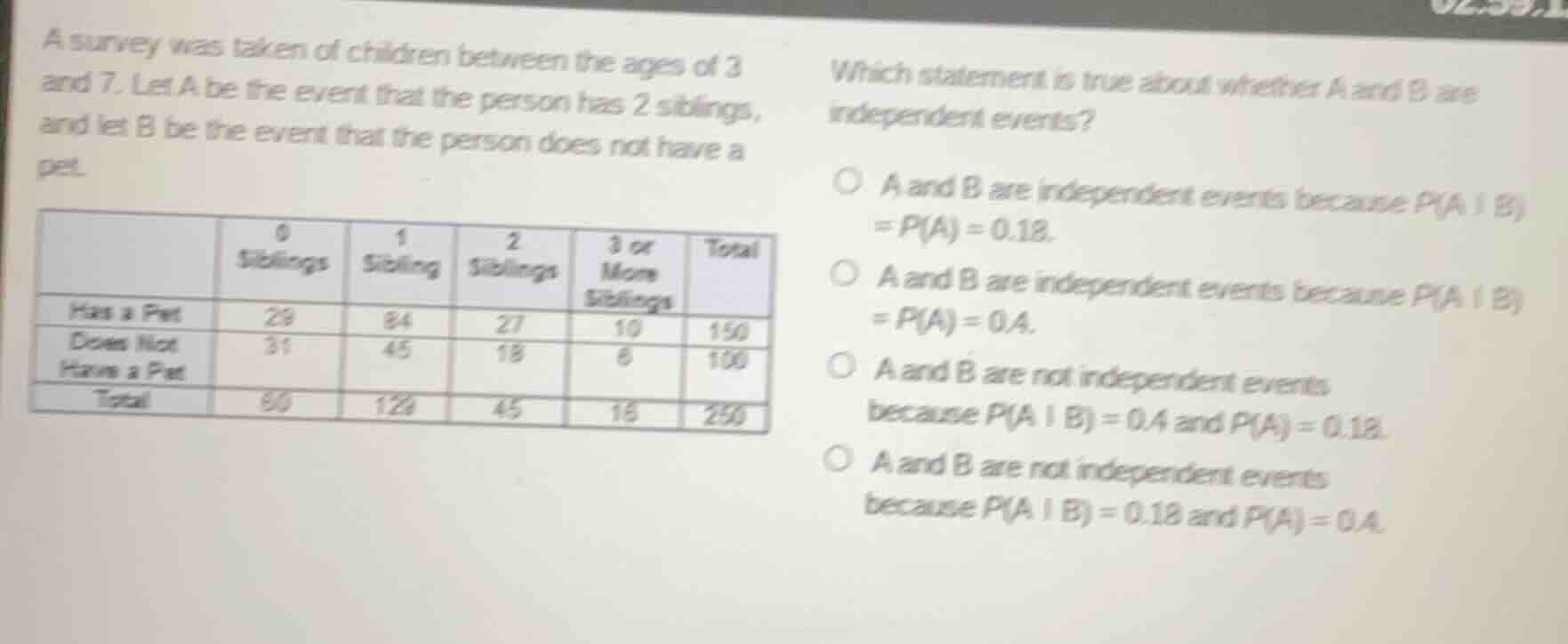
a survey was taken of children between the ages of 3 and 7. let a be the event that the person has 2 siblings, and let b be the event that the person does not have a pet.
| 0 siblings | 1 sibling | 2 siblings | 3 or more siblings | total | |
|---|---|---|---|---|---|
| does not have a pet | 31 | 45 | 18 | 6 | 100 |
| total | 60 | 129 | 45 | 16 | 250 |
which statement is true about whether a and b are independent events?
- a and b are independent events because ( p(a mid b) = p(a) = 0.18 ).
- a and b are independent events because ( p(a mid b) = p(a) = 0.4 ).
- a and b are not independent events because ( p(a mid b) = 0.4 ) and ( p(a) = 0.18 ).
- a and b are not independent events because ( p(a mid b) = 0.18 ) and ( p(a) = 0.4 ).
Step1: Calculate P(A)
$P(A) = \frac{\text{Total with 2 siblings}}{\text{Total surveyed}} = \frac{45}{250} = 0.18$
Step2: Calculate P(A|B)
$P(A|B) = \frac{\text{2 siblings and no pet}}{\text{Total no pet}} = \frac{18}{100} = 0.18$
Step3: Compare P(A|B) and P(A)
Two events are independent if $P(A|B) = P(A)$. Here, both equal 0.18.

Snap & solve any problem in the app
Get step-by-step solutions on Sovi AI
Photo-based solutions with guided steps
Explore more problems and detailed explanations
A. A and B are independent events because P(A | B) = P(A) = 0.18.