QUESTION IMAGE
Question
svlc algebra 1a - standard (15260)
introduction to compound inequalities
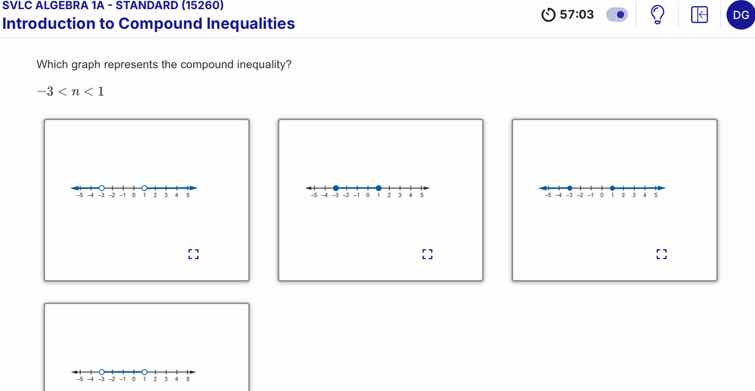
which graph represents the compound inequality?
-3 < n < 1
Step1: Analyze the inequality
The compound inequality is \(-3 < n < 1\). This means \(n\) is greater than \(-3\) and less than \(1\). So, on a number line, we should have open circles at \(-3\) and \(1\) (because the inequality is strict, not including the endpoints) and a line segment connecting the two open circles, representing all the numbers between \(-3\) and \(1\).
Step2: Evaluate each graph
- The first graph: Check the circles and the line. If it has open circles at \(-3\) and \(1\) and a line between them, that would match. Wait, let's visualize. Wait, the first graph (top left) – let's see the number line. The open circles: one at \(-3\) (since the arrow? Wait no, wait the inequality is \(-3 < n < 1\), so the solution is between \(-3\) and \(1\). So the graph should have open circles at \(-3\) and \(1\), and the line between them. Let's check the options. Wait, the fourth graph (bottom) – wait, maybe I misread. Wait, the inequality is \(-3 < n < 1\), so \(n\) is between \(-3\) and \(1\), not including the endpoints. So the correct graph should have open circles at \(-3\) and \(1\), and a line segment connecting them (shading between \(-3\) and \(1\)). Let's check the graphs:
Looking at the options, the graph with open circles at \(-3\) and \(1\), and the line between them (so the region between \(-3\) and \(1\) is shaded or the line is between the two open circles) is the correct one. Let's assume the fourth graph (bottom) or maybe the first? Wait, maybe the first graph (top left) has open circles at \(-3\) and \(1\), but the arrows? No, wait the inequality is between \(-3\) and \(1\), so it's a segment, not arrows. Wait, maybe the bottom graph? Wait, the user's image: let's parse. The inequality is \(-3 < n < 1\), so the solution set is all real numbers \(n\) such that \(n\) is greater than \(-3\) and less than \(1\). So on the number line, we place an open circle at \(-3\) (since \(n > -3\), not equal) and an open circle at \(1\) (since \(n < 1\), not equal), and draw a line segment connecting the two open circles (indicating all numbers between \(-3\) and \(1\) are solutions).
So the correct graph is the one with open circles at \(-3\) and \(1\), and a line between them (not extending to the left of \(-3\) or right of \(1\), except the line is between the two open circles). Let's say the fourth graph (bottom) or maybe the first? Wait, maybe the first graph (top left) has open circles at \(-3\) and \(1\), but the arrows are going left and right? No, that would be for \(n < -3\) or \(n > 1\), which is the opposite. Wait, no. Wait, the inequality \(-3 < n < 1\) is a conjunction, meaning \(n\) is greater than \(-3\) AND less than \(1\), so the solution is the intersection, which is between \(-3\) and \(1\). So the graph should have open circles at \(-3\) and \(1\), and the line between them (so the region between \(-3\) and \(1\) is the solution). So the correct graph is the one with open circles at \(-3\) and \(1\), and the line segment between them (not the arrows going out, but the segment between the two open circles).
Assuming the bottom graph (the fourth one) or maybe the first? Wait, maybe the first graph (top left) has open circles at \(-3\) and \(1\), but the arrows are in the middle? Wait, no, let's think again. The inequality is \(-3 < n < 1\), so \(n\) is between \(-3\) and \(1\), so the graph should show that. So the correct graph is the one with open circles at \(-3\) and \(1\), and a line connecting them (so the part between \(-3\) and \(1\) is the solution). So among the given graphs, the one with o…

Snap & solve any problem in the app
Get step-by-step solutions on Sovi AI
Photo-based solutions with guided steps
Explore more problems and detailed explanations
The graph with open circles at \(-3\) and \(1\), and a line segment connecting them (representing all \(n\) such that \(-3 < n < 1\)). (Assuming the specific graph with open circles at \(-3\) and \(1\) and the region between them is shaded or the line is between the two open circles.)