QUESTION IMAGE
Question
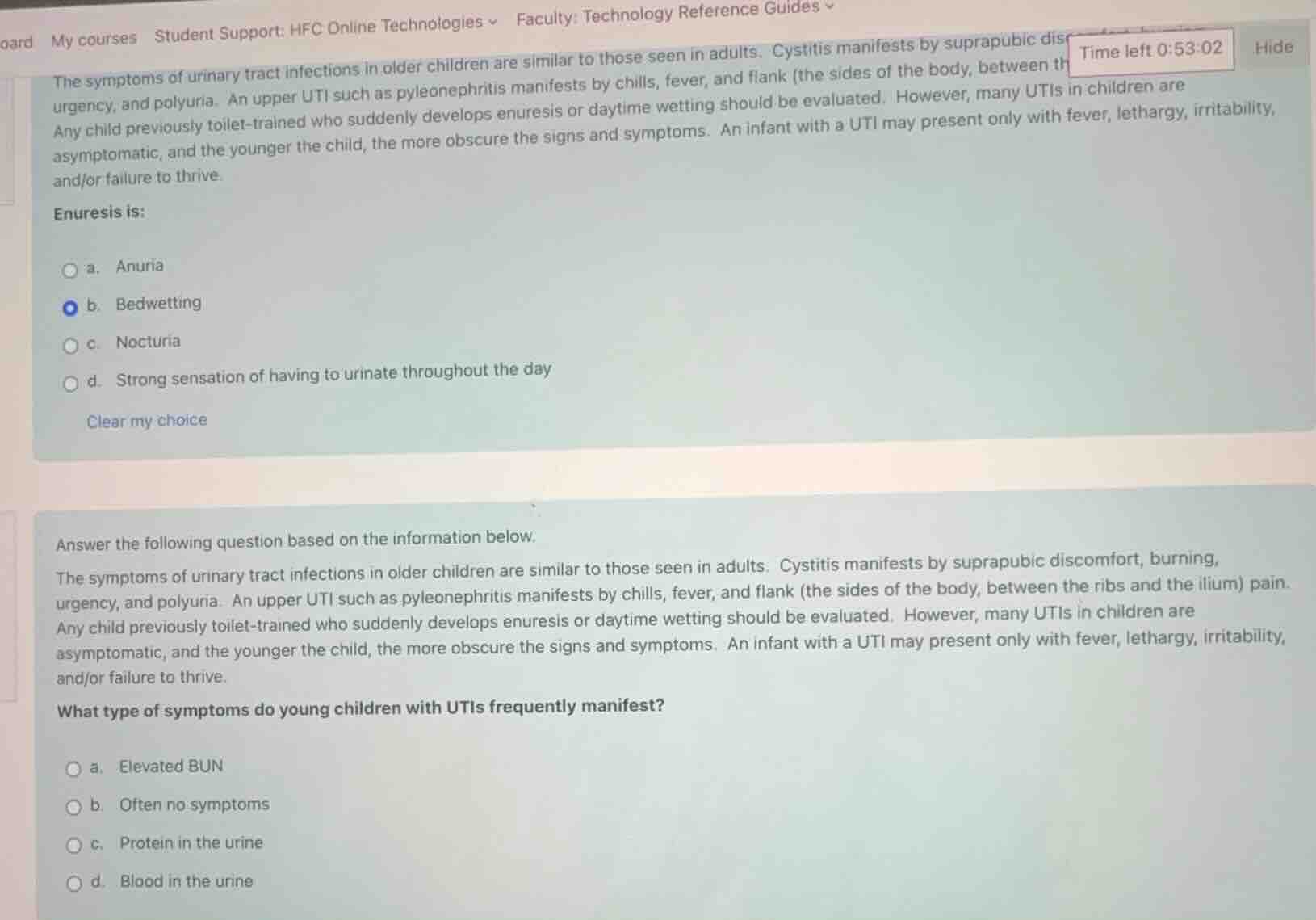
the symptoms of urinary tract infections in older children are similar to those seen in adults. cystitis manifests by suprapubic dis urgency, and polyuria. an upper uti such as pyleonephritis manifests by chills, fever, and flank (the sides of the body, between th any child previously toilet - trained who suddenly develops enuresis or daytime wetting should be evaluated. however, many utis in children are asymptomatic, and the younger the child, the more obscure the signs and symptoms. an infant with a uti may present only with fever, lethargy, irritability, and/or failure to thrive. enuresis is: a. anuria b. bedwetting c. nocturia d. strong sensation of having to urinate throughout the day clear my choice answer the following question based on the information below. the symptoms of urinary tract infections in older children are similar to those seen in adults. cystitis manifests by suprapubic discomfort, burning, urgency, and polyuria. an upper uti such as pyleonephritis manifests by chills, fever, and flank (the sides of the body, between the ribs and the ilium) pain. any child previously toilet - trained who suddenly develops enuresis or daytime wetting should be evaluated. however, many utis in children are asymptomatic, and the younger the child, the more obscure the signs and symptoms. an infant with a uti may present only with fever, lethargy, irritability, and/or failure to thrive. what type of symptoms do young children with utis frequently manifest? a. elevated bun b. often no symptoms c. protein in the urine d. blood in the urine
For the first question: The text states that toilet-trained children who develop enuresis or daytime wetting need evaluation, so enuresis refers to bedwetting.
For the second question: The text notes that many UTIs in children are asymptomatic, with younger children having more obscure signs, meaning they often have no symptoms.

Snap & solve any problem in the app
Get step-by-step solutions on Sovi AI
Photo-based solutions with guided steps
Explore more problems and detailed explanations
- b. Bedwetting
- b. Often no symptoms