QUESTION IMAGE
Question
(3) synthesis of molecules
(4) release of energy
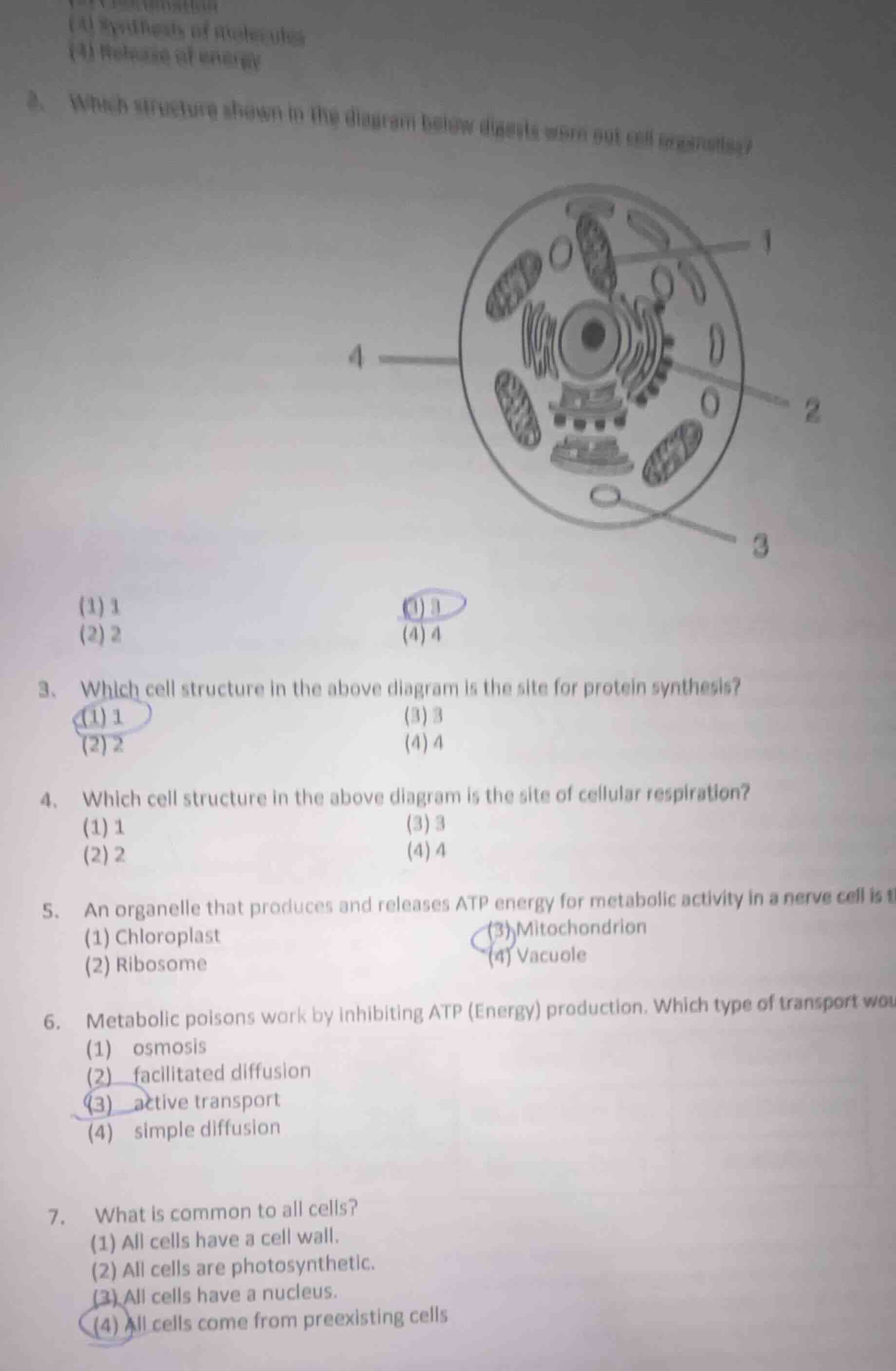
- which structure shown in the diagram below digests worn out cell organelles?
(1) 1
(2) 2
(3) 3
(4) 4
- which cell structure in the above diagram is the site for protein synthesis?
(1) 1
(2) 2
(3) 3
(4) 4
- which cell structure in the above diagram is the site of cellular respiration?
(1) 1
(2) 2
(3) 3
(4) 4
- an organelle that produces and releases atp energy for metabolic activity in a nerve cell is the
(1) chloroplast
(2) ribosome
(3) mitochondrion
(4) vacuole
- metabolic poisons work by inhibiting atp (energy) production. which type of transport would be affected?
(1) osmosis
(2) facilitated diffusion
(3) active transport
(4) simple diffusion
- what is common to all cells?
(1) all cells have a cell wall.
(2) all cells are photosynthetic.
(3) all cells have a nucleus.
(4) all cells come from preexisting cells
Brief Explanations
- Lysosomes digest worn-out cell organelles; structure 3 is a lysosome.
- Ribosomes are the site of protein synthesis; structure 1 is a ribosome.
- Mitochondria are the site of cellular respiration; these are the oval, folded structures in the diagram, which correspond to option (2) 2.
- Mitochondria produce ATP for cellular metabolic activity, including in nerve cells.
- Active transport requires ATP to move substances against their concentration gradient, so inhibiting ATP production will stop this process.
- The cell theory states that all cells arise from preexisting cells; this is true for all cells (prokaryotes and eukaryotes), while cell walls, photosynthesis, and nuclei are not universal.

Snap & solve any problem in the app
Get step-by-step solutions on Sovi AI
Photo-based solutions with guided steps
Explore more problems and detailed explanations
- (3) 3
- (1) 1
- (2) 2
- (3) Mitochondrion
- (3) active transport
- (4) All cells come from preexisting cells