QUESTION IMAGE
Question
the system of equations is solved using the linear combination method.
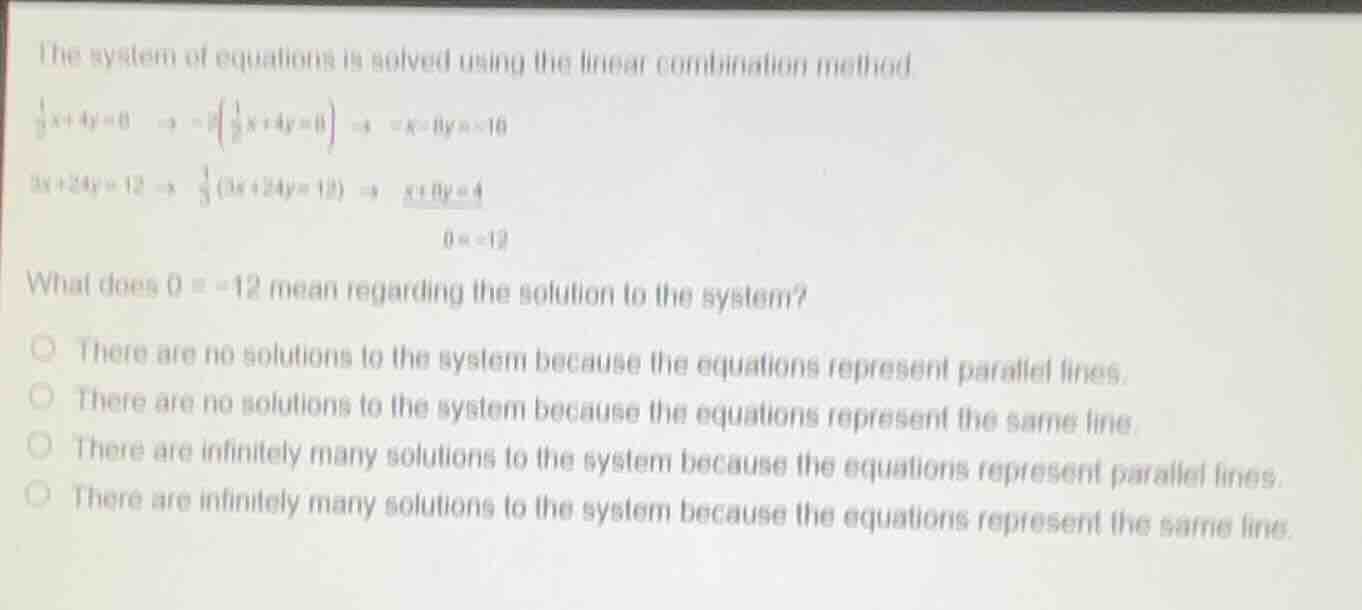
\\(\frac{1}{2}x + 4y = 8\\) \\(\to 2\left(\frac{1}{2}x + 4y = 8\
ight)\\) \\(\to x + 8y = 16\\)
\\(3x + 24y = 12\\) \\(\to \frac{1}{3}\left(3x + 24y = 12\
ight)\\) \\(\to \underline{x + 8y = 4}\\)
\\(0 = -12\\)
what does \\(0 = -12\\) mean regarding the solution to the system?
\\(\circ\\) there are no solutions to the system because the equations represent parallel lines.
\\(\circ\\) there are no solutions to the system because the equations represent the same line.
\\(\circ\\) there are infinitely many solutions to the system because the equations represent parallel lines.
\\(\circ\\) there are infinitely many solutions to the system because the equations represent the same line.
When solving a system of linear equations, obtaining a false statement like $0=-12$ means the equations are inconsistent. Inconsistent linear systems correspond to parallel lines that never intersect, so there are no solutions. The second option incorrectly claims the lines are the same (which would give infinitely many solutions, not a false statement), while the third and fourth options misstate the relationship between the result and the number of solutions/line type.

Snap & solve any problem in the app
Get step-by-step solutions on Sovi AI
Photo-based solutions with guided steps
Explore more problems and detailed explanations
There are no solutions to the system because the equations represent parallel lines.