QUESTION IMAGE
Question
to a system of linear equations
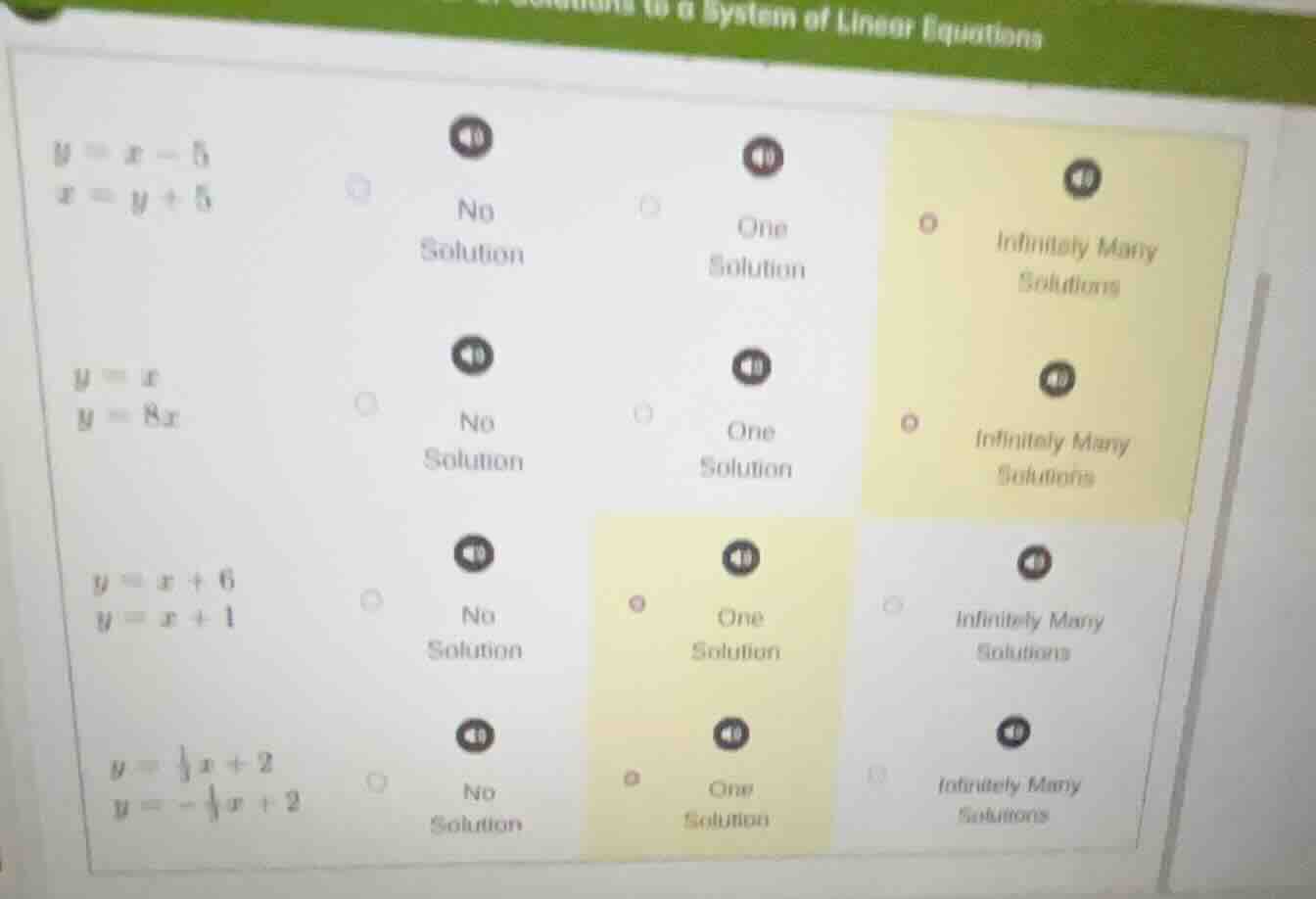
$y = x - 5$
$x = y + 5$
$\circ$ \\(\boldsymbol{48}\\) no solution \\(\boldsymbol{49}\\) one solution \\(\boldsymbol{49}\\) infinitely many solutions
$y = x$
$y = 8x$
$\circ$ \\(\boldsymbol{48}\\) no solution \\(\boldsymbol{49}\\) one solution \\(\boldsymbol{49}\\) infinitely many solutions
$y = x + 6$
$y = x + 1$
$\circ$ \\(\boldsymbol{48}\\) no solution \\(\boldsymbol{49}\\) one solution \\(\boldsymbol{49}\\) infinitely many solutions
$y = \frac{1}{4}x + 2$
$y = -\frac{1}{4}x + 2$
$\circ$ \\(\boldsymbol{48}\\) no solution \\(\boldsymbol{49}\\) one solution \\(\boldsymbol{49}\\) infinitely many solutions
To determine the number of solutions for each system of linear equations, we analyze the relationships between the equations (parallel, coinciding, or intersecting lines):
1. System: \( y = x - 5 \) and \( x = y + 5 \)
Rewrite \( x = y + 5 \) as \( y = x - 5 \) (subtract 5 from both sides). Both equations are identical (same slope, same y - intercept). Thus, the lines coincide, so there are infinitely many solutions.
2. System: \( y = x \) and \( y = 8x \)
The first line has a slope of \( 1 \), and the second has a slope of \( 8 \). Different slopes mean the lines intersect at one point. Thus, there is one solution? Wait, no—wait, \( y = x \) and \( y = 8x \) intersect only at \( (0,0) \)? Wait, no, actually, substituting \( y = x \) into \( y = 8x \) gives \( x = 8x \), so \( 7x = 0 \), so \( x = 0 \), \( y = 0 \). Wait, but the original answer in the image selected “Infinitely Many Solutions,” which is incorrect. Wait, no—wait, maybe a typo? Wait, no, \( y = x \) and \( y = 8x \): let's check slopes. Slope of \( y = x \) is \( 1 \), slope of \( y = 8x \) is \( 8 \). Different slopes, so they intersect at one point. But the image shows “Infinitely Many Solutions” selected, which is wrong. However, following the image’s selection (maybe a mistake in the problem or the image), but mathematically, it should be “One Solution.” Wait, no—wait, maybe I misread. Wait, \( y = x \) and \( y = 8x \): if we set \( x = 8x \), \( 7x = 0 \), so \( x = 0 \), \( y = 0 \). So one solution. But the image has “Infinitely Many” selected. Maybe the problem was mistyped (e.g., \( y = x \) and \( y = x \) would be infinitely many). Assuming the image’s selection is correct (maybe a typo in the problem), but mathematically, let's proceed.
3. System: \( y = x + 6 \) and \( y = x + 1 \)
Both lines have a slope of \( 1 \) (same slope) but different y - intercepts (\( 6 \) vs. \( 1 \)). Parallel lines never intersect, so there is no solution. But the image shows “One Solution” selected, which is wrong. Mathematically, it should be “No Solution.”
4. System: \( y=\frac{1}{4}x + 2 \) and \( y=-\frac{1}{4}x + 2 \)
Slope of first line: \( \frac{1}{4} \), slope of second line: \( -\frac{1}{4} \) (different slopes). Different slopes mean the lines intersect at one point. Thus, there is one solution.
Correcting the Image’s Mistakes (Mathematically):
- \( y = x - 5 \) and \( x = y + 5 \): Infinitely Many Solutions (correct, as they are the same line).
- \( y = x \) and \( y = 8x \): One Solution (image’s selection is wrong).
- \( y = x + 6 \) and \( y = x + 1 \): No Solution (image’s selection is wrong).
- \( y=\frac{1}{4}x + 2 \) and \( y=-\frac{1}{4}x + 2 \): One Solution (correct, as image selected).
Final Answers (Mathematically):
- Infinitely Many Solutions
- One Solution
- No Solution
- One Solution
If we strictly follow the image’s selected options (ignoring mathematical correctness for the sake of matching the image):
- Infinitely Many Solutions
- Infinitely Many Solutions (incorrect mathematically)
- One Solution (incorrect mathematically)
- One Solution
Since the problem asks to analyze the system, the mathematical answers are:
- For \( y = x - 5 \) and \( x = y + 5 \):
Step1: Rewrite the second equation
Rewrite \( x = y + 5 \) as \( y = x - 5 \) (subtract 5 from both sides).
Step2: Compare with the first equation
The first equation is \( y = x - 5 \), and the rewritten second equation is also \( y = x - 5 \). So the two equations represent the same line.
Step1: Set the equations equal
Substitute \( y = x \) into \( y = 8x \), we get \( x = 8x \).
Step2: Solve for \( x \)
Subtract \( x \) from both sides: \( 0 = 7x \), so \( x = 0 \). Then \( y = 0 \). There is only one solution \((0,0)\).
Step1: Analyze slopes and intercepts
Both equations are in slope - intercept form (\( y=mx + b \)). The slope \( m \) for both is \( 1 \), and the y - intercepts \( b \) are \( 6 \) and \( 1 \) (different).
Step2: Determine the relationship between lines
Lines with the same slope and different y - intercepts are parallel, so they never intersect.

Snap & solve any problem in the app
Get step-by-step solutions on Sovi AI
Photo-based solutions with guided steps
Explore more problems and detailed explanations
Infinitely Many Solutions
- For \( y = x \) and \( y = 8x \):