QUESTION IMAGE
Question
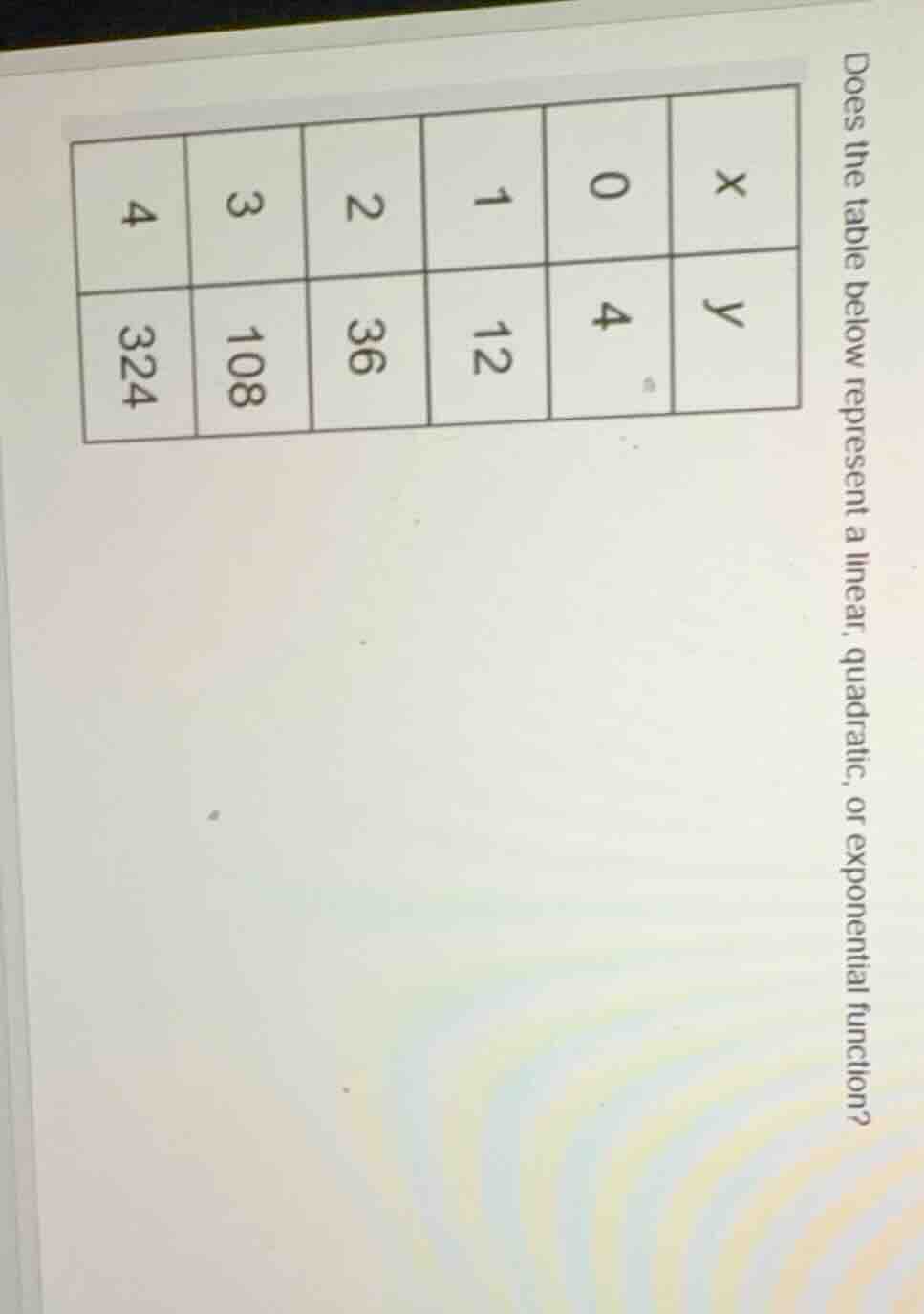
does the table below represent a linear, quadratic, or exponential function?
x | 0 | 1 | 2 | 3 | 4
y | 4 | 12 | 36 | 108 | 324
Step1: Check for linear (constant difference)
Calculate differences between consecutive y - values:
- \(12 - 4=8\)
- \(36 - 12 = 24\)
- \(108 - 36=72\)
- \(324 - 108 = 216\)
Differences are not constant, so not linear.
Step2: Check for quadratic (constant second - difference)
First differences (from step1): \(8,24,72,216\)
Second differences: \(24 - 8 = 16\), \(72 - 24=48\), \(216 - 72 = 144\)
Second differences are not constant, so not quadratic.
Step3: Check for exponential (constant ratio)
Calculate the ratio of consecutive y - values:
- \(\frac{12}{4}=3\)
- \(\frac{36}{12}=3\)
- \(\frac{108}{36}=3\)
- \(\frac{324}{108}=3\)
The ratio between consecutive y - values is constant (\(r = 3\)). Also, when \(x = 0\), \(y=4\), so the exponential function is of the form \(y = 4\times3^{x}\) (since for \(x = 0\), \(y = 4\times3^{0}=4\), for \(x = 1\), \(y = 4\times3^{1}=12\), etc.)

Snap & solve any problem in the app
Get step-by-step solutions on Sovi AI
Photo-based solutions with guided steps
Explore more problems and detailed explanations
The table represents an exponential function.