QUESTION IMAGE
Question
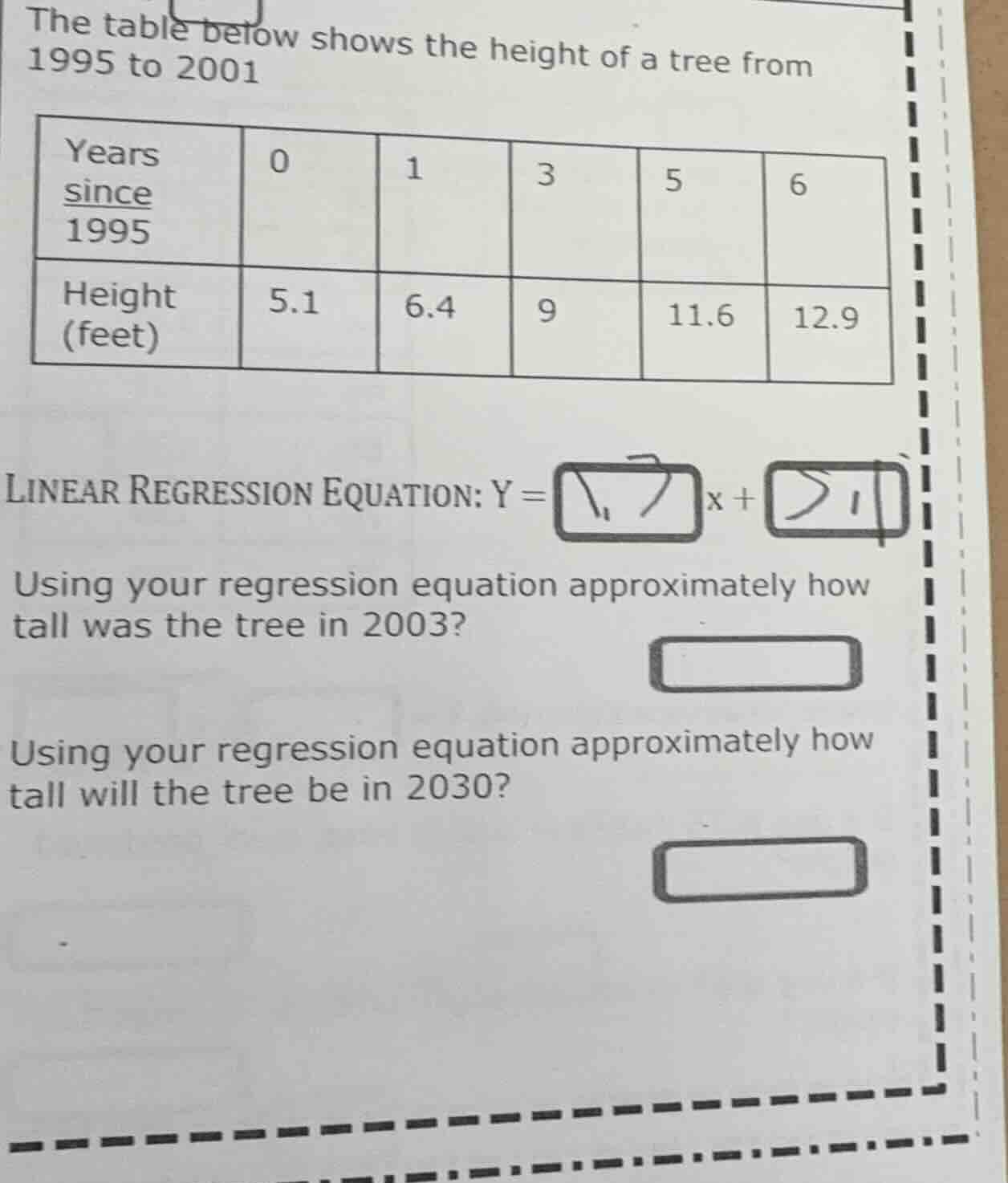
the table below shows the height of a tree from 1995 to 2001
years since 1995: 0, 1, 3, 5, 6
height (feet): 5.1, 6.4, 9, 11.6, 12.9
linear regression equation: y = \boxed{}x + \boxed{}
using your regression equation approximately how tall was the tree in 2003?
\boxed{}
using your regression equation approximately how tall will the tree be in 2030?
\boxed{}
Step 1: Calculate the slope (\(m\)) of the linear regression
The formula for the slope \(m\) of a linear regression is \(m=\frac{n\sum xy - \sum x\sum y}{n\sum x^{2}-(\sum x)^{2}}\), where \(n\) is the number of data points.
First, list the data:
- \(x\) values: \(0, 1, 3, 5, 6\)
- \(y\) values: \(5.1, 6.4, 9, 11.6, 12.9\)
- \(n = 5\)
Calculate \(\sum x=0 + 1+3 + 5+6=15\)
\(\sum y=5.1 + 6.4+9 + 11.6+12.9 = 45\)
\(\sum xy=(0\times5.1)+(1\times6.4)+(3\times9)+(5\times11.6)+(6\times12.9)=0 + 6.4+27+58+77.4 = 168.8\)
\(\sum x^{2}=0^{2}+1^{2}+3^{2}+5^{2}+6^{2}=0 + 1+9+25+36 = 71\)
Now plug into the slope formula:
\(m=\frac{5\times168.8-15\times45}{5\times71 - 15^{2}}=\frac{844 - 675}{355 - 225}=\frac{169}{130}\approx1.3\)
Step 2: Calculate the y-intercept (\(b\))
The formula for the y-intercept \(b\) is \(b=\frac{\sum y - m\sum x}{n}\)
\(b=\frac{45-1.3\times15}{5}=\frac{45 - 19.5}{5}=\frac{25.5}{5}=5.1\)
So the linear regression equation is \(Y = 1.3x+5.1\)
Step 3: Find the height in 2003
2003 is \(2003 - 1995 = 8\) years since 1995, so \(x = 8\)
Substitute \(x = 8\) into the equation: \(Y=1.3\times8 + 5.1=10.4+5.1 = 15.5\) feet
Step 4: Find the height in 2030
2030 is \(2030 - 1995 = 35\) years since 1995, so \(x = 35\)
Substitute \(x = 35\) into the equation: \(Y=1.3\times35+5.1 = 45.5+5.1=50.6\) feet
Linear Regression Equation:
\(Y = 1.3x + 5.1\)
Height in 2003:
\(\boxed{15.5}\) feet
Height in 2030:
\(\boxed{50.6}\) feet

Snap & solve any problem in the app
Get step-by-step solutions on Sovi AI
Photo-based solutions with guided steps
Explore more problems and detailed explanations
Step 1: Calculate the slope (\(m\)) of the linear regression
The formula for the slope \(m\) of a linear regression is \(m=\frac{n\sum xy - \sum x\sum y}{n\sum x^{2}-(\sum x)^{2}}\), where \(n\) is the number of data points.
First, list the data:
- \(x\) values: \(0, 1, 3, 5, 6\)
- \(y\) values: \(5.1, 6.4, 9, 11.6, 12.9\)
- \(n = 5\)
Calculate \(\sum x=0 + 1+3 + 5+6=15\)
\(\sum y=5.1 + 6.4+9 + 11.6+12.9 = 45\)
\(\sum xy=(0\times5.1)+(1\times6.4)+(3\times9)+(5\times11.6)+(6\times12.9)=0 + 6.4+27+58+77.4 = 168.8\)
\(\sum x^{2}=0^{2}+1^{2}+3^{2}+5^{2}+6^{2}=0 + 1+9+25+36 = 71\)
Now plug into the slope formula:
\(m=\frac{5\times168.8-15\times45}{5\times71 - 15^{2}}=\frac{844 - 675}{355 - 225}=\frac{169}{130}\approx1.3\)
Step 2: Calculate the y-intercept (\(b\))
The formula for the y-intercept \(b\) is \(b=\frac{\sum y - m\sum x}{n}\)
\(b=\frac{45-1.3\times15}{5}=\frac{45 - 19.5}{5}=\frac{25.5}{5}=5.1\)
So the linear regression equation is \(Y = 1.3x+5.1\)
Step 3: Find the height in 2003
2003 is \(2003 - 1995 = 8\) years since 1995, so \(x = 8\)
Substitute \(x = 8\) into the equation: \(Y=1.3\times8 + 5.1=10.4+5.1 = 15.5\) feet
Step 4: Find the height in 2030
2030 is \(2030 - 1995 = 35\) years since 1995, so \(x = 35\)
Substitute \(x = 35\) into the equation: \(Y=1.3\times35+5.1 = 45.5+5.1=50.6\) feet
Linear Regression Equation:
\(Y = 1.3x + 5.1\)
Height in 2003:
\(\boxed{15.5}\) feet
Height in 2030:
\(\boxed{50.6}\) feet