QUESTION IMAGE
Question
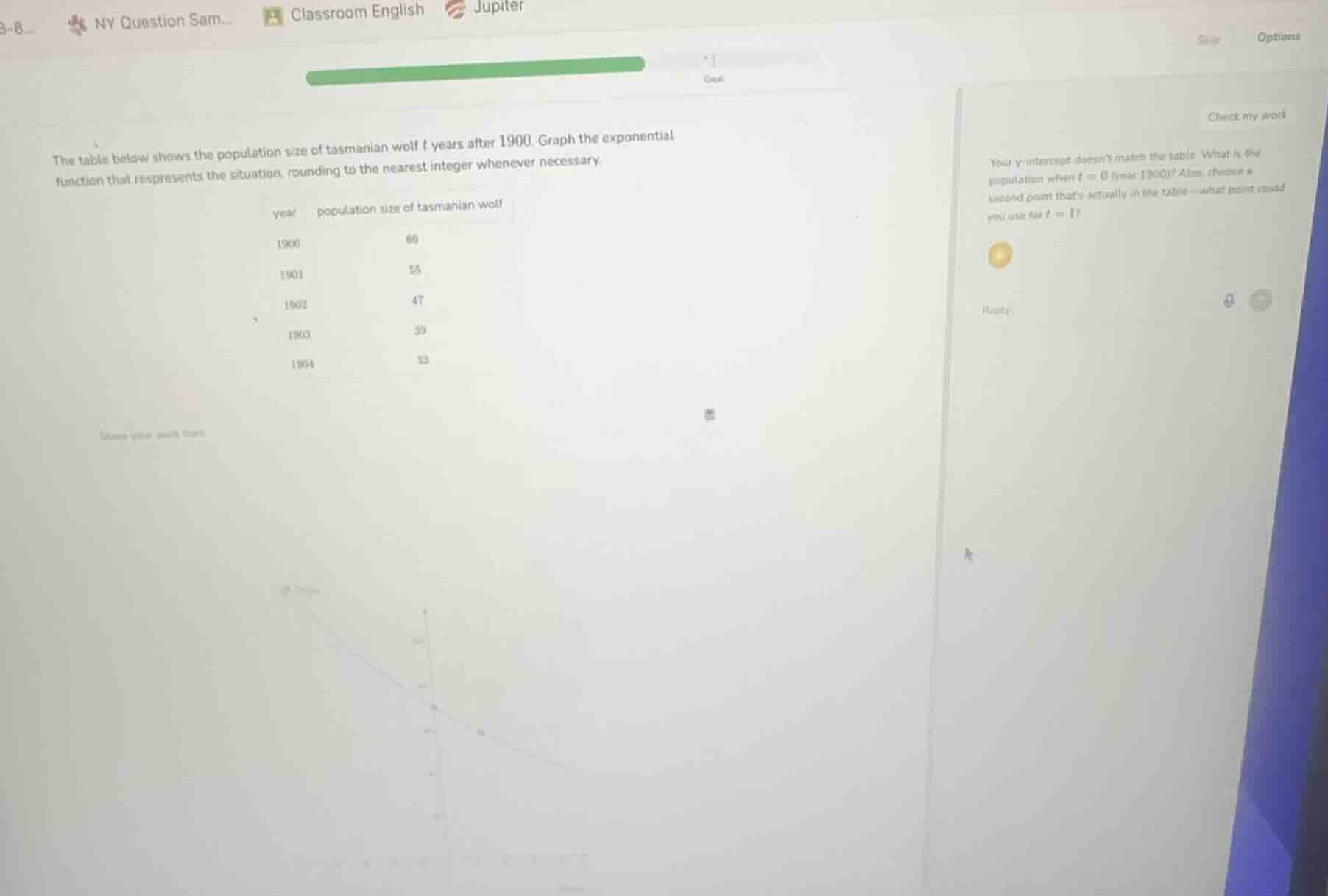
the table below shows the population size of tasmanian wolf t years after 1900. graph the exponential function that respresents the situation, rounding to the nearest integer whenever necessary.
year population size of tasmanian wolf
1900 66
1901 55
1902 47
1903 39
1904 33
show your work here
check my work
your y-intercept doesnt match the table. what is the population when t = 0 (year 1900)? also, choose a second point thats actually in the table--what point would you use for t = 1?
Step1: Identify initial population (t=0)
When \(t=0\) (year 1900), the population \(P_0 = 66\). This is the y-intercept.
Step2: Find decay factor b
Use \(t=1\) (1901, population 55). Exponential form: \(P(t) = P_0 b^t\).
Substitute values: \(55 = 66b^1\)
Solve for \(b\): \(b = \frac{55}{66} \approx 0.833\)
Step3: Define the exponential function
Substitute \(P_0\) and \(b\) into the model:
\(P(t) = 66(0.833)^t\)
Step4: Verify with t=1 point
The point for \(t=1\) is \((1, 55)\), which is from the table.

Snap & solve any problem in the app
Get step-by-step solutions on Sovi AI
Photo-based solutions with guided steps
Explore more problems and detailed explanations
- The y-intercept (population at \(t=0\)) is \((0, 66)\)
- The point for \(t=1\) is \((1, 55)\)
- The exponential function is \(P(t) = 66(0.83)^t\) (rounded to two decimal places for \(b\))