QUESTION IMAGE
Question
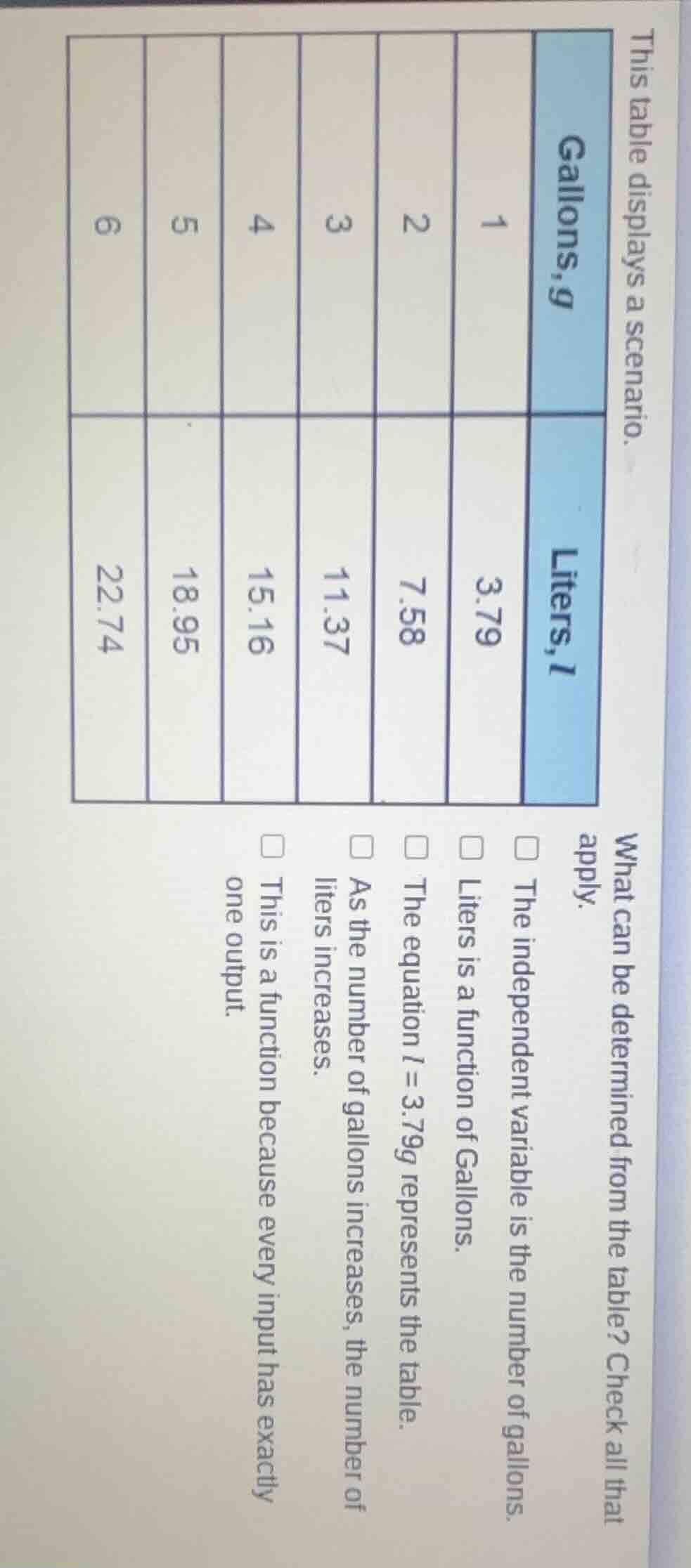
this table displays a scenario.
| gallons, $g$ | 1 | 2 | 3 | 4 | 5 | 6 | ---- | ---- | ---- | ---- | ---- | ---- | ---- | liters, $l$ | 3.79 | 7.58 | 11.37 | 15.16 | 18.95 | 22.74 | what can be determined from the table? check all that apply.$square$ the independent variable is the number of gallons.$square$ liters is a function of gallons.$square$ the equation $l = 3.79g$ represents the table.$square$ as the number of gallons increases, the number of liters increases.$square$ this is a function because every input has exactly one output. |
Brief Explanations
- La variable independiente es la que se controla o elige primero, en este caso los galones ($g$), ya que los litros dependen de ellos.
- Los litros ($l$) dependen del valor de los galones, por lo que $l$ es una función de $g$.
- Al multiplicar cada valor de galones por 3.79 se obtiene el valor correspondiente de litros: $1\times3.79=3.79$, $2\times3.79=7.58$, etc., así que la ecuación $l=3.79g$ representa la tabla.
- Al observar la tabla, a medida que los galones aumentan de 1 a 6, los litros también aumentan de 3.79 a 22.74.
- Cada valor de galones (entrada) tiene un único valor de litros (salida), por lo que se trata de una función.

Snap & solve any problem in the app
Get step-by-step solutions on Sovi AI
Photo-based solutions with guided steps
Explore more problems and detailed explanations
- The independent variable is the number of gallons.
- Liters is a function of Gallons.
- The equation $l = 3.79g$ represents the table.
- As the number of gallons increases, the number of liters increases.
- This is a function because every input has exactly one output.