QUESTION IMAGE
Question
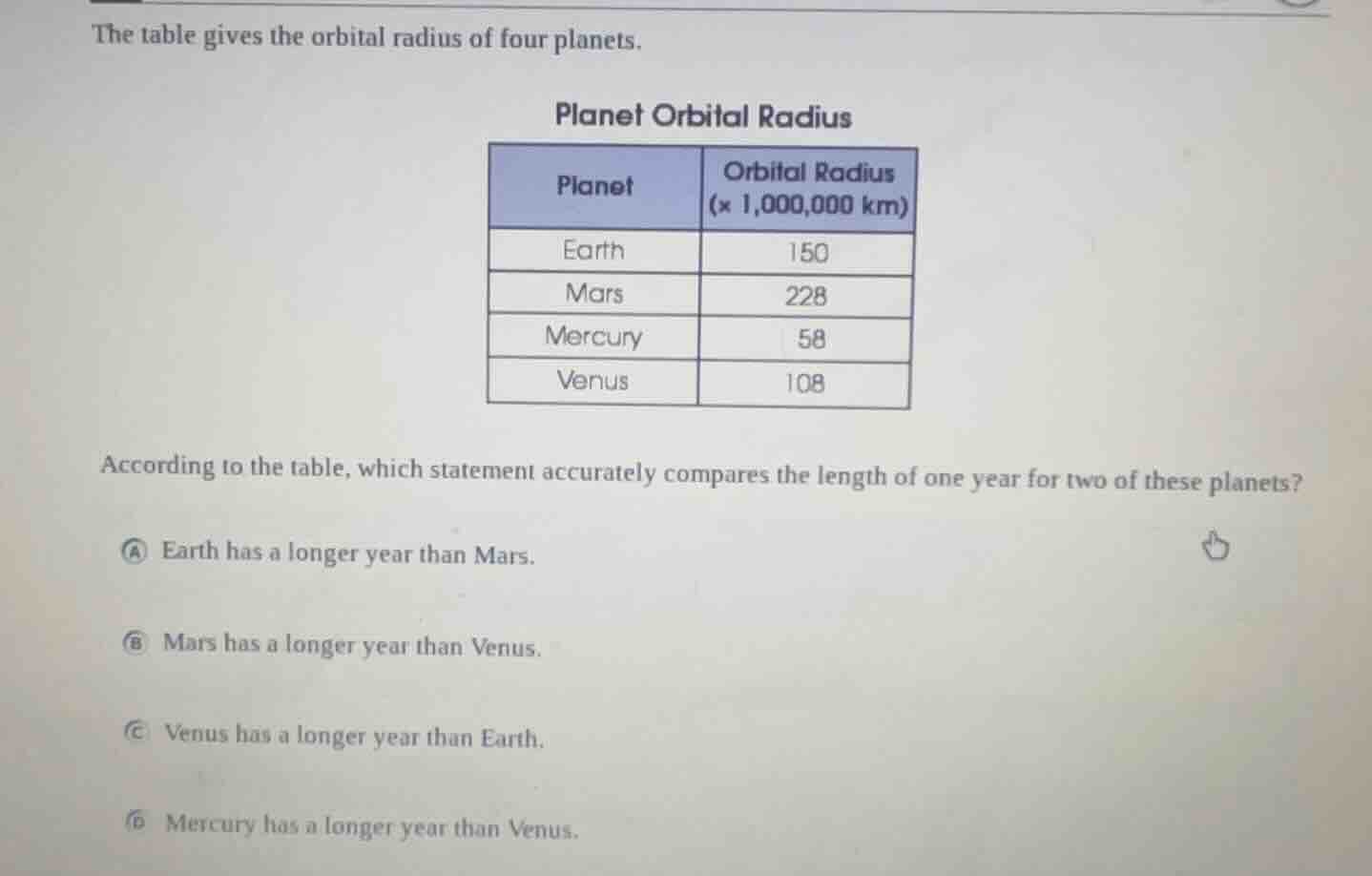
the table gives the orbital radius of four planets.
planet orbital radius
| planet | orbital radius (× 1,000,000 km) |
|---|---|
| mars | 228 |
| mercury | 58 |
| venus | 108 |
according to the table, which statement accurately compares the length of one year for two of these planets?
a earth has a longer year than mars.
b mars has a longer year than venus.
c venus has a longer year than earth.
d mercury has a longer year than venus.
To solve this, we use Kepler's third law, which states that the square of the orbital period (length of a year) is proportional to the cube of the orbital radius. So, a larger orbital radius means a longer orbital period (longer year).
Step 1: Recall Kepler's Third Law
Kepler's third law: $T^2 \propto r^3$, where $T$ is the orbital period (year length) and $r$ is the orbital radius. Thus, larger $r$ implies larger $T$.
Step 2: Compare Orbital Radii
- Earth: 150, Mars: 228. Since 150 < 228, Mars has a larger radius, so Mars should have a longer year than Earth. So option A is wrong.
- Mars: 228, Venus: 108. 228 > 108, so Mars has a larger radius. Thus, Mars has a longer year than Venus. Let's check other options to confirm.
- Venus: 108, Earth: 150. 108 < 150, so Earth has a larger radius, meaning Earth has a longer year than Venus. So option C is wrong.
- Mercury: 58, Venus: 108. 58 < 108, so Venus has a larger radius, meaning Venus has a longer year than Mercury. So option D is wrong.

Snap & solve any problem in the app
Get step-by-step solutions on Sovi AI
Photo-based solutions with guided steps
Explore more problems and detailed explanations
B. Mars has a longer year than Venus.