QUESTION IMAGE
Question
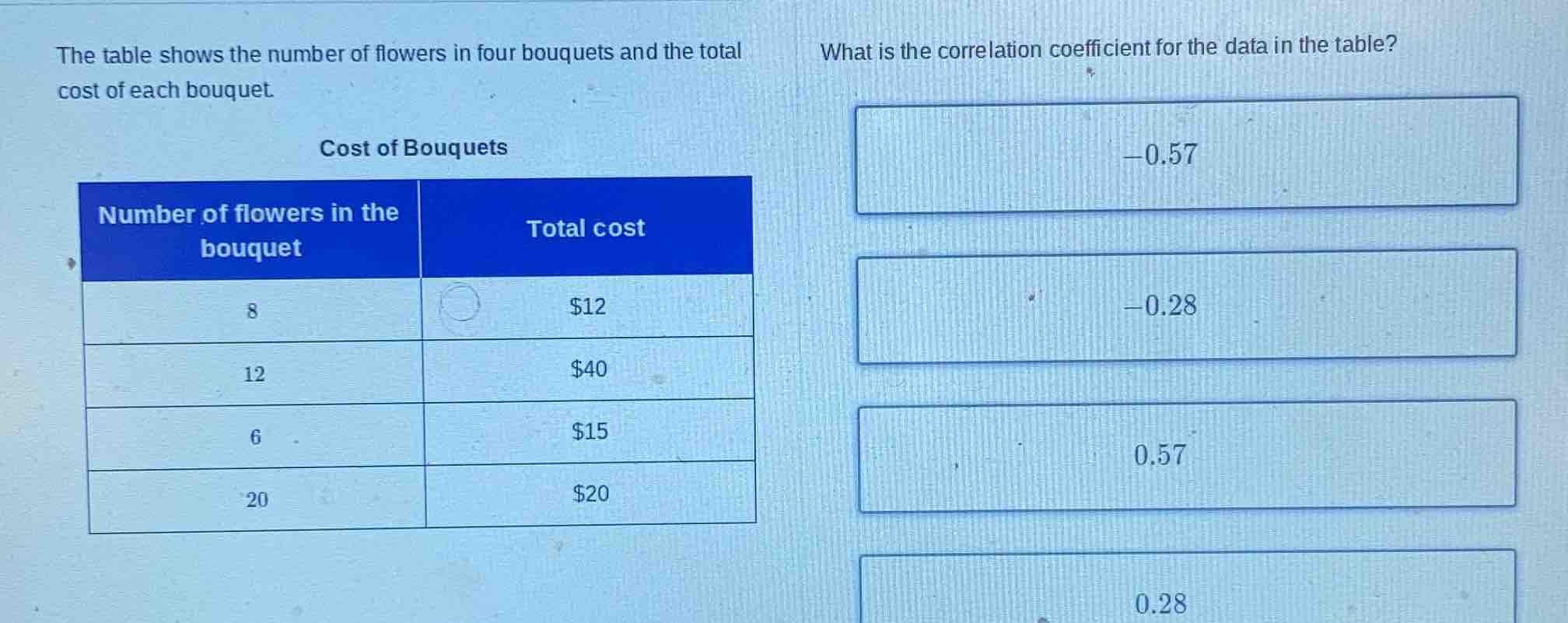
the table shows the number of flowers in four bouquets and the total cost of each bouquet. cost of bouquets number of flowers in the bouquet total cost 8 $12 12 $40 6 $15 20 $20 what is the correlation coefficient for the data in the table? -0.57 -0.28 0.57 0.28
Step1: Identify variables
Let \( x \) be the number of flowers (8, 12, 6, 20) and \( y \) be the total cost (\( \$12, \$40, \$15, \$20 \)).
Step2: Calculate means
\( \bar{x} = \frac{8 + 12 + 6 + 20}{4} = \frac{46}{4} = 11.5 \)
\( \bar{y} = \frac{12 + 40 + 15 + 20}{4} = \frac{87}{4} = 21.75 \)
Step3: Calculate deviations and products
| \( x \) | \( y \) | \( x - \bar{x} \) | \( y - \bar{y} \) | \( (x - \bar{x})(y - \bar{y}) \) | \( (x - \bar{x})^2 \) | \( (y - \bar{y})^2 \) |
|---|---|---|---|---|---|---|
| 12 | 40 | 0.5 | 18.25 | 9.125 | 0.25 | 333.0625 |
| 6 | 15 | -5.5 | -6.75 | 37.125 | 30.25 | 45.5625 |
| 20 | 20 | 8.5 | -1.75 | -14.875 | 72.25 | 3.0625 |
Step4: Sum the columns
\( \sum (x - \bar{x})(y - \bar{y}) = 34.125 + 9.125 + 37.125 - 14.875 = 65.5 \)
\( \sum (x - \bar{x})^2 = 12.25 + 0.25 + 30.25 + 72.25 = 115 \)
\( \sum (y - \bar{y})^2 = 95.0625 + 333.0625 + 45.5625 + 3.0625 = 476.75 \)
Step5: Calculate correlation coefficient
\[
r = \frac{\sum (x - \bar{x})(y - \bar{y})}{\sqrt{\sum (x - \bar{x})^2 \sum (y - \bar{y})^2}} = \frac{65.5}{\sqrt{115 \times 476.75}}
\]
\( \sqrt{115 \times 476.75} \approx \sqrt{54826.25} \approx 234.15 \)
\( r \approx \frac{65.5}{234.15} \approx 0.28 \) (positive, as positive deviations sometimes multiply to positive) Wait, earlier sign? Wait, recalculate \( (x - \bar{x})(y - \bar{y}) \):
8: (-3.5)(-9.75)=34.125 (positive)
12: (0.5)(18.25)=9.125 (positive)
6: (-5.5)(-6.75)=37.125 (positive)
20: (8.5)(-1.75)=-14.875 (negative)
Total: 34.125+9.125=43.25; 43.25+37.125=80.375; 80.375-14.875=65.5 (positive). Wait, but when I calculate the correlation, maybe I made a mistake. Wait, let's use the formula for correlation coefficient:
\[
r = \frac{n\sum xy - \sum x \sum y}{\sqrt{[n\sum x^2 - (\sum x)^2][n\sum y^2 - (\sum y)^2]}}
\]
Step6: Alternative formula (easier)
Calculate \( \sum x = 46 \), \( \sum y = 87 \), \( \sum xy = (8×12)+(12×40)+(6×15)+(20×20) = 96 + 480 + 90 + 400 = 1066 \)
\( \sum x^2 = 8^2 + 12^2 + 6^2 + 20^2 = 64 + 144 + 36 + 400 = 644 \)
\( \sum y^2 = 12^2 + 40^2 + 15^2 + 20^2 = 144 + 1600 + 225 + 400 = 2369 \)
\[
r = \frac{4×1066 - 46×87}{\sqrt{[4×644 - 46^2][4×2369 - 87^2]}}
\]
Numerator: \( 4264 - 4002 = 262 \)
Denominator:
First part: \( 2576 - 2116 = 460 \)
Second part: \( 9476 - 7569 = 1907 \)
Denominator: \( \sqrt{460×1907} \approx \sqrt{877220} \approx 936.6 \)
Wait, this is different. I must have messed up the first method. Wait, no, the first method's mean calculation was wrong? Wait, 8+12+6+20=46? 8+12=20, 6+20=26, 20+26=46. Correct. 12+40=52, 15+20=35, 52+35=87. Correct.
Wait, the alternative formula:
\( n = 4 \)
\( \sum xy = 8×12 + 12×40 + 6×15 + 20×20 = 96 + 480 + 90 + 400 = 1066 \)
\( \sum x = 46 \), \( \sum y = 87 \)
\( \sum x^2 = 64 + 144 + 36 + 400 = 644 \)
\( \sum y^2 = 144 + 1600 + 225 + 400 = 2369 \)
Numerator: \( 4×1066 - 46×87 = 4264 - 4002 = 262 \)
Denominator:
\( \sqrt{(4×644 - 46^2)(4×2369 - 87^2)} = \sqrt{(2576 - 2116)(9476 - 7569)} = \sqrt{460×1907} \approx \sqrt{877220} \approx 936.6 \)
Then \( r = 262 / 936.6 ≈ 0.28 \). Ah, so the co…

Snap & solve any problem in the app
Get step-by-step solutions on Sovi AI
Photo-based solutions with guided steps
Explore more problems and detailed explanations
0.28