QUESTION IMAGE
Question
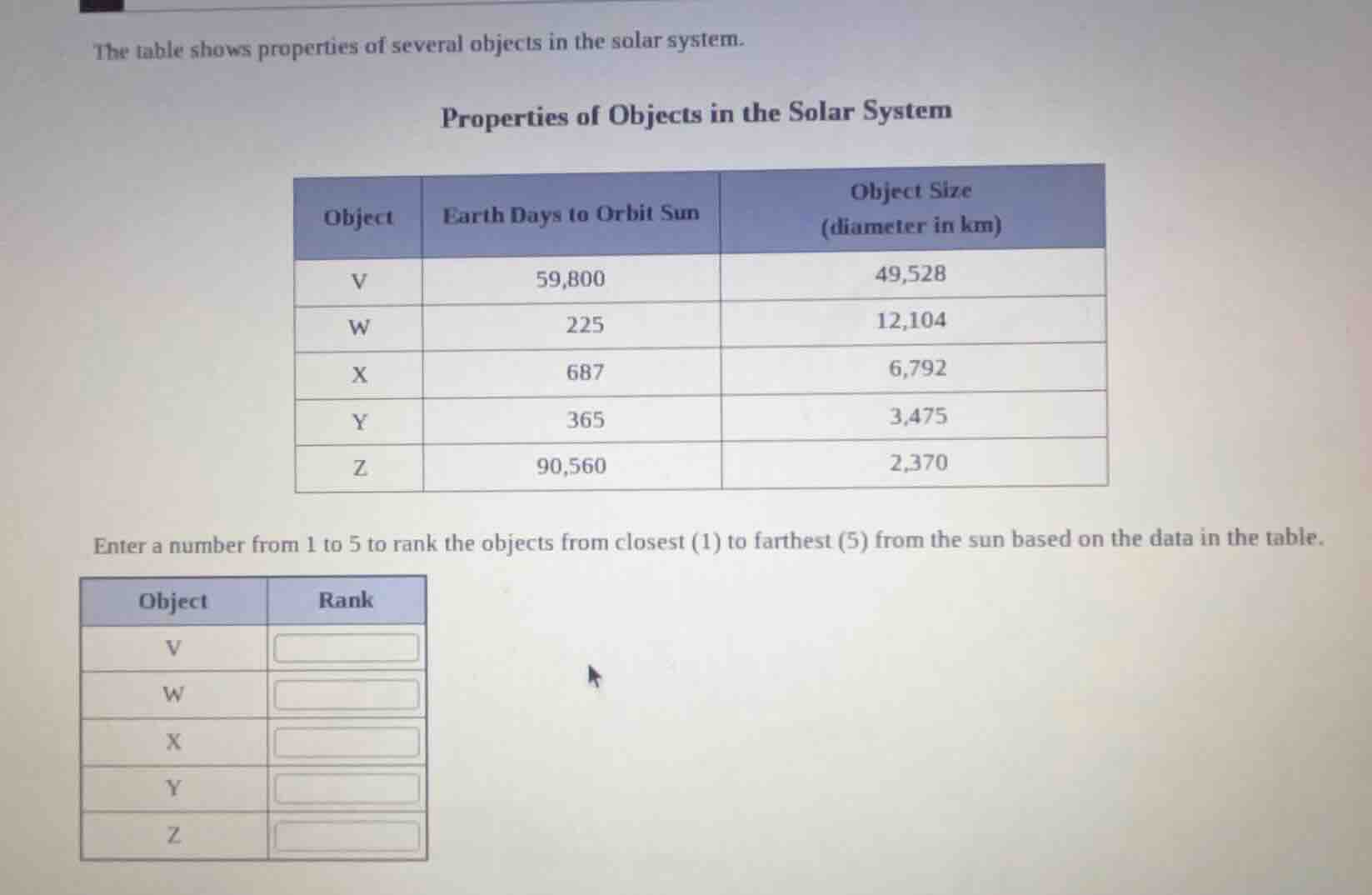
the table shows properties of several objects in the solar system.
properties of objects in the solar system
| object | earth days to orbit sun | object size (diameter in km) |
|---|---|---|
| w | 225 | 12,104 |
| x | 687 | 6,792 |
| y | 365 | 3,475 |
| z | 90,560 | 2,370 |
enter a number from 1 to 5 to rank the objects from closest (1) to farthest (5) from the sun based on the data in the table.
| object | rank |
|---|---|
| w | |
| x | |
| y | |
| z |
Step1: Recall Kepler's Law (orbital period and distance)
In the solar system, according to Kepler's third law, the square of the orbital period (in Earth years or days) is proportional to the cube of the semi - major axis (distance from the Sun). So, a shorter orbital period (in Earth days to orbit the Sun) means the object is closer to the Sun, and a longer orbital period means it is farther from the Sun.
Step2: List the orbital periods
- Object V: 59,800 days
- Object W: 225 days
- Object X: 687 days
- Object Y: 365 days
- Object Z: 90,560 days
Step3: Sort the orbital periods from smallest to largest
First, compare the values:
225 (W) < 365 (Y) < 687 (X) < 59,800 (V) < 90,560 (Z)
Step4: Assign ranks
Since a smaller orbital period means closer to the Sun (rank 1 is closest, rank 5 is farthest):
- W has the smallest orbital period, so rank 1.
- Y has the next smallest, rank 2.
- X has the next, rank 3.
- V has the next, rank 4.
- Z has the largest, rank 5.

Snap & solve any problem in the app
Get step-by-step solutions on Sovi AI
Photo-based solutions with guided steps
Explore more problems and detailed explanations
- Object V: 4
- Object W: 1
- Object X: 3
- Object Y: 2
- Object Z: 5