QUESTION IMAGE
Question
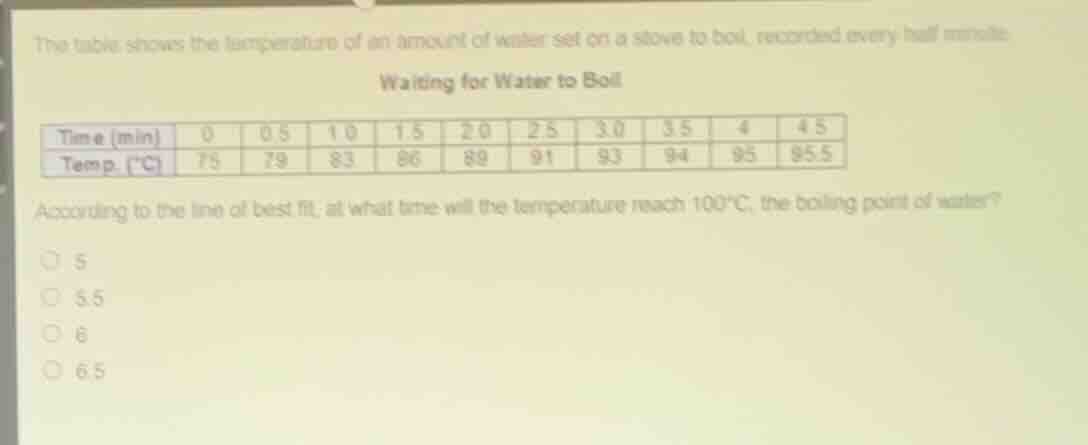
the table shows the temperature of an amount of water set on a stove to boil, recorded every half minute: waiting for water to boil time (min) 0 0.5 1.0 1.5 2.0 2.5 3.0 3.5 4 4.5 temp. (°c) 75 79 83 86 89 91 93 94 95 95.5 according to the line of best fit, at what time will the temperature reach 100°c, the boiling point of water? 5 5.5 6 6.5
Step1: Analyze the trend of temperature change
First, we observe the temperature change over time. From the table, as time \( t \) (in minutes) increases, the temperature \( T \) (in \(^\circ C\)) also increases. Let's list out the time - temperature pairs: \((0,75)\), \((0.5,79)\), \((1.0,83)\), \((1.5,86)\), \((2.0,89)\), \((2.5,91)\), \((3.0,93)\), \((3.5,94)\), \((4.0,95)\), \((4.5,95.5)\)
We can calculate the rate of temperature increase (slope of the line of best - fit approximately). Let's take two points, say \((0,75)\) and \((4.5,95.5)\). The slope \( m=\frac{y_2 - y_1}{x_2 - x_1}=\frac{95.5 - 75}{4.5-0}=\frac{20.5}{4.5}\approx4.56\) (approximate rate of temperature increase per minute).
Or we can look at the change between consecutive points:
From \( t = 0\) to \( t=0.5\), \(\Delta T=79 - 75 = 4\), \(\Delta t = 0.5\), rate \(=\frac{4}{0.5}=8\) per minute? Wait, no, wait. Wait, from \(t = 0\) to \(t = 0.5\), time change is \(0.5\) min, temperature change is \(4^\circ C\), so rate is \(\frac{4}{0.5}=8^\circ C\) per minute? But from \(t = 3.5\) to \(t = 4.0\), \(\Delta T=95 - 94 = 1\), \(\Delta t=0.5\), rate \(=\frac{1}{0.5}=2^\circ C\) per minute. Wait, actually, the rate of increase is slowing down as we approach the boiling point, but we can use linear approximation for the line of best - fit.
Let's use the later points to get a better approximation of the slope when approaching the boiling point. Let's take points \((3.5,94)\), \((4.0,95)\), \((4.5,95.5)\)
From \((3.5,94)\) to \((4.0,95)\): \(\Delta t = 0.5\), \(\Delta T=1\), so slope \(m_1=\frac{1}{0.5}=2\)
From \((4.0,95)\) to \((4.5,95.5)\): \(\Delta t = 0.5\), \(\Delta T = 0.5\), slope \(m_2=\frac{0.5}{0.5}=1\)
But maybe a better way is to set up a linear equation. Let's assume the line of best - fit has the equation \(T=mt + b\). We know that when \(t = 0\), \(T = 75\), so \(b = 75\).
Let's use two points to find \(m\). Let's take \((0,75)\) and \((4,95)\). Then \(m=\frac{95 - 75}{4-0}=\frac{20}{4}=5\). So the equation of the line of best - fit is approximately \(T = 5t+75\)
Step2: Solve for \(t\) when \(T = 100\)
We set \(T = 100\) in the equation \(T=5t + 75\)
\(100=5t+75\)
Subtract 75 from both sides: \(100 - 75=5t\)
\(25 = 5t\)
Divide both sides by 5: \(t=\frac{25}{5}=5\)
Wait, but let's check with the actual trend. Wait, when \(t = 4.5\), \(T = 95.5\). The difference between \(100\) and \(95.5\) is \(4.5\). If we look at the rate of change in the later stages, from \(t = 4\) to \(t = 4.5\), the temperature increases by \(0.5^\circ C\) in \(0.5\) minutes (rate of \(1^\circ C\) per minute). From \(t = 3.5\) to \(t = 4\), it increases by \(1^\circ C\) in \(0.5\) minutes (rate of \(2^\circ C\) per minute). From \(t = 3\) to \(t = 3.5\), it increases by \(1^\circ C\) in \(0.5\) minutes (rate of \(2^\circ C\) per minute). From \(t = 2.5\) to \(t = 3\), it increases by \(2^\circ C\) in \(0.5\) minutes (rate of \(4^\circ C\) per minute). From \(t = 2\) to \(t = 2.5\), it increases by \(2^\circ C\) in \(0.5\) minutes (rate of \(4^\circ C\) per minute). From \(t = 1.5\) to \(t = 2\), it increases by \(3^\circ C\) in \(0.5\) minutes (rate of \(6^\circ C\) per minute). From \(t = 1\) to \(t = 1.5\), it increases by \(3^\circ C\) in \(0.5\) minutes (rate of \(6^\circ C\) per minute). From \(t = 0.5\) to \(t = 1\), it increases by \(4^\circ C\) in \(0.5\) minutes (rate of \(8^\circ C\) per minute). From \(t = 0\) to \(t = 0.5\), it increases by \(4^\circ C\) in \(0.5\) minutes (rate of \(8^\circ C\) per minute).
But the overall trend, if we consider the lin…

Snap & solve any problem in the app
Get step-by-step solutions on Sovi AI
Photo-based solutions with guided steps
Explore more problems and detailed explanations
A. 5