QUESTION IMAGE
Question
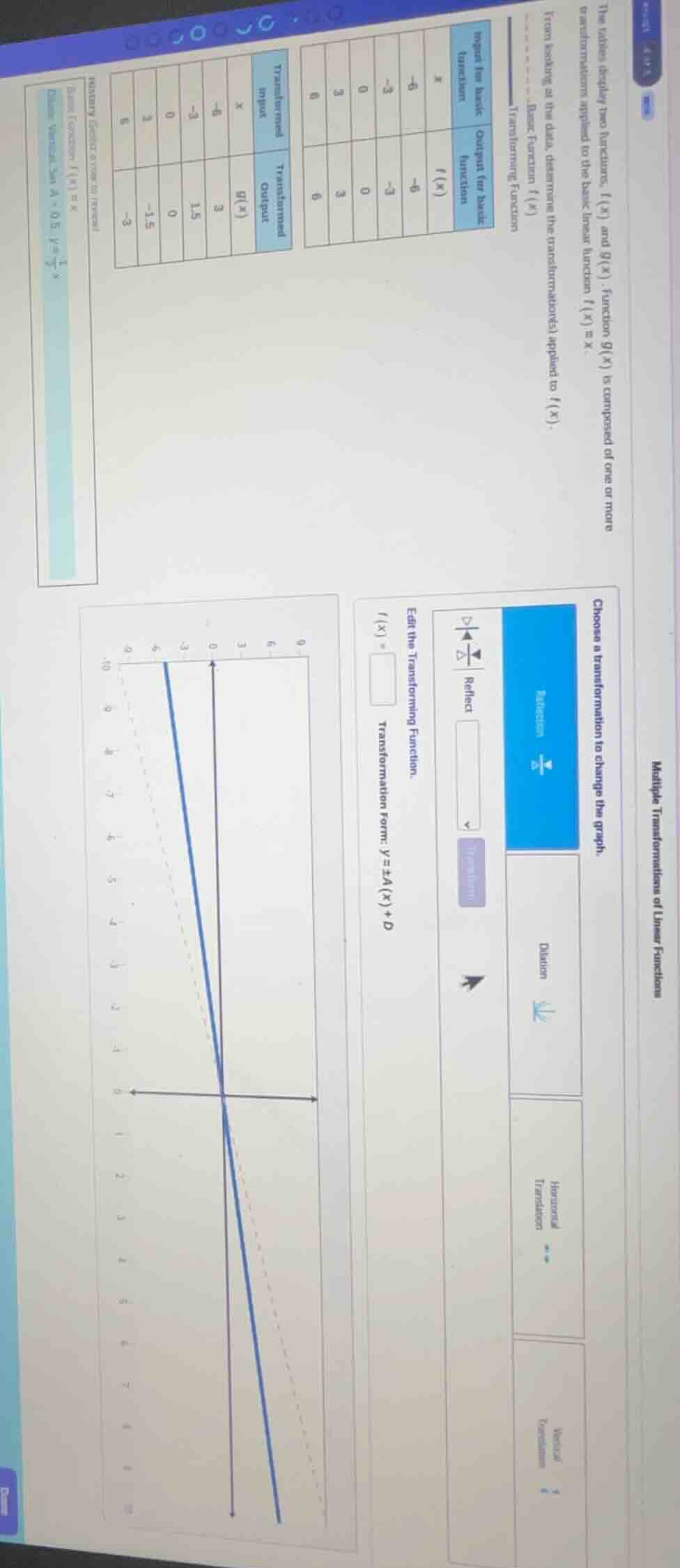
the tables display two functions: ( f(x) ) and ( g(x) ). function ( g(x) ) is composed of one or more transformations applied to the base linear function ( f(x) = x ).
from looking at the data, determine the transformation(s) applied to ( f(x) ).
transforming function
input for basic function ( f(x) )
| ( x ) | -6 | -3 | 0 | 3 | 6 |
|---|
input for transformed function ( g(x) )
| ( x ) | -6 | -3 | 0 | 3 | 6 |
|---|
basic function: ( f(x) = x )
choose a transformation to change the graph.
transformations
- reflection
- dilation
- horizontal translation
- vertical translation
edit the transforming function.
( f(x) = )
transformation form: ( y = a f(x) + d )
(graph of the transformed function is also shown.)
Step1: Analyze the base function and transformed function
The base function \( f(x) = x \). Let's take a point from the original input - output of \( f(x) \), for example, when \( x=-6 \), \( f(x)=-6 \); when \( x = - 3\), \( f(x)=-3 \); when \( x = 0\), \( f(x)=0 \); when \( x=3 \), \( f(x)=3 \); when \( x = 6\), \( f(x)=6 \). For the transformed function \( g(x) \), when \( x=-6 \), \( g(x) = 3\); when \( x=-3 \), \( g(x)=1.5 \); when \( x = 0\), \( g(x)=0 \); when \( x = 3\), \( g(x)=-1.5 \); when \( x=6 \), \( g(x)=-3 \).
Step2: Determine the transformation
Let's assume the transformation is of the form \( g(x)=A\times f(x)+D \). First, check the value at \( x = 0 \). For \( x = 0 \), \( f(0)=0 \) and \( g(0)=0 \), so \( D = 0 \). Now, take \( x=-6 \), \( f(-6)=-6 \), \( g(-6) = 3\). So \( 3=A\times(-6)\), solving for \( A \), we get \( A=\frac{3}{-6}=-\frac{1}{2}=-0.5 \). Let's verify with another point, \( x=-3 \), \( f(-3)=-3 \), \( g(-3)=1.5 \). \( A\times f(-3)=-0.5\times(-3) = 1.5 \), which matches. Another point \( x = 3\), \( f(3)=3 \), \( g(3)=-1.5=-0.5\times3 \), which also matches. So the transformation is a vertical dilation (compression) with a scale factor of \( - 0.5 \) (the negative sign indicates a reflection over the x - axis and the \( 0.5 \) is the dilation factor) or we can say \( g(x)=-0.5x \).

Snap & solve any problem in the app
Get step-by-step solutions on Sovi AI
Photo-based solutions with guided steps
Explore more problems and detailed explanations
The transforming function \( g(x)=-0.5x \) (or in the form \( y = A\times f(x)+D \), \( A=-0.5 \), \( D = 0 \))