QUESTION IMAGE
Question
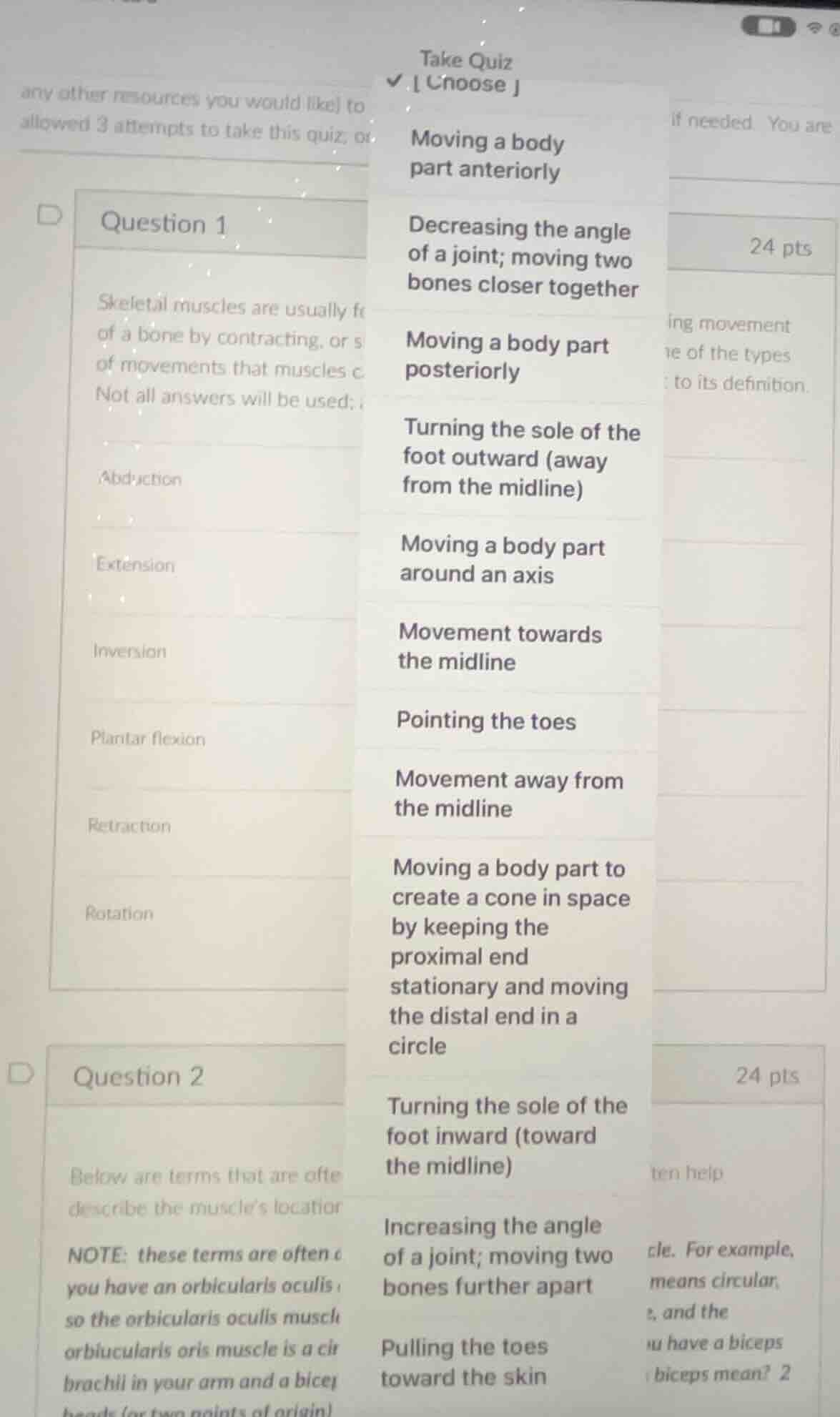
take quiz choose moving a body part anteriorly decreasing the angle of a joint; moving two bones closer together moving a body part posteriorly turning the sole of the foot outward (away from the midline) moving a body part around an axis movement towards the midline pointing the toes movement away from the midline moving a body part to create a cone in space by keeping the proximal end stationary and moving the distal end in a circle turning the sole of the foot inward (toward the midline) increasing the angle of a joint; moving two bones further apart pulling the toes toward the skin question 1 skeletal muscles are usually f of a bone by contracting, or s of movements that muscles c not all answers will be used; abduction extension inversion plantar flexion retraction rotation question 2 below are terms that are ofte describe the muscle’s locatior note: these terms are often c you have an orbicularis oculis so the orbicularis oculis muscl orbicularis oris muscle is a cl brachii in your arm and a bicep
Each movement term is matched to its standard anatomical definition:
- Abduction: Movement away from the body's midline.
- Extension: Increasing the angle of a joint, moving bones apart.
- Inversion: Turning the sole of the foot inward toward the midline.
- Plantar flexion: Pointing the toes downward.
- Retraction: Moving a body part posteriorly (backward).
- Rotation: Moving a body part around an axis.

Snap & solve any problem in the app
Get step-by-step solutions on Sovi AI
Photo-based solutions with guided steps
Explore more problems and detailed explanations
- Abduction: Movement away from the midline
- Extension: Increasing the angle of a joint; moving two bones further apart
- Inversion: Turning the sole of the foot inward (toward the midline)
- Plantar flexion: Pointing the toes
- Retraction: Moving a body part posteriorly
- Rotation: Moving a body part around an axis