QUESTION IMAGE
Question
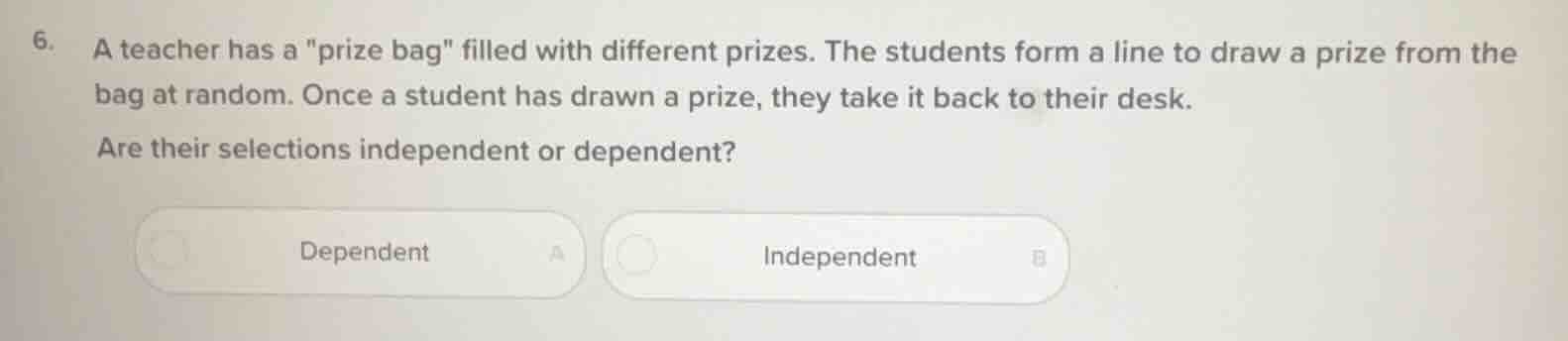
- a teacher has a \prize bag\ filled with different prizes. the students form a line to draw a prize from the bag at random. once a student has drawn a prize, they take it back to their desk. are their selections independent or dependent? dependent a independent b
When a student draws a prize and keeps it (doesn't replace it), the total number of prizes and the composition of the prize bag change for the next student. This means the outcome of one student's selection affects the probability of the next student's selection. In probability, events where the outcome of one affects the other are dependent. However, wait—wait, no, wait. Wait, the problem says "they take it back to their desk"—wait, does that mean they remove the prize (don't put it back) or take it to their desk but maybe the prize is removed from the bag? Wait, the wording: "Once a student has drawn a prize, they take it back to their desk." So the prize is no longer in the bag for the next student. So the first student's draw reduces the number of prizes, and the types of prizes left. So the probability of the next student's draw depends on the first. Wait, but wait—no, wait, maybe I misread. Wait, the question is about independent or dependent. Let's recall: Independent events are those where the outcome of one does not affect the outcome of the other. Dependent events are where the outcome of one affects the other. Since each student takes the prize (so the bag has one less prize, and the specific prize is removed), the next student's probability of drawing a particular prize is affected by the previous draw. Wait, but wait—wait, the problem says "different prizes"—so each prize is unique? So when a student draws a prize, that prize is no longer available for the next student. So the first student's draw changes the set of possible outcomes for the second student. Therefore, the selections are dependent? Wait, no—wait, no, wait. Wait, maybe I made a mistake. Wait, let's re-express: If the prize is not replaced (taken out of the bag), then the events are dependent. But let's check the definition again. Wait, the key is: does the first event affect the second? If a prize is removed, then yes. So when the first student draws a prize and keeps it (removes it from the bag), the probability of the second student drawing a certain prize is different than if the first student hadn't drawn. So the events are dependent. Wait, but the options are Dependent (A) and Independent (B). Wait, but wait—wait, maybe the problem is that when the student takes the prize to their desk, they are removing it from the bag, so the next student's draw is dependent on the previous. So the correct answer is Dependent? Wait, no, wait—wait, maybe I got it wrong. Wait, let's think of a simple example: suppose the bag has 2 prizes, A and B. First student draws A (and takes it away). Then the second student can only draw B. So the first draw affects the second. So the events are dependent. Therefore, the answer should be Dependent? Wait, but the problem says "different prizes"—so each prize is unique. So when a student draws a prize, that prize is no longer in the bag. So the probability of the next draw is affected. Therefore, the selections are dependent. Wait, but the option A is Dependent, B is Independent. So the correct answer is A. Dependent? Wait, no—wait, wait, maybe I misread the problem. Wait, the problem says "they take it back to their desk"—does "take it back" mean they remove it from the bag (so not replaced), so the bag has one less prize. So the first student's draw changes the sample space for the second. Hence, dependent. So the correct option is A. Dependent? Wait, no—wait, no, wait. Wait, no, wait: Wait, maybe the problem is that when you take the prize to your desk, you are removing it from the bag, so the next student has a different set o…

Snap & solve any problem in the app
Get step-by-step solutions on Sovi AI
Photo-based solutions with guided steps
Explore more problems and detailed explanations
A. Dependent