QUESTION IMAGE
Question
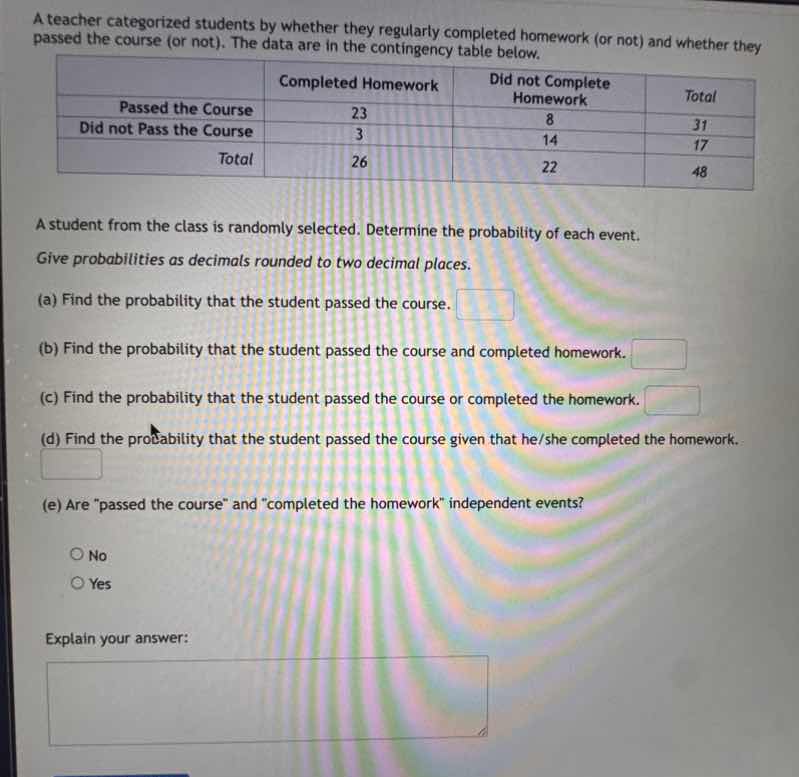
a teacher categorized students by whether they regularly completed homework (or not) and whether they passed the course (or not). the data are in the contingency table below.
| completed homework | did not complete homework | total | |
|---|---|---|---|
| did not pass the course | 3 | 14 | 17 |
| total | 26 | 22 | 48 |
a student from the class is randomly selected. determine the probability of each event.
give probabilities as decimals rounded to two decimal places.
(a) find the probability that the student passed the course.
(b) find the probability that the student passed the course and completed homework.
(c) find the probability that the student passed the course or completed the homework.
(d) find the probability that the student passed the course given that he/she completed the homework.
(e) are \passed the course\ and \completed the homework\ independent events?
\\( \circ \\) no
\\( \circ \\) yes
explain your answer:
Step1: Calculate P(passed course)
Divide total passed by total students.
$\frac{31}{48} \approx 0.65$
Step2: Calculate P(passed and completed)
Divide joint count by total students.
$\frac{23}{48} \approx 0.48$
Step3: Calculate P(passed or completed)
Use addition rule: $P(A \cup B) = P(A) + P(B) - P(A \cap B)$
$\frac{31}{48} + \frac{26}{48} - \frac{23}{48} = \frac{34}{48} \approx 0.71$
Step4: Calculate P(passed | completed)
Divide joint count by total completed.
$\frac{23}{26} \approx 0.88$
Step5: Test independence
Check if $P(A \cap B) = P(A) \times P(B)$
$P(\text{passed}) \times P(\text{completed}) = \frac{31}{48} \times \frac{26}{48} \approx 0.35$, which does not equal $P(\text{passed and completed}) \approx 0.48$. So events are dependent.
The probability of both events occurring together ($\approx0.48$) is not equal to the product of the individual probabilities ($\frac{31}{48} \times \frac{26}{48} \approx0.35$), so the events are not independent.

Snap & solve any problem in the app
Get step-by-step solutions on Sovi AI
Photo-based solutions with guided steps
Explore more problems and detailed explanations
(a) 0.65
(b) 0.48
(c) 0.71
(d) 0.88
(e) No