QUESTION IMAGE
Question
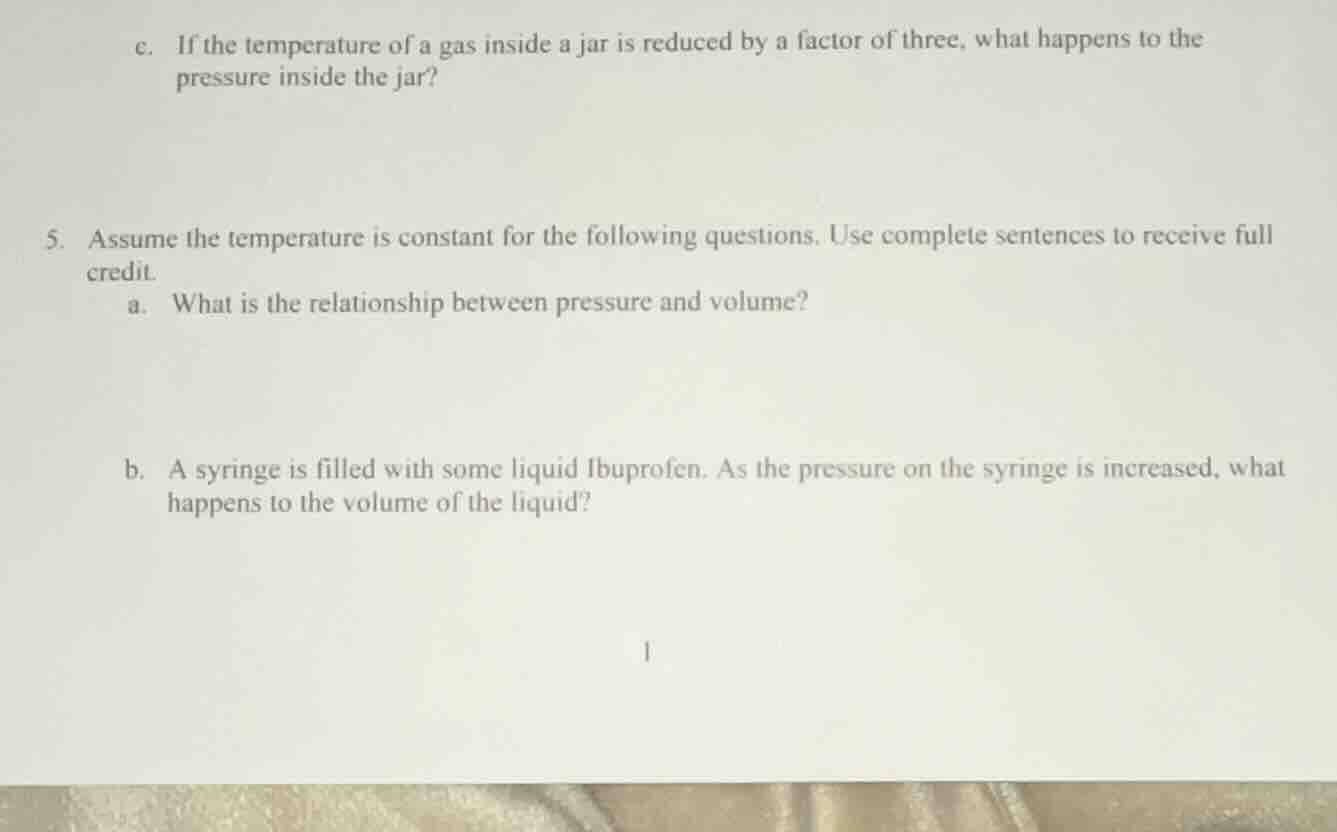
c. if the temperature of a gas inside a jar is reduced by a factor of three, what happens to the pressure inside the jar?
- assume the temperature is constant for the following questions. use complete sentences to receive full credit.
a. what is the relationship between pressure and volume?
b. a syringe is filled with some liquid ibuprofen. as the pressure on the syringe is increased, what happens to the volume of the liquid?
For question c:
This uses Gay-Lussac's Law, which states that for a fixed volume of gas, pressure is directly proportional to absolute temperature. Reducing temperature by a factor of 3 reduces pressure by the same factor.
For question 5a:
At constant temperature, Boyle's Law defines the inverse relationship between gas pressure and volume: as one rises, the other falls proportionally.
For question 5b:
Liquids are nearly incompressible, so changing external pressure has no significant effect on their volume.

Snap & solve any problem in the app
Get step-by-step solutions on Sovi AI
Photo-based solutions with guided steps
Explore more problems and detailed explanations
c. The pressure inside the jar will be reduced by a factor of three (it will become one-third of its original value), as long as the volume of the jar and the amount of gas remain constant.
5a. At constant temperature, the pressure and volume of a gas have an inverse proportional relationship: when the pressure of a gas increases, its volume decreases proportionally, and when the pressure decreases, the volume increases proportionally, assuming the amount of gas remains constant.
5b. The volume of the liquid Ibuprofen will remain essentially unchanged because liquids are nearly incompressible, so increases in external pressure do not significantly alter their volume.