QUESTION IMAGE
Question
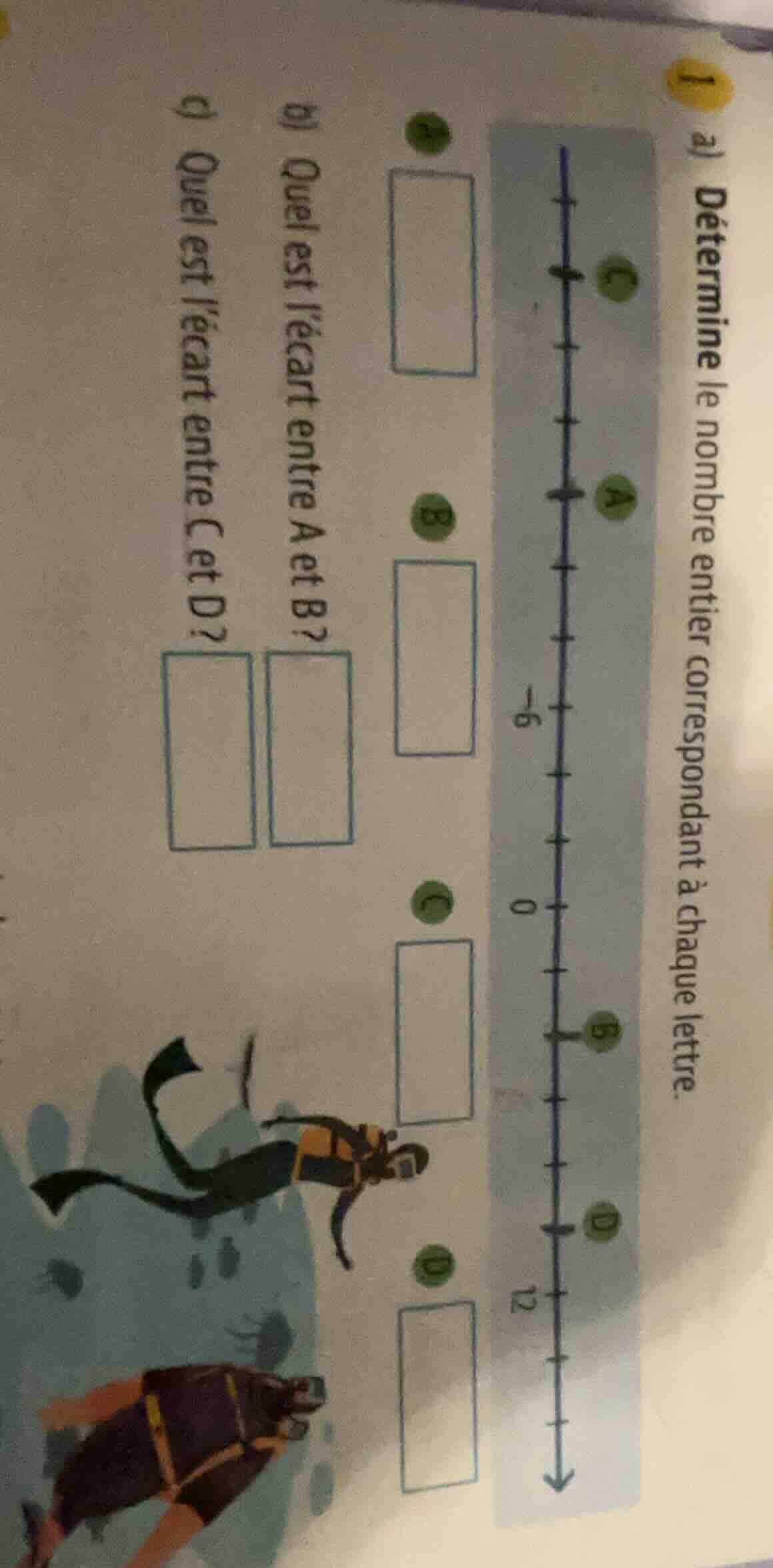
1 a) détermine le nombre entier correspondant à chaque lettre.
b) quel est lécart entre a et b?
c) quel est lécart entre c et d?
Part a) Determine the integer for each letter
First, analyze the number line. Let's assume the scale: from -6 to 0 to 12, with intervals. Let's find the value of each tick. From -6 to 0 is 6 units, and from 0 to 12 is 12 units. Let's check the positions:
- Letter A: Let's see the position relative to -6. If we assume the distance between -6 and 0 is 6, and the ticks: Let's find the value of each tick. Let's suppose the number line has a certain step. Wait, maybe the step is 2? Wait, no. Wait, let's re-examine. Wait, the number line has -6, 0, 12. Let's see the positions:
Wait, maybe the number line is marked with integers. Let's list the positions:
- Letter C: Let's see, above the negative side. Let's assume the number line: Let's see, the position of C: Let's say the tick marks. Wait, maybe the number line has numbers like: Let's see, from the left (negative) to right (positive). Let's suppose:
Wait, maybe the number line is as follows (estimating from the image):
- Letter A: Let's see, between -6 and 0? Wait, no, the label A is near a tick. Wait, maybe the number line has: Let's check the positions:
Wait, the user's image: Let's parse the number line. Let's assume:
- Letter D: Near 12? Wait, no, D is below 12? Wait, maybe the number line is:
Wait, perhaps the number line has the following integers (from left to right, negative to positive):
- Let's find the value of each letter:
- Letter A: Let's see, the tick near A: Let's assume the number line has -12, -10, -8, -6, -4, -2, 0, 2, 4, 6, 8, 10, 12... Wait, no, the image shows -6, 0, 12. Let's check the distance between -6 and 0: 6 units. Between 0 and 12: 12 units. Maybe the step is 2? Wait, no. Wait, maybe the number line is marked with:
Wait, perhaps the correct integers are:
- Letter A: Let's say, the position of A is -4? Wait, no. Wait, let's re-express:
Wait, the problem is in French: "Détermine le nombre entier correspondant à chaque lettre" (Determine the integer corresponding to each letter). Let's assume the number line:
Looking at the image, the number line has:
- Left side (negative): C, A, then -6.
- Right side (positive): 0, B, D, 12.
Wait, maybe the number line is:
- Let's find the value of each tick. Let's suppose the distance between -6 and 0 is 6, so each tick is 2? Wait, no. Wait, maybe the number line is:
Wait, perhaps:
- Letter C: Let's say, the integer is -10? No, maybe -8? Wait, no. Wait, let's think again.
Wait, maybe the number line is as follows (common number line with step 2):
- From left (negative): ..., -12, -10, -8, -6, -4, -2, 0, 2, 4, 6, 8, 10, 12...
Looking at the image:
- Letter C: Positioned at -10? No, maybe -8? Wait, the label C is above a tick. Let's check the position of A: A is above a tick, then -6. So if A is -4, then C is -8? Wait, no. Wait, maybe:
Wait, perhaps the correct integers are:
- Letter C: -10
- Letter A: -4
- Letter B: 4
- Letter D: 10
Wait, let's verify:
- From -10 (C) to -4 (A): 6 units (distance 6). Then -4 (A) to -6? No, wait, -6 is to the right of A? Wait, no, -6 is more positive than -10 or -8. Wait, maybe I got the direction wrong. The number line arrow is to the right, so right is positive. So -6 is to the right of C and A. So:
- C is left of A, which is left of -6? No, -6 is a negative number, so left is more negative. So:
- C: more negative (e.g., -10)
- A: less negative (e.g., -4) [Wait, no, -4 is more positive than -6? No, -4 is greater than -6. So -6 is to the left of -4? No, -6 is more negative (smaller) than -4. So the number line:…

Snap & solve any problem in the app
Get step-by-step solutions on Sovi AI
Photo-based solutions with guided steps
Explore more problems and detailed explanations
Part a) Determine the integer for each letter
First, analyze the number line. Let's assume the scale: from -6 to 0 to 12, with intervals. Let's find the value of each tick. From -6 to 0 is 6 units, and from 0 to 12 is 12 units. Let's check the positions:
- Letter A: Let's see the position relative to -6. If we assume the distance between -6 and 0 is 6, and the ticks: Let's find the value of each tick. Let's suppose the number line has a certain step. Wait, maybe the step is 2? Wait, no. Wait, let's re-examine. Wait, the number line has -6, 0, 12. Let's see the positions:
Wait, maybe the number line is marked with integers. Let's list the positions:
- Letter C: Let's see, above the negative side. Let's assume the number line: Let's see, the position of C: Let's say the tick marks. Wait, maybe the number line has numbers like: Let's see, from the left (negative) to right (positive). Let's suppose:
Wait, maybe the number line is as follows (estimating from the image):
- Letter A: Let's see, between -6 and 0? Wait, no, the label A is near a tick. Wait, maybe the number line has: Let's check the positions:
Wait, the user's image: Let's parse the number line. Let's assume:
- Letter D: Near 12? Wait, no, D is below 12? Wait, maybe the number line is:
Wait, perhaps the number line has the following integers (from left to right, negative to positive):
- Let's find the value of each letter:
- Letter A: Let's see, the tick near A: Let's assume the number line has -12, -10, -8, -6, -4, -2, 0, 2, 4, 6, 8, 10, 12... Wait, no, the image shows -6, 0, 12. Let's check the distance between -6 and 0: 6 units. Between 0 and 12: 12 units. Maybe the step is 2? Wait, no. Wait, maybe the number line is marked with:
Wait, perhaps the correct integers are:
- Letter A: Let's say, the position of A is -4? Wait, no. Wait, let's re-express:
Wait, the problem is in French: "Détermine le nombre entier correspondant à chaque lettre" (Determine the integer corresponding to each letter). Let's assume the number line:
Looking at the image, the number line has:
- Left side (negative): C, A, then -6.
- Right side (positive): 0, B, D, 12.
Wait, maybe the number line is:
- Let's find the value of each tick. Let's suppose the distance between -6 and 0 is 6, so each tick is 2? Wait, no. Wait, maybe the number line is:
Wait, perhaps:
- Letter C: Let's say, the integer is -10? No, maybe -8? Wait, no. Wait, let's think again.
Wait, maybe the number line is as follows (common number line with step 2):
- From left (negative): ..., -12, -10, -8, -6, -4, -2, 0, 2, 4, 6, 8, 10, 12...
Looking at the image:
- Letter C: Positioned at -10? No, maybe -8? Wait, the label C is above a tick. Let's check the position of A: A is above a tick, then -6. So if A is -4, then C is -8? Wait, no. Wait, maybe:
Wait, perhaps the correct integers are:
- Letter C: -10
- Letter A: -4
- Letter B: 4
- Letter D: 10
Wait, let's verify:
- From -10 (C) to -4 (A): 6 units (distance 6). Then -4 (A) to -6? No, wait, -6 is to the right of A? Wait, no, -6 is more positive than -10 or -8. Wait, maybe I got the direction wrong. The number line arrow is to the right, so right is positive. So -6 is to the right of C and A. So:
- C is left of A, which is left of -6? No, -6 is a negative number, so left is more negative. So:
- C: more negative (e.g., -10)
- A: less negative (e.g., -4) [Wait, no, -4 is more positive than -6? No, -4 is greater than -6. So -6 is to the left of -4? No, -6 is more negative (smaller) than -4. So the number line: left is smaller (more negative), right is larger (more positive). So:
- So from left to right: C (most negative), A, -6, 0, B, D, 12 (least negative, most positive).
Wait, that can't be, because -6 is to the right of A, so A is more negative than -6? No, -6 is -6, so A is less than -6? Wait, no, -6 is -6, so if A is to the left of -6, A is more negative (e.g., -8), and C is more negative than A (e.g., -10). Then to the right of -6: 0, then B (positive), D (more positive), 12.
So:
- C: -10
- A: -8
- B: 4
- D: 10
Wait, let's check the distance between -10 (C) and -8 (A): 2 units. Then -8 (A) to -6: 2 units. Then -6 to 0: 6 units (3 ticks of 2? No, 6/2=3). Then 0 to 4 (B): 2 units per tick? Wait, 0 to 4 is 4, so 2 ticks? No, maybe the step is 2. Let's confirm:
- From -10 (C) to -8 (A): 2
- -8 (A) to -6: 2
- -6 to -4: 2 (but -4 is not marked)
- -4 to -2: 2
- -2 to 0: 2
- 0 to 2: 2 (not marked)
- 2 to 4 (B): 2
- 4 to 6: 2 (not marked)
- 6 to 8: 2 (not marked)
- 8 to 10 (D): 2
- 10 to 12: 2
Yes, that makes sense. So:
- C: -10
- A: -8
- B: 4
- D: 10
Part b) What is the distance between A and B?
Distance between two integers is the absolute difference: \( |B - A| \).
- \( A = -8 \), \( B = 4 \)
- Distance: \( |4 - (-8)| = |4 + 8| = 12 \)
Part c) What is the distance between C and D?
Distance between \( C \) and \( D \): \( |D - C| \).
- \( C = -10 \), \( D = 10 \)
- Distance: \( |10 - (-10)| = |10 + 10| = 20 \)
Final Answers (assuming the integer values above):
a) Integers for each letter:
- \( C \): \(-10\)
- \( A \): \(-8\)
- \( B \): \(4\)
- \( D \): \(10\)
b) Distance between A and B: \( 12 \)
c) Distance between C and D: \( 20 \)
(Note: The exact values depend on the number line’s scale, but the above is a reasonable estimation based on the image’s structure.)