QUESTION IMAGE
Question
test content
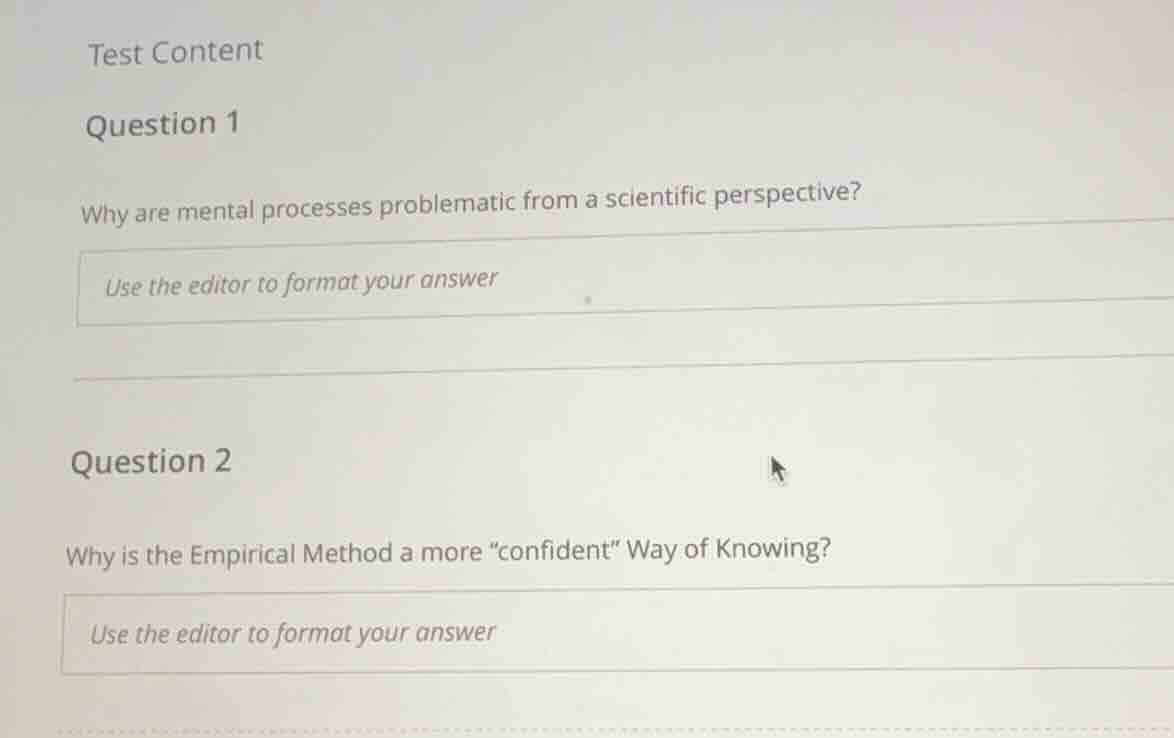
question 1
why are mental processes problematic from a scientific perspective?
use the editor to format your answer
question 2
why is the empirical method a more \confident\ way of knowing?
use the editor to format your answer
For Question 1:
Scientific inquiry relies on observable, measurable phenomena. Mental processes like thoughts, feelings, and perceptions are internal, subjective experiences that cannot be directly observed or measured by external, objective tools. Additionally, they vary greatly between individuals, making consistent, replicable study difficult—core requirements of scientific methodology.
For Question 2:
The Empirical Method prioritizes evidence gathered through direct observation, experimentation, and measurable data. Unlike other ways of knowing (such as intuition, tradition, or authority), it is self-correcting: findings can be tested, replicated, and validated by others. This reliance on verifiable, objective evidence reduces bias and uncertainty, leading to more reliable, "confident" knowledge claims.

Snap & solve any problem in the app
Get step-by-step solutions on Sovi AI
Photo-based solutions with guided steps
Explore more problems and detailed explanations
- Mental processes are problematic scientifically because they are internal, subjective, unobservable directly, and hard to measure or replicate consistently, violating core scientific requirements of objectivity and replicability.
- The Empirical Method is a more "confident" Way of Knowing because it relies on verifiable, objective, observable evidence; its findings can be tested, replicated, and corrected, minimizing bias and uncertainty compared to non-empirical knowledge sources.